The project is also expected to bring vehicle manufacturers, technology companies, start-ups, researchers and regulators together in one testing ecosystem.
Watch: How Dubai is preparing its roads for a driverless future
New testing hub unveiled as emirate targets 25% self-driving journeys by 2030
Last updated:
4 MIN READ
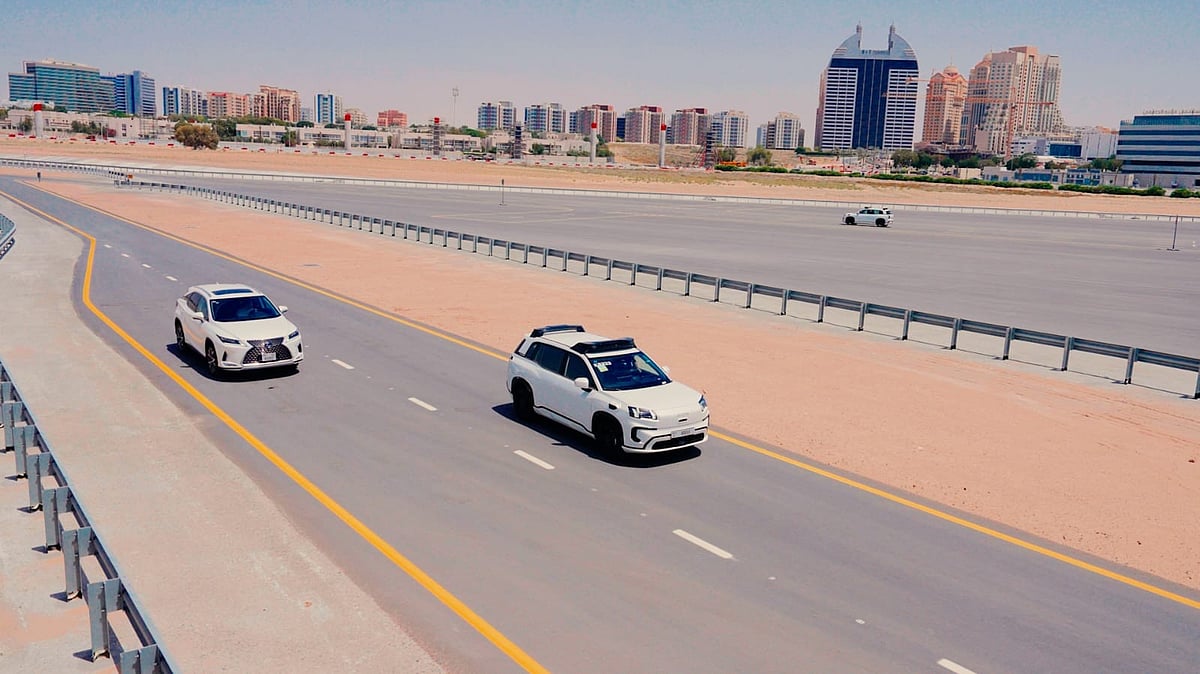
The project is a key part of the Dubai Smart Self-Driving Transport Strategy, which aims to make 25 per cent of all mobility journeys in Dubai autonomous by 2030
Dubai: Driverless vehicles will be put through hundreds of simulated and real-world traffic situations at a new testing facility in Dubai as the emirate steps up efforts to move autonomous transport technologies from experimental trials to everyday use on its roads.
Dubai’s Roads and Transport Authority (RTA), in partnership with the Dubai Integrated Economic Zones Authority (DIEZ), has inaugurated Dubai Mobility Labs at Dubai Silicon Oasis, describing it as the smartest integrated autonomous mobility testing ground of its kind in the Middle East.
Testing scenarios
The facility provides 248 testing scenarios across controlled environments and public roads, allowing autonomous vehicles to be assessed for safety, reliability and their ability to respond to complex traffic and environmental conditions before being cleared for wider deployment.
The project is a key part of the Dubai Smart Self-Driving Transport Strategy, which aims to make 25 per cent of all mobility journeys in Dubai autonomous by 2030.
Unlike a conventional closed testing track, Dubai Mobility Labs combines dedicated proving grounds with real-world trials on public roads stretching from Dubai Silicon Oasis towards Al Qudra.
The approach is designed to give developers a pathway from initial testing and validation through to certification and eventual commercial operation.
Testing area
At the heart of the facility is a multi-purpose testing area capable of recreating 195 different situations that autonomous vehicles could encounter on city streets.
Of these, 143 scenarios were incorporated into the original design, while another 52 were added through subsequent enhancements.
Together with testing conducted on public roads, the facility offers 248 scenarios covering interactions with other road users, changing traffic conditions and environmental factors.
The tests are intended to assess critical autonomous-driving functions, including vehicle sensing, decision-making and responses to unexpected situations.
Vehicles can therefore be evaluated in a controlled setting before progressing to public-road testing.
The facility also includes various test tracks, traffic features, offices and support facilities, as well as three light-industrial units for operations and indoor installations. Three 60kW electric vehicle chargers have also been installed.
From testing to commercial use
Mattar Al Tayer, Director General and Chairman of the Board of Executive Directors of RTA, said the project would provide the infrastructure needed to test emerging mobility systems before they are deployed on Dubai roads.
“The inauguration of Dubai Mobility Labs is a practical manifestation of the directives of the wise leadership to reinforce Dubai’s leadership in developing and adopting future technologies and consolidate its position as a global model for smart and autonomous mobility,” Al Tayer said.
He said the facility would allow new technologies to be tested in both controlled and real-world environments to establish their “safety, efficiency and readiness before deployment on public roads”.
Al Tayer said Dubai Mobility Labs would also provide an integrated route for developing, testing, validating and certifying autonomous transport technologies.
This, he said, would help speed up the transition “from trials to real-world and commercial deployment”.
The project is also expected to bring vehicle manufacturers, technology companies, start-ups, researchers and regulators together in one testing ecosystem.
RTA said this could help attract autonomous mobility companies, investment and specialised talent to Dubai while allowing developers to launch technologies tested in the emirate into regional and international markets.
Testing vehicles
The facility has already hosted trials involving autonomous driving technologies and vehicles developed by international companies including WeRide, Pony.ai and Tesla.
RTA said the trials demonstrated the facility’s ability to accommodate different autonomous mobility technologies and evaluate them before their potential operation on Dubai’s road network.
DEKRA has been appointed to operate Dubai Mobility Labs for its first three years. The company will manage daily operations, organise testing and oversee compliance with international safety standards and operational practices.
Beyond testing vehicles, the facility is intended to encourage collaboration between government agencies, private companies, universities and research institutions.
Future mobility hub
Dr Mohammed Al Zarooni, Executive Chairman of DIEZ, said the project was also aligned with the Dubai Economic Agenda D33 and its emphasis on building a knowledge- and innovation-driven economy.
“Dubai Mobility Labs embodies the objectives of the Dubai Economic Agenda D33, which aims to build a globally competitive, knowledge- and innovation-driven economy and strengthen Dubai’s position as a hub for industries shaping the future,” he said.
Al Zarooni said Dubai Silicon Oasis offered the infrastructure and technology ecosystem required for companies to develop and test advanced mobility solutions and accelerate their transition into commercial operation.
Beyond testing vehicles, the facility is intended to encourage collaboration between government agencies, private companies, universities and research institutions.
RTA said the combination of controlled testing and public-road trials should allow developers to identify problems earlier, improve the reliability of test results and shorten the journey from prototype to deployment.
The broader ambition is to establish Dubai as an international testing and certification centre for autonomous mobility technologies – and a launchpad for driverless transport systems destined for cities across the region and beyond.
Sign up for the Daily Briefing
Get the latest news and updates straight to your inbox
Network Links
GN StoreAbout Gulf NewsTerms & ConditionsReach by GNSitemapContact usPrivacy PolicyGN FocusHave your sayWork with usAdvertise with usGulf News epaperPrinting Services
Download our app
© Al Nisr Publishing LLC 2026. All rights reserved.