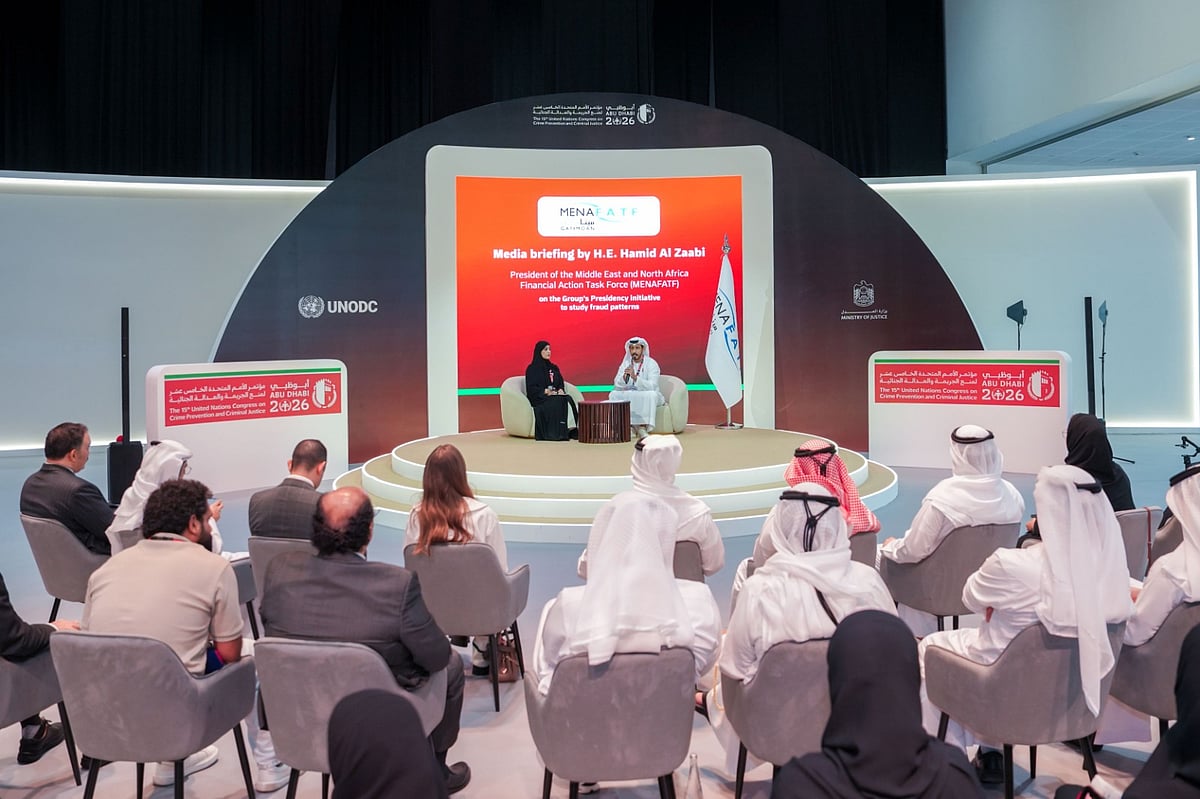
Abu Dhabi: The United Arab Emirates intends to put forward a proposal for a regional initiative aimed at studying fraud typologies and associated money laundering, as part of its presidency of the Middle East and North Africa Financial Action Task Force (MENAFATF).
Hamid Saif Al Zaabi, President of MENAFATF, confirmed the plan, saying the initiative is designed to deepen understanding of fraud-related risks and strengthen cooperation among the Group's member states.
The proposal is expected to be formally presented at MENAFATF's next Plenary Meeting in Abu Dhabi.
Al Zaabi announced the plan today at a press conference held on the sidelines of the 15th United Nations Congress on Crime Prevention and Criminal Justice, taking place in Abu Dhabi.
Importance of building early detection
As he put it, the initiative reflects one of the core priorities of the UAE's presidency of MENAFATF, which includes supporting the implementation of international standards and reinforcing the effectiveness of national systems in combating financial crime.
According to Al Zaabi, the cross-border nature of fraud, the constant evolution of criminal methods, and the growing use of digital financial services all point to the need for a shared regional understanding of these crimes.
He underlined the importance of building early detection tools and improving coordination among relevant authorities to trace fraud proceeds and tackle related money laundering.
The proposed project would create a shared regional knowledge base documenting the types, methods and scale of fraud across the region, Al Zaabi said. It would also facilitate the exchange of case studies and expertise between member states and support the development of indicators to help identify emerging fraud and money-laundering patterns.
Several priorities
Other objectives outlined by Al Zaabi include examining the challenges involved in freezing, seizing and recovering criminal proceeds — particularly those linked to cyber-enabled fraud and crimes involving virtual assets. The initiative also proposes setting up a regional network of practitioners to strengthen operational cooperation in money laundering investigations and coordination among competent authorities.
Al Zaabi said the planned study would focus on several priority areas: banking and financial fraud; cyber-enabled, investment and real estate fraud; fraud involving money transfers and hawala channels; fraud linked to virtual assets and digital trading platforms; and trade-based money laundering connected to fraud.
Connect knowledge and expertise
He explained that the project would depend on member states' participation, through data collection, the exchange of case studies, and review of mutual evaluation reports, to analyze regional patterns and produce a specialized report.
The initiative would draw on the experience of the Financial Action Task Force (FATF) and peer regional bodies, while accounting for the specific risk landscape of the Middle East and North Africa.
Al Zaabi stressed that a stronger grasp of fraud-related risks lays the groundwork for more effective countermeasures. He emphasized the need to connect knowledge and expertise with practical cooperation, in order to strengthen member states' capacity to trace and recover criminal proceeds and safeguard their financial systems from abuse.
Sign up for the Daily Briefing
Get the latest news and updates straight to your inbox
Network Links
GN StoreDownload our app
© Al Nisr Publishing LLC 2026. All rights reserved.