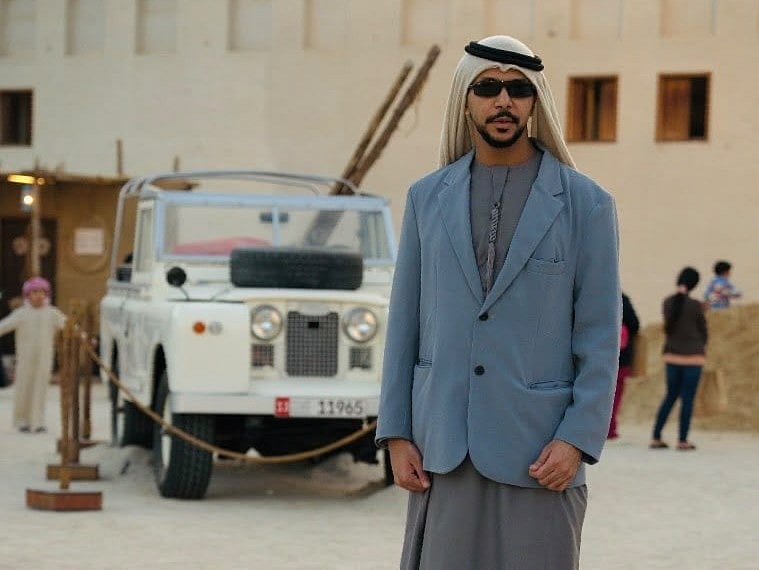
Abu Dhabi: Past The Emirates Palace, on the quiet side of the Corniche, a car is parked. Inside, a man holds a karak, or maybe an americano from Cartel. The news is on low. Through the windshield sit the Etihad Towers and Qasr Al Watan, glowing in the late light.
Hamdan Al Qubaisi will tell you roughly where this is, then laugh and insist it is still a secret. It is where his mind goes quiet, and a place like that only works if it stays yours. He also keeps the news on for a reason. When he sits in the majlis later, he wants to bring something to the table.
"I don't want to just sit there," he said.
When Gulf News sat down with him, the first thing he did was correct the premise. We had come to talk about Abu Dhabi, and he had already decided what it was.
"It is my city," he said. "City of love, Abu Dhabi for sure."
Hamdan is 29, Emirati, and Abu Dhabi born. His family's roots here run back through the generations that built the country from the sand up. Three words for Abu Dhabi? He did not pause: "Safe, power, life."
Then comes the line that became the spine of this the conversation
"You can ask me anything about Abu Dhabi, and my answers will prove to you why the city is the heaven on earth."
It starts with safety
Hamdan has a theory about the emirates, and he laid it out like someone who has explained it to many visitors. Every emirate has its gift.
"Abu Dhabi is calm, Dubai is tourism, Sharjah is culture," he said, before moving on to the sea-facing charms of Umm Al Quwain, Ajman and Ras Al Khaimah. Abu Dhabi's gift is stillness, the composure of a place with nothing to prove.
You can feel it in your shoulders. The Corniche curves along the water, the towers catch the light, and the city seems to say that it is in no hurry because it has already arrived.
His love of Abu Dhabi starts with safety, and he puts it more vividly than any statistic could.
"If you have a family and your little child wakes up at 3 a.m. and goes out of the house, he will come back," he said. "Safety is a priority."
Some people call the UAE overrated. He waves that off, and his answer is about people, not skylines.
"The people work so hard here, which is why we have safety and a good life." In his telling, the calm of the city is earned daily.
The rhythm of his everyday
Hamdan's routine is simple, and he is proud of it.
"In the morning I go to work, I finish my work, I go back home, and I stay with my mother. We eat lunch," he said. Then it's the gym, "I do my exercise," and then home again, with the family, until about seven.
It is a rhythm built around the people he loves, with work, body and family each given their hour before the evening begins.
If a visitor asked Hamdan for one meal in Abu Dhabi, there is no debate. It is to find in Al Mrzab, and you will find him there about three times a week.
That alone says something. Emirati food is what his family cooks at home nearly every day, and he still drives out to eat it again. The restaurant is not about the food alone.
"The atmosphere is like entering the Emirates," he said. "It's an Emirati meal, very beautiful."
His order is majboos, the spiced rice dish with its slow-cooked meat, served with cool yogurt and daqous, the tangy tomato sauce with a kick that Emirati tables have always kept close. Rice, tang, spice and cream make a plate he never tires of. "I go with my family, friends or alone" he said. "The most important thing is to go."
Then there is dessert, and here Hamdan is strict. "I don't eat dessert," he said. He watches what he eats, and he will skip the sweets at any café in the city. There is one exception, and it lives at Al Mrzab: luqaimat, the small Emirati golden dumplings, crisp outside and soft within, usually finished with a drizzle of date syrup. It is the only dessert he allows himself, and the only place he will have it is at that table.
The coffee, taken very seriously
Mention coffee and something happens before he says a word.
"Hooo... hooo..." The sound rolls out of him, low and drawn out, the way an Emirati lets you know you have wandered into serious territory. His brows lift, his hand turns in the air, palm tilting, and the whole gesture says what the words have not yet: now this one, this question is a subject of its own. It is the sound of someone setting down everything else to give the topic its due.
Then he gets going. Hamdan drinks specialty, and he has his rotation. There's a coffee truck called Number 13, Aptitude, and on the Corniche there's Cartel, where he sometimes picks up a cup before heading to his secret spot, though on other days it is a karak from the roadside.
His order depends on the hour. "Americano," he said, when he needs fuel. "It gives me fuel up." On other days it is a Spanish cortado, smooth and sweet, for when he wants something gentler.
The Majlis, where the door is always open
Around seven, the day turns toward the majlis, which Hamdan treats as the heart of Emirati life.
Outsiders tend to see a room for coffee and conversation. He calls it something else. "The majlis is like school in our culture," he said.
Sit with the elders for three or four years, and you learn how to talk to people, how to respect them and how to respect yourself.
It is also a safety net. "If you want to find a job, if you want to study, he gives you support," Hamdan said of the elders. "Maybe he knows someone who can help. Even if you want to start a new life, if you want to marry, he gives you support, like money. Maybe in the majlis there are ten people sitting. Someone gives you 5k, maybe seven people give you. It depends on the people."
The rule of the majlis is that its door is never closed. "Whoever opens one has to be ready for a guest at any time. If I have a majlis, I open it so someone can come, drink coffee, talk." And it cannot be replaced by a café table. "If I want to talk to a man, it does not work to talk in a coffee shop. The majlis is the right place."
Right now, the talk is cars. "We plan what to do in the winter," he said, describing how his friends are stripping and tuning their vehicles for the festival in Liwa.
Sheikh Zayed is never far from these conversations. "Anything Sheikh Zayed said in the past, today we do it," Hamdan says. "Go on YouTube and you'll find what he said in the majlis."
The close ties
Hamdan lives in Mushrif, and he talks about it the way people talk about a village that happens to sit in the middle of a capital.
"The most beautiful thing about Mushrif is it's in the middle of the capital, and everything is close," he said.
Over a hundred households in the area know each other. The children grew up on the same streets, played football against one another and stayed neighbours.
When a wedding or celebration comes, the whole area turns out. When there is sadness, the whole area also turns out. "There are many ties," he said. He is quick to add that Mushrif is no exception: "It's in every area of Abu Dhabi."
What home smells, sounds and tastes like
The place where he feels most at home is Qasr Al Hosn, the oldest stone building in Abu Dhabi and the birthplace of Sheikh Zayed.
"There is a coffee shop there, they play old music, they serve our culture food. It is our home food. You eat like you eat at home. The atmosphere, the photo of the Sheikh. It is a very, very amazing place to be. You have to go there."
For him it is more than nostalgia. He talks about Sheikh Zayed as a man who grew up with little, who fished and worked with his hands and built something enormous out of effort. "That is why we are today on this level," he said. "Because he worked hard, and the local people in the UAE worked hard to get this level of life." Every December the festival returns, and Hamdan goes back.
Everything is close
His best moment in Abu Dhabi? He is quiet for a second, then smiled.
Five or six years ago, during the Qasr Al Hosn Festival, he was sitting in a coffee shop when the President of the UAE, Sheikh Mohammed bin Zayed Al Nahyan, walked past and greeted him.
"In some countries it is impossible to see a president. You would need twenty doors to pass. And here you're just sitting, and the president passes by."
He tells it with disbelief, even now. Then he returns to what it meant: "The country is so nice. Everything is close."
What he wants the world to know
Abu Dhabi, he says, is a city for every month of the year, even the hottest ones. "Every day. Every day," he says when asked for the best time to be here. "You can live in the winter, you can live in the summer. The summer is too hot, but there's activity for the summer and activity for the winter."
When the heat bears down, there are the malls, and there is Saadiyat. "There's a beach, a coffee shop around the beach, a restaurant at Mamsha Saadiyat. There are a lot of restaurants along the beach. It is a good place."
When the weather turns kind, the city opens up. "In the winter, you can go to Liwa Festival," he said. The desert, the dunes and the engines are all part of the season. Some weekends are for restaurants, some for the beach, and some for the sea and a fishing line. "It depends on the season, if it is winter or summer."
What would he tell people outside Abu Dhabi? He paused, then said it does not need telling.
"I don't need to tell people about Abu Dhabi because Abu Dhabi is one of the best-known capitals in the world."
He softens the point with a welcome. If you have a good idea, bring it here. "We are a country of support and stability. We respect good ideas. We all win." Leave the old destinations behind, he added: "Let it be Abu Dhabi."
Sign up for the Daily Briefing
Get the latest news and updates straight to your inbox
Network Links
GN StoreDownload our app
© Al Nisr Publishing LLC 2026. All rights reserved.