DZDubai coordinates UAE car rentals across multiple fleets
A website test and founder interview examine the roles of its team and rental partners
Launched in 2023 by French-Algerian entrepreneur Abdelnour Boumediene, dzdubai.com is a car rental platform operated by DZ PRESTIGE FOR CAR RENTAL L.L.C S.O.C, a Dubai-based company. Its catalogue brings together the company’s own vehicles and those of partner rental firms. Delivery and collection are available across all seven emirates, subject to minimum rental periods that vary by vehicle and destination.
Customers search for a car and submit a request through the website; the team then arranges the rental and oversees it. Behind this centralised booking process, the cars come from several fleets. Co-ordination with the rental firms is needed to ensure that the availability and terms shown online match those of the vehicle being offered.
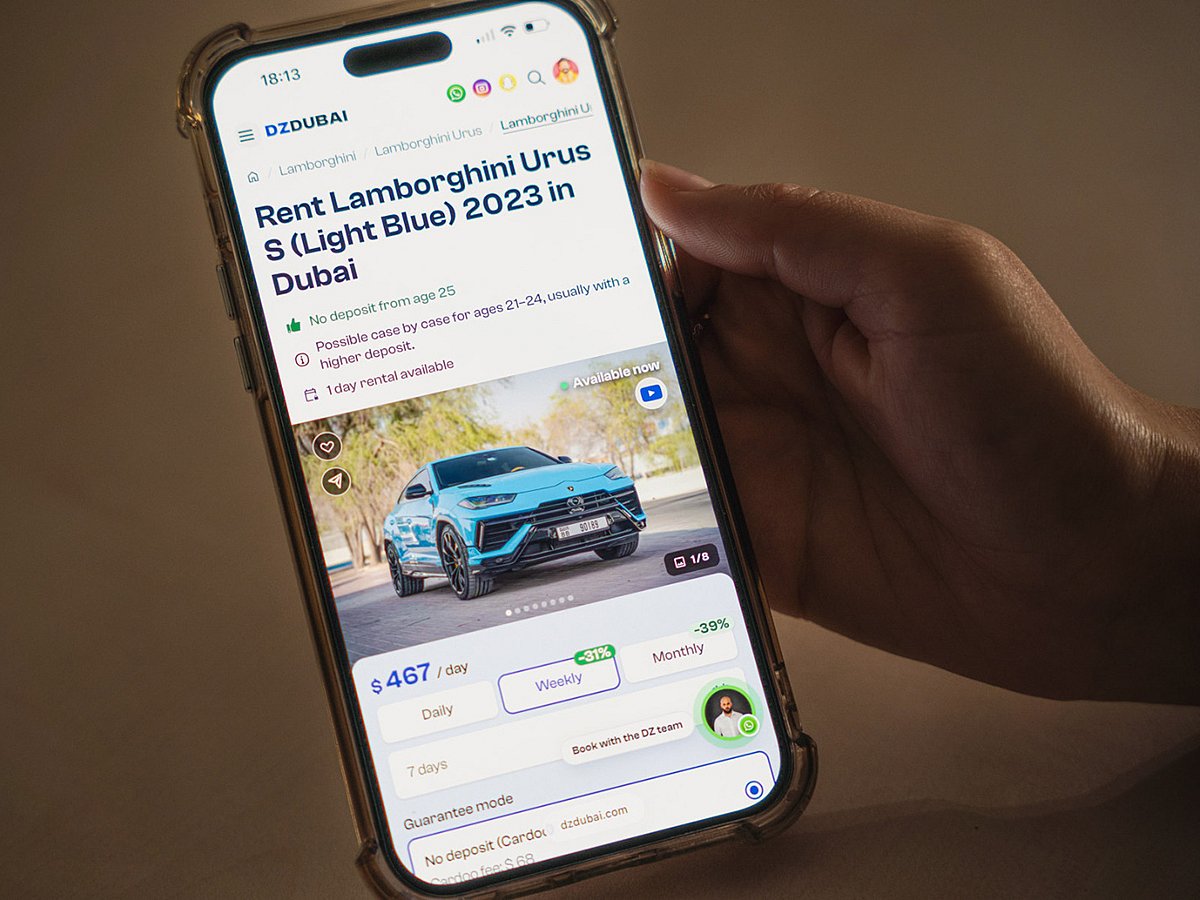
For our test, we selected a light blue 2023 Lamborghini Urus S for a rental from November 23 to 30, 2026. The listing showed the age requirements, a minimum rental period of one day and an availability status. On desktop, the images appeared on one side of the page and the booking panel on the other. On mobile, these elements were stacked vertically, requiring some scrolling to read the full summary.
Using the weekly rate, our quote showed seven days of rental with 1,750 kilometres included. With the Cardoo option, which removes the need for a security deposit, the total came to $3,502, including VAT. Switching to the option with a security deposit brought the rental price down to $3,431.
A security deposit of $1,361 was then shown separately. With the same settings, we obtained the same total and mileage allowance on mobile. The summary clearly separated the rental charge from the amount held as security. The Cardoo option removed the latter requirement in exchange for an additional fee.
We then submitted a request using the “Book now and pay later” button, without making an immediate payment. Twelve minutes later, an agent contacted us on WhatsApp and confirmed both the vehicle’s availability for our chosen dates and the rental price. That response time was specific to our test and does not indicate how quickly other enquiries might be answered. We could prepare the booking ourselves on the website, but an agent checked the details before it was finalised.
The company says it launched its real-time availability update system in February 2026. It is intended to help drivers looking to rent without delay identify cars that are available immediately. That raises questions about how the system works in practice: where does the information supplied by partners come from, when are statuses updated, and how does DZDubai spot a missed or late update? An agent’s confirmation checks availability for the requested dates. On its own, it does not explain how the catalogue is monitored between enquiries.
Asked about this, Boumediene explains that each partner has a professional dashboard through which it can update its vehicles’ availability directly. The team also monitors the rental firms’ internal communications. These companies use WhatsApp groups, whose members include staff and sales representatives, to share daily updates on vehicle availability.
“A condition of becoming a partner is that we are added to this group,” the founder says. A member of the DZDubai team is responsible for comparing this information with the statuses displayed on the website. If a change shared in the group has not been entered in the dashboard, that person can update the catalogue on the partner’s behalf.
The dashboard is therefore not the only means of keeping the website up to date. The process described also draws on the rental firms’ existing communication habits: the team checks information already circulating internally against the catalogue. Partners can update the new tool themselves, but keeping it current does not depend entirely on their doing so.
This comparison can reveal a mismatch between reported availability and a published status. It has a limitation, however: both pieces of information come from the same rental firm. Agreement between them is not an independent check of the car’s actual status.
There is also a distinction between the website’s ability to publish a change immediately and the time it takes for that change to be reported and entered. Confirmation before a booking is finalised adds a check for the requested dates, without establishing that every status in the catalogue is accurate at all times.
The relationship with partners extends beyond availability. In its public description of its operations, DZDubai says it checks partners’ licences and vehicle documents, inspects every car before adding it to the catalogue, and takes the photographs and videos itself. The stated selection process covers both the rental firm and its individual vehicles. Accepting a partner does not automatically mean listing its entire fleet.
During the rental, DZDubai remains the customer’s main point of contact. For a partner vehicle, however, the rental agreement is signed with the company supplying the car. The team also says it reviews supporting evidence for additional charges before these are requested from the customer, and that it can suspend a partnership if its requirements are breached. Customer contact is centralised and partners are subject to common standards, but their roles remain distinct: DZDubai co-ordinates the rental, while the relevant rental firm provides the service.
This selection process comes with a commitment to supply the car shown in the photographs, rather than simply a vehicle in the same category. The booking therefore relates to a specific car, which the images, availability status and confirmation must all identify consistently.
If that car unexpectedly becomes unavailable, DZDubai says any replacement or complimentary upgrade requires the customer’s prior agreement. If the customer declines the alternatives, the booking deposit is refunded.
Under the stated terms, a rental firm cannot impose a different car simply because it costs more. These rules address the consequences of a vehicle becoming unavailable; they do not remove that possibility. We did not have occasion to test how they are applied.
At DZDubai, online booking still leaves a substantial role for the team. The website allows customers to prepare their requests, while agents confirm the details. The availability monitoring described by the company follows the same approach, linking the catalogue to information supplied by rental firms.
Digitalisation here concerns the co-ordination of the people involved as much as the interface customers see. Our test ended with confirmation of the dates and price. It does not allow us to assess the rental itself, from delivery of the car to its return.
Sign up for the Daily Briefing
Get the latest news and updates straight to your inbox
Network Links
GN StoreDownload our app
© Al Nisr Publishing LLC 2026. All rights reserved.