Abu Dhabi’s airport in 1955, featuring a modest terminal building and control tower during the emirate’s early years of commercial aviation.
Abu Dhabi airport’s remarkable journey from 1955 to Zayed International Airport
From a desert airfield in 1955 to a modern international aviation hub in Abu Dhabi
Last updated:
3 MIN READ
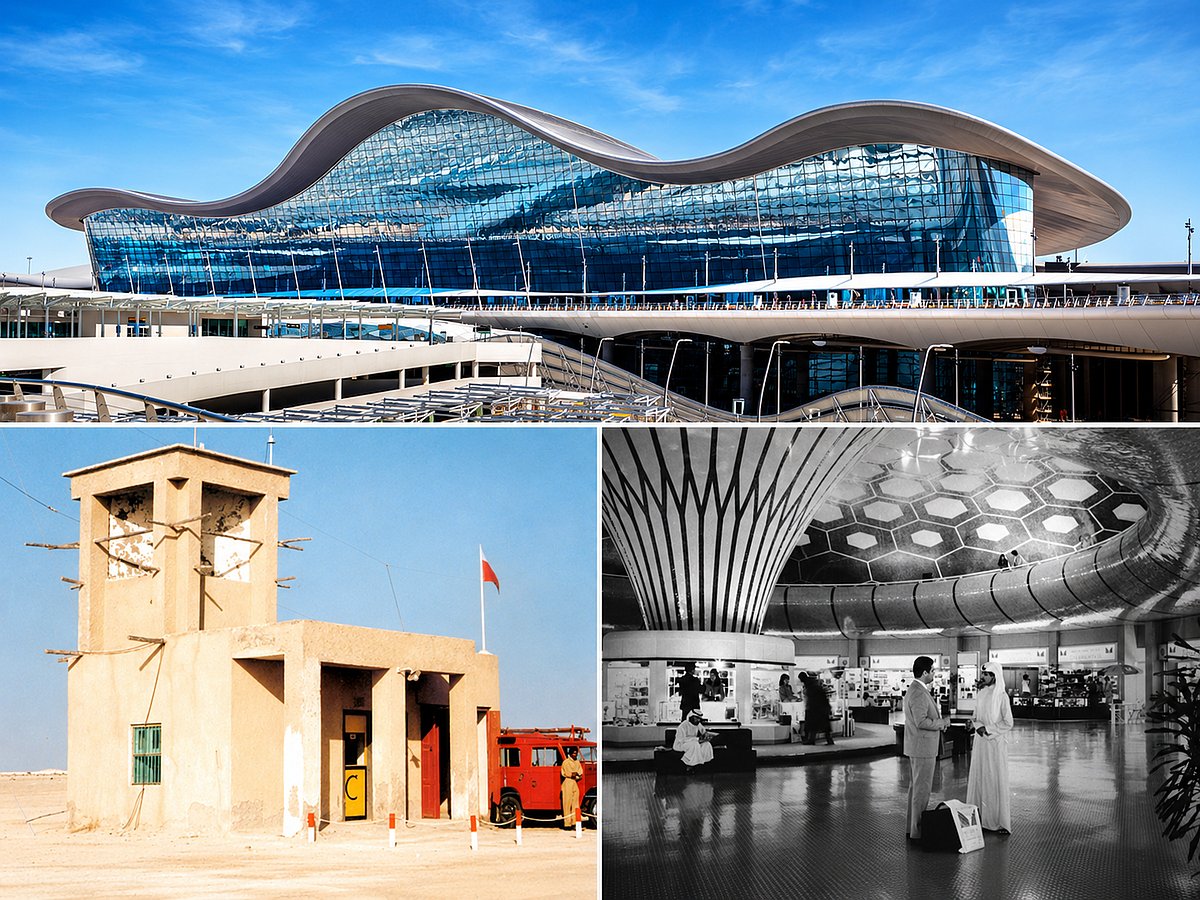
A visual journey through Abu Dhabi’s aviation history, from its early airport building to the terminal interiors of the past and the striking modern architecture of Zayed International Airport.
Gulf News archives
From a modest sand runway to Zayed International Airport, the capital’s aviation history reflects seven decades of transformation.
Abu Dhabi’s aviation story dates to 1955, when a small airport with a sand runway and basic terminal served early commercial flights. The original control building, preserved near Muroor Road, remains a reminder of the capital’s beginnings in aviation.
In 1968, Al Bateen Airport opened in what was then desert on the outskirts of the city. It became Abu Dhabi’s first international airport and served as the capital’s main aviation gateway until the opening of a new airport in 1982.
Abu Dhabi International Airport opened on January 2, 1982, with a circular satellite terminal connected to a semi-circular main terminal. As passenger numbers increased, the airport expanded with Terminal 2 in 2005, a second runway in 2008 and Terminal 3 in 2009.
The establishment of Etihad Airways in 2003 further strengthened Abu Dhabi’s international connections.
A major milestone came in November 2023, when Terminal A began operations. Covering 742,000 square metres, it was designed to handle up to 45 million passengers annually.
On February 9, 2024, the airport was renamed Zayed International Airport in honour of the UAE’s Founding Father, Sheikh Zayed bin Sultan Al Nahyan.
In 2025, the airport handled a record 32.5 million passengers. By 2026, it had become a major global aviation hub, connecting Abu Dhabi to more than 100 destinations worldwide.
A view of Abu Dhabi airport’s interior in the 1960s, showcasing its distinctive geometric ceiling, passenger waiting areas and retail counters, reflecting an earlier era of aviation in the capital.
A Gulf Air aircraft at Abu Dhabi International Airport in 1982, following the inauguration of the airport at its present location on January 2. The opening marked a major milestone in the capital’s aviation history.
A historical view of Abu Dhabi International Airport in 1982, showing its distinctive circular terminal and aircraft at the gates during an earlier phase of the capital’s aviation development.
An exterior view of Abu Dhabi International Airport in 1986, showing the terminal’s distinctive curved canopy, control tower and passenger drop-off area, reflecting the capital’s aviation infrastructure in the early years of its development.
Abu Dhabi International Airport in 1997.
Passengers check in for their flights at Abu Dhabi International Airport in 2001, as airport staff process travel documents and luggage at the counters. The scene captures the airport’s operations before the major terminal expansions that transformed the capital’s aviation hub.
The interior of Terminal A at Zayed International Airport in Abu Dhabi in 2024, featuring its expansive glass façade, high ceilings and digital displays.
Zayed International Airport in Abu Dhabi, photographed in 2025, showcases the striking architecture of Terminal A, a major gateway connecting the UAE capital to the world.
Zayed International Airport in Abu Dhabi handled 32.5 million passengers in 2025 and welcomed more than 93,000 passengers daily during late June 2026, highlighting its growing role as a major global aviation hub.
Network Links
GN StoreAbout Gulf NewsTerms & ConditionsReach by GNSitemapContact usPrivacy PolicyGN FocusHave your sayWork with usAdvertise with usGulf News epaperPrinting Services
Download our app
© Al Nisr Publishing LLC 2026. All rights reserved.