Why quartz watches keep such good time
How a vibrating crystal delivers precision, and why mechanical watches still endure.
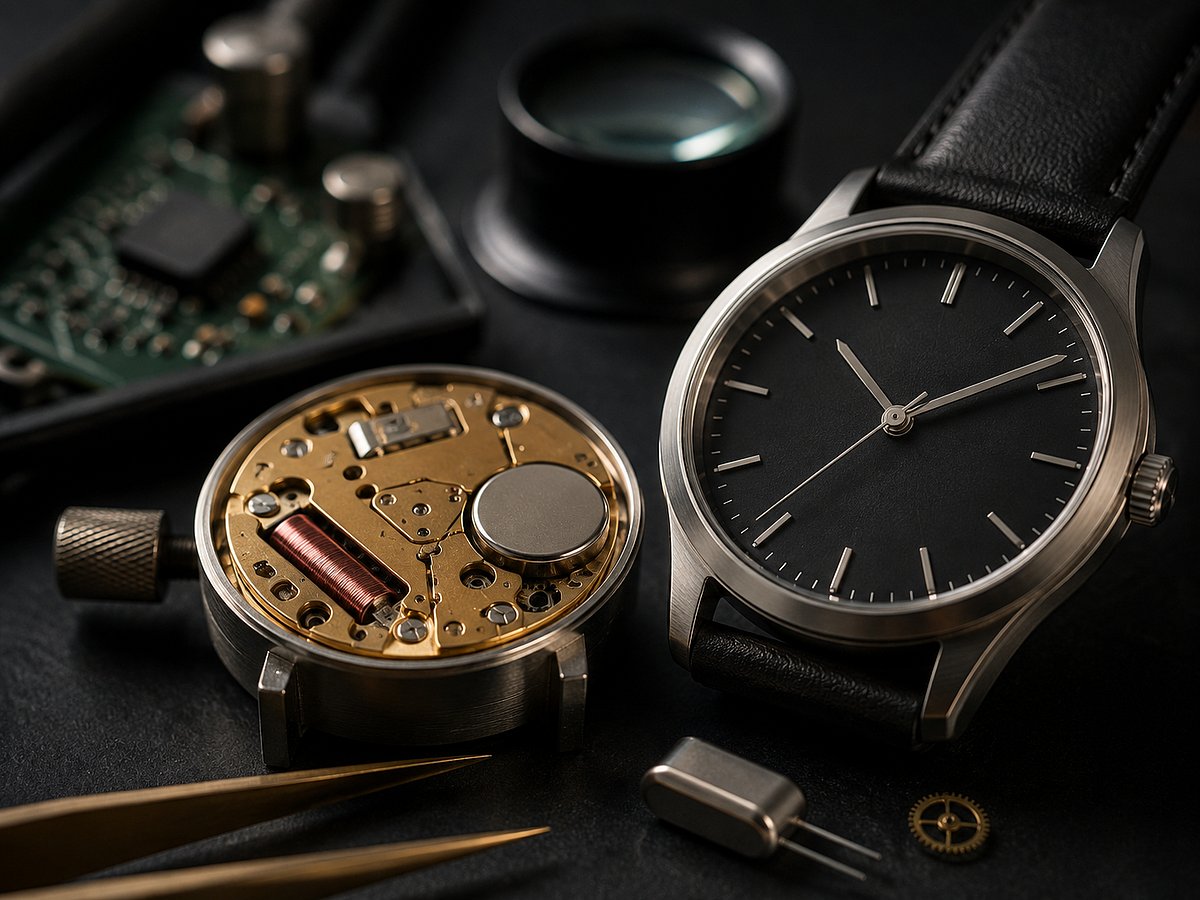
A quartz watch performs a surprisingly large amount of counting. The National Institute of Standards and Technology explains that the crystal in a typical quartz wristwatch vibrates at 32,768 Hz. Its electronic circuit divides that frequency by 32,768 until it produces a one second signal, which can drive the hands. That high, stable frequency is the key advantage over a mechanical watch, whose balance wheel and escapement operate much more slowly and are affected by position, temperature and tiny mechanical variations. Accuracy, in other words, has less to do with how complicated a watch looks than with the oscillator regulating it.
Quartz is piezoelectric: apply an electrical charge to a suitably cut crystal and it oscillates at a predictable frequency. A battery supplies the energy, electronics count the oscillations and, in a conventional analogue watch, a small motor advances the hands. NIST notes that even inexpensive quartz watches are generally capable of very good accuracy because their oscillator runs at such a high frequency.
Mechanical watches solve the same problem without a battery or electronic oscillator. Energy stored in a wound mainspring passes through gears, while the escapement and balance regulate its release. The attraction is therefore different. A mechanical watch gives its owner a miniature machine that can contain hundreds of carefully interacting components. Quartz is usually the rational answer for someone who wants to set a watch and think about it less. Mechanical remains compelling for its engineering, craft and the pleasure of the mechanism itself.
For Quartz watches specifically, concentrate on features you will actually use. Check the case size and water resistance rating first, since both affect everyday suitability far more than decorative complexity. Solar charging is useful if you would rather avoid conventional battery changes. Chronographs, multiple time displays and illuminated dials can be worthwhile.
The DZ7315 uses quartz to make an unusually complicated analogue display practical. Diesel's linebook identifies it as a 57mm quartz multi display watch with a gunmetal stainless steel case and bracelet and 3 ATM water resistance. Its oversized dimensions are central to the design, so this is best viewed as a statement watch. Multiple displays and chronograph functions show another strength of quartz: one movement architecture can support plenty of information without asking the wearer to wind a complicated mechanical calibre.
Casio adds a useful variation to the quartz formula by making the MTP S120L solar powered. The specifications identify a quartz analogue movement, solar charging, mineral glass, day and date displays and 100 metre water resistance. Solar does not change the fundamental quartz timekeeping principle. It changes how the watch gets its electricity, replenishing its rechargeable cell from light. For someone choosing quartz partly for low maintenance, that makes this Casio particularly coherent.
The Grant demonstrates that quartz does not have to look purely functional. Fossil specifies a 44mm case, quartz chronograph movement, stainless steel bracelet, mineral crystal and 5 ATM water resistance. The Roman numeral dial and subdials borrow visual cues associated with traditional watchmaking, while the movement underneath provides straightforward quartz regulation. The chronograph is the practical addition here, giving the wearer stopwatch functionality without turning the watch into a digital instrument. It suits someone who wants conventional dress watch styling with the convenience of battery powered quartz.
Timex takes the opposite approach and keeps the purpose obvious. Its official specifications list a 39mm case, quartz analogue movement, mineral crystal, 50 metre water resistance and an INDIGLO illuminated dial. The green dial, Arabic numerals and 24 hour markings follow the readable field watch formula, while a date window adds everyday utility. Timex also specifies a CR2016 battery. At 39mm, it is considerably more restrained on the wrist than the Diesel, making it an appealing example of quartz used for simple, legible timekeeping rather than spectacle.
Quartz wins this particular contest because its crystal provides a fast, stable reference frequency that electronics can count with great consistency. Mechanical watches answer a different question, offering craftsmanship and mechanical fascination rather than the easiest route to precision. Among these four, the Casio MTP S120L is the clearest expression of quartz's practical strengths: accurate electronic regulation paired with solar charging and useful everyday specifications. The Timex is the simpler alternative if legibility and compact field watch styling matter more.
Gulf News earns a commission on purchases made through links in this article, at no extra cost to you. Our editorial team selects products independently.
Sign up for the Daily Briefing
Get the latest news and updates straight to your inbox
Network Links
GN StoreDownload our app
© Al Nisr Publishing LLC 2026. All rights reserved.