US–Iran ceasefire: Indian ships reverse course in Strait of Hormuz; Trump says Iran cannot 'blackmail us'
Tehran says strategic oil route has been shut following blockade dispute
Highlights
We are closing this coverage now. For the latest updates, click here.
Israel army says soldier killed in south Lebanon
The Israeli military said on Saturday that a soldier was killed the day before in southern Lebanon, where a ceasefire came into effect earlier this week.
Command Sergeant Barak Kalfon, 48, died after being wounded on Friday in an incident that also injured three other soldiers, the military said.
The military did not provide other details.
Israeli news site Ynet said the incident occurred during an operation to clear structures in southern Lebanon, about 3.5 kilometres (two miles) from the border.
Kalfon was among the first to enter a booby-trapped building, which then exploded, the report said.
He received emergency medical treatment but was later declared dead.
His death brings the military's losses in the six-week war between Israel and Hezbollah to 14, according to an AFP tally based on military figures.
A ceasefire between Israel and Lebanon came into effect at midnight on Thursday.
Hezbollah chief says truce can't be one-sided, vows to respond to Israel attacks
Hezbollah leader Naim Qassem said on Saturday that the ongoing 10-day truce with Israel cannot be one-sided, vowing that his fighters would respond to Israeli attacks on Lebanon.
"A ceasefire means a complete cessation of all hostilities. Because we do not trust this enemy, the resistance fighters will remain in the field with their hands on the trigger, and they will respond to violations accordingly," Qassem said in a statement read out on TV.
"There is no ceasefire from the side of the resistance only, it must be from both sides."
Iranian official says US 'maximalist' demands stall face-to-face talks
Iran is not yet ready to hold a new round of face-to-face talks with U.S. officials, a senior Iranian official said Saturday, citing Washington's refusal to abandon "maximalist" demands on key issues.
In an interview with The Associated Press on the margins of a diplomacy forum in Turkey, Iranian Deputy Foreign Minister Saeed Khatibzadeh also said his country will not hand over its enriched uranium to the United States, rejecting claims made by U.S. President Donald Trump.
"I can tell you that no enriched material is going to be shipped to United States," Khatibzadeh said. "This is non-starter and I can assure you that while we are ready to address any concerns that we do have, we're not going to accept things that are nonstarters."
Israel hits Lebanon
The Israeli military said its air force had eliminated a "terrorist cell" operating near its troops in southern Lebanon, despite the ceasefire there.
"The IDF eliminated a terrorist cell operating in proximity to IDF soldiers in southern Lebanon, in the area of the forward defence line dedicated to preventing imminent threats to Israel's northern communities," it said, without specifying how many suspected militants were killed.
New Delhi protests Iran fire at Indian-flagged ships in Hormuz
New Delhi summoned the Iranian ambassador on Saturday to lodge a protest over a "shooting incident" involving two Indian-flagged ships in the Strait of Hormuz, the foreign ministry said.
Iran has reversed its pledge to reopen the strategic trade route to commercial traffic during a ceasefire in the Middle East war in protest at a US counter-blockade of the waterway, a crucial passage for crude oil and gas.
Security monitors said several commercial ships came under fire and threats from Iranian forces on Saturday as they tried to cross the strait.
India's foreign ministry said in a statement that Secretary Vikram Misri summoned the Iranian ambassador and "conveyed India's deep concern at the shooting incident earlier today involving two Indian-flagged ships in the Strait of Hormuz".
New Delhi also urged Iran to "resume at the earliest the process of facilitating India-bound ships across the Strait", the statement said, adding that the envoy "undertook to convey these views to the Iranian authorities".
Monitoring site TankerTrackers.com said in post on X that "two Indian vessels were forced back west out of the Strait of Hormuz by Iran's Sepah (IRGC) Navy", adding one of the vessels was "an Indian-flagged VLCC supertanker carrying 2 million barrels of Iraqi oil."
India, the world's second-largest buyer of liquefied petroleum gas, has managed to secure passage for several Indian-flagged vessels in recent weeks.
India imports about 60 percent of its LPG needs and has been grappling with a gas crunch since the war in the Middle East began on February 28.
New Delhi maintains strong relations with Tehran but has steadily expanded cooperation with Iran's rival Israel in defence, agriculture, technology and cybersecurity.
Hezbollah denies involvement in deadly attack on UN peacekeepers
Hezbollah on Saturday denied it was involved in a deadly attack on United Nations peacekeepers (UNIFIL) in southern Lebanon, after France accused the group of being behind the incident.
"Hezbollah denies any connection to the incident that occurred with UNIFIL forces in the Ghandouriyeh-Bint Jbeil area, and calls for caution in making judgments and assigning responsibilities regarding the incident pending the Lebanese army's investigations to determine the full circumstances of the incident," the group said in a statement.
One peacekeeper was killed and three others wounded from the French battalion, with Paris blaming Hezbollah.
Iran says reviewing 'new proposals' from United States
Iran's top national security body said Saturday that the country was reviewing "new proposals" received from the United States, even as it warned that its negotiators would cut no compromises with Washington.
"In recent days, with the presence of the commander of the Pakistani army in Tehran as an intermediary and mediator in the negotiations, new proposals have been put forward by the Americans, which the Islamic Republic of Iran is currently reviewing and has not yet responded to," the Supreme National Security Council said in a statement.
It went on to say that Iran's negotiating delegation "will not make even the slightest compromise, retreat or leniency, and will defend with all its strength the interests of the Iranian nation".
Trump says Iran cannot 'blackmail us' with Strait of Hormuz
US President Donald Trump on Saturday warned Iran not to "blackmail" Washington with its flip-flopping on the fate of the Strait of Hormuz, after Tehran declared the strategic waterway once again closed.
"We're talking to them. They wanted to close up the strait again - you know, as they've been doing for years - and they can't blackmail us," Trump said at a White House event.
Trump said there would be "some information" about Iran later in the day, adding: "We're taking a tough stand."
Iran's military on Saturday declared the strait, through which about one-fifth of the world's crude and liquefied natural gas normally passes, was once again closed, a day after saying it was open.
Pope says he regrets his remarks interpreted as a debate with Trump
Pope Leo XIV said Saturday he regretted remarks he made were interpreted as a response to criticism from President Donald Trump, insisting he had no interest in debating the US leader.
An example was a speech about "tyrants" ransacking the world that he delivered in Cameroon on the second leg of a tour of Africa, Leo told journalists as he travelled to Angola.
The remarks had been written well before Trump's comment that he was "not a big fan" of the American pope. "And yet it was perceived as if I were trying to start a new debate with the president, which doesn't interest me at all," Leo said.
Hezbollah-allied Lebanon parliament speaker condemns attack on UN peacekeepers
Lebanese Parliament Speaker and Hezbollah ally Nabih Berri condemned on Saturday the deadly attack on French UN peacekeepers, which Paris accused the Iran-backed group of committing.
In a statement shared by his office, Berri "condemned the attack on a patrol belonging to the French contingent serving with the United Nations Interim Force in Lebanon (UNIFIL) in southern Lebanon".
The speaker "praised the sacrifices made by UNIFIL forces over the decades, particularly the French contingent", and contacted UNIFIL Force Commander General Diodato Abagnara to offer his condolences.
US says 23 ships turned back since Iran blockade started
The U.S. military says it has forced 23 ships to turn around near the Strait of Hormuz since it imposed a naval blockade of Iranian ports.
In a post on X, the Central Command said U.S. forces are still enforcing the blockade "against ships entering or exiting Iranian ports and coastal areas."
The blockade ordered by President Donlad Trump started April 13 as part of U.S. pressure on Iran to reopen the Strait of Hormuz.
In response to the continued blockade, Iran reimposed restrictions on transit through the strait.
Global Village in Dubai set to reopen, welcome visitors
Calling all fans of Global Village! After weeks of maintaining it would remain closed until further notice, good news finally landed on April 18, Saturday, with the popular destination set to welcome visitors again soon. It will open again on April 20th, 5pm.
The destination will be open daily from 5pm to 12am.
Dubai school buses to resume from April 20 under safety protocols
In line with ongoing assessments conducted by the National Emergency and Crisis Management Authority, in coordination with the Ministry of Education, bus services for private educational institutions in Dubai will resume starting Monday, April 20, 2026, in accordance with the approved safety protocols.
This decision is an extension of the country's continuous assessment approach during this period, ensuring continuity of education, student safety, and the efficiency of services provided.
No date set for next round of Iran-US talks: Iran deputy FM
No date has been set for the next round of Iran-US peace talks brokered by Pakistan following the failure of an initial round, Iran's deputy foreign minister said on Saturday.
"Until we agree on the framework, we cannot set a date," Saeed Khatibzadeh told journalists on the sidelines of an annual diplomatic forum in Turkey's southern Antalya province.
"We hope that as soon as we can finalise that, then we can move on to the next step".
France blames Hezbollah for French peacekeeper's death in Lebanon
A French soldier was killed and three others wounded in an attack Saturday on UN peacekeepers in Lebanon that appeared to have been carried out by Hezbollah, French President Emmanuel Macron said.
"Everything points to Hezbollah being responsible for this attack," he said on X, urging Lebanese authorities to arrest the perpetrators.
Get updated faster and for FREE: Download the Gulf News app now - simply click here.
Israel army says established 'Yellow Line' in Lebanon, as in Gaza
The Israeli military said Saturday it had established a "Yellow Line" demarcation in southern Lebanon, similar to the one separating its forces from territory still held by Hamas in Gaza, adding that it had already struck suspected militants approaching its troops along the line.
"Over the past 24 hours, IDF forces operating south of the Yellow Line in southern Lebanon identified terrorists who violated the ceasefire understandings and approached the forces from north of the Yellow Line in a manner that posed an immediate threat," the military said, referring to such a line for the first time since a ceasefire came into effect.
"Immediately after identification and in order to eliminate the threat ... forces attacked the terrorists in several areas in southern Lebanon," it said, noting that the military was authorised to take action against threats, despite the ceasefire.
Lebanon PM says French UN peacekeepers attacked, orders investigation
Lebanese Prime Minister Nawaf Salam said on Saturday that French United Nations peacekeepers had been attacked in southern Lebanon, ordering an investigation into the incident.
"I condemn in the strongest terms today's attack on members of the French battalion in UNIFIL," Salam said, referring to the peacekeepers, adding that he gave "strict instructions for an immediate investigation to uncover the circumstances of this attack and hold the perpetrators accountable".
A spokesperson for UNIFIL confirmed to AFP that an incident involving their peacekeepers took place in Ghandouriyeh, southern Lebanon, saying they are looking into it without giving additional details on the nature of the attack or casualties.
Statement from supreme leader says Iran's navy 'stands ready' to defeat US
A statement said to have been issued by Iran's supreme leader Mojtaba Khamenei warned Saturday that Tehran's navy was ready to defeat US forces, as the foes sparred over the Strait of Hormuz.
In a statement carried on his Telegram channel, Khamenei, who has not been seen in public since before the start of the war, said Iran's "brave navy stands ready to make the enemies taste the bitterness of new defeats".
Indian ships reverse course in Hormuz strait, vessel tracker says
Two Indian vessels were revealed to have been the tankers who reversed course in the Strait of Hormuz following reports of gunfire from Iran's Revolutionary Guard, a vessel-tracker said.
TankerTrackers.com said the vessels include an Indian-flagged super tanker, carrying 2 million barrels of Iraqi oil.
Two tankers fired upon near Strait of Hormuz, reports say
Two tankers attempting to transit the Strait of Hormuz were fired upon by Iran’s Islamic Revolutionary Guard Corps, Reuters reported, citing maritime sources.
The tanker-monitoring site TankerTrackers said IRGC naval units forced two Indian-flagged vessels to turn back outside the strait, with the incident involving gunfire.
The developments come after the IRGC signalled that it had reclosed the Strait of Hormuz due to excessive US demands.
Iran says it won’t hand over enriched uranium to US
Iranian Deputy Foreign Minister Saeed Khatibzadeh dismissed claims from US President Donald Trump over the uranium and sounded a note of caution with regard to future talks between the two countries.
Speaking to the Associated Press in the Turkish city of Antalya, Khatibzadeh said the Iranians were not ready for a new round of face-to-face talks with the US because the Americans “have not abandoned their maximalist position.”
On Friday, Trump said the US will go into Iran and “get all the nuclear dust,” referring to the 970 pounds (440 kilograms) of enriched uranium believed to be buried under nuclear sites badly damaged by US military strikes last year.
Get updated faster and for FREE: Download the Gulf News app now - simply click here.
Egypt FM says hopes for Iran-US peace deal 'in the coming days'
Egypt and Pakistan are working "very hard" as mediators to bring about "a final agreement between the United States and Iran", Egypt's foreign minister said Saturday as he attended an Antalya Diplomacy Forum in Turkey.
"We hope to do so (reach an agreement) in the coming days," Badr Abdelatty said, noting that "not only us in the region, but the whole world is suffering from the continuation of this war".
We are pushing very hard in order to move forward.Badr Abdelatty
Tankers pass Hormuz Strait in brief Iran reopening
At least eight oil and gas tankers crossed the Strait of Hormuz on Saturday after Iran briefly declared the crucial trade route open during a ceasefire in the Middle East war, maritime tracking data showed.
One crude oil tanker, four liquified petroleum gas carriers, two oil and chemical tankers and one classified as an "oil products" vessel crossed the strait early Saturday after the Iranian announcement on Friday afternoon, data from tracking firm Kpler indicated.
Tracking platform MarineTraffic showed several other crude oil tankers in the strait near Iran's Larak Island, a checkpoint for vessels seeking to exit the Gulf under Iranian forces' blockade of the passage in the war.
However, Iran's central military command on Saturday appeared to reverse the decision to reopen the route, saying it would resume "strict management" of the strait in protest at a US naval counter-blockade.
At least three of the vessels tracked exiting via the strait on Saturday were listed as being under US sanctions. Some ships in the strait broadcast their identity as linked to India or China in a signal of neutrality.
Get updated faster and for FREE: Download the Gulf News app now - simply click here.
US-Iran deal ‘very close’: Pakistan minister
Pakistan’s Foreign Minister Ishaq Dar said Pakistani diplomats are working to “bridge” differences between the US and Iran.
He said one of the sticking points is Lebanon, while welcoming the ceasefire between Israel and Hezbollah.
Speaking at the Antalya Diplomacy Forum in southern Turkey on Friday, Dar said the US and Iran were “very close” to agreeing a deal last weekend in talks in Islamabad.
Lebanese leaders discuss future talks with Israel
The meeting between President Joseph Aoun and Prime Minister Nawaf Salam came during a 10-day ceasefire between Israel and Lebanon’s Iran-backed Hezbollah group.
According to a statement from Aoun’s office, the pair discussed Lebanon’s “readiness for negotiations” with Israel.
Earlier this week, the two countries’ ambassadors to the US held a meeting, in the first direct talks in decades.
US President Donald Trump has invited Aoun and Israeli Prime Minister Benjamin Netanyahu to the White House, although no date has been set yet.
Aoun has said he is ready to go anywhere to “liberate my country, protect my people and save my nation.”
Iran reimposes restrictions on Strait of Hormuz, accusing US of violating deal to reopen it
Iran swiftly reversed course on reopening the Strait of Hormuz, reimposing restrictions on the critical waterway on Saturday after the US said the move would not end its blockade.
The country's joint military command said on Saturday that it "control of the Strait of Hormuz has returned to its previous state ... under strict management and control of the armed forces." It warned that it would continue to block transit through the strait as long as the US blockade of Iranian ports remained in effect.
The announcement came the morning after US President Donald Trump said the American blockade "will remain in full force" until Tehran reaches a deal with the US, including on its nuclear program.
Get updated faster and for FREE: Download the Gulf News app now - simply click here.
Israel using security as a pretext to acquire 'more land': Turkey
Turkey's foreign minister on Saturday accused Israel of using security as a pretext to acquire "more land".
"Israel is not after its own security. Israel is after more land. Security is being used by the Netanyahu government as an excuse to occupy more land," Hakan Fidan told the Antalya Diplomacy Forum, referring to Israeli Prime Minister Benjamin Netanyahu.
Get updated faster and for FREE: Download the Gulf News app now - simply click here.
Strait of Hormuz only open during ceasefire: Iranian military official
Iran’s Defence Ministry spokesperson said the Strait of Hormuz is only open during a ceasefire and conditionally, two Iranian semi-official news agencies reported.
Brig. Gen. Reza Talaei-Nik said “military vessels and those linked to hostile forces have no right” of transit, according to the ISNA and Mehr news agencies.
UAE to resume school bus operations from April 20
The UAE has announced that school bus operations will resume across all public and private schools starting Monday, April 20, 2026.
The decision follows ongoing assessments carried out by the National Emergency and Crisis Management Authority in coordination with the Ministry of Education and local education authorities.
Officials said the move reflects the country’s continuous assessment approach during the current period, aimed at ensuring the smooth continuation of the education process while maintaining student safety and service efficiency.
Authorities confirmed that the situation will continue to be closely monitored, with additional measures introduced if necessary in response to any developments.
Pakistan PM completes three-country diplomatic tour
Pakistan's prime minister concluded his trip to Turkey on Saturday, he said in a social media post, ending a three-country diplomatic blitz as Islamabad pushes for an end to the US-Israeli war on Iran.
"I leave Antalya, with fond memories and a renewed commitment to further strengthening the enduring fraternal bonds between our two nations, and to continuing our close cooperation to advance dialogue and diplomacy for lasting peace and stability in the region," Shehbaz Sharif said.
Get updated faster and for FREE: Download the Gulf News app now - simply click here.
Iran partially reopens airspace: agency
Iran partially reopened its airspace on Saturday to international flights crossing the eastern part of its territory, the country's Civil Aviation Authority said.
"Air routes in the eastern section of the country's airspace are open for international flights transiting through Iran," it said, adding that some airports had also reopened at 7:00 am (0330 GMT).
More than three hours later, however, flight tracker websites still showed no international flights crossing Iran, and several avoiding its airspace by making long detours.
Pakistan's military chief concludes three-day visit to Iran
Pakistan's powerful army chief completed a three-day visit to Tehran, the country's military said on Saturday, having met top Iranian leaders and negotiators as part of efforts to end the Middle East war.
Field Marshal Asim Munir met Iran's president, foreign minister, parliament speaker and the head of Iran's military central command centre, the statement said.
The visit showed Pakistan's "unwavering resolve to facilitate a negotiated settlement... and to promote peace, stability, and prosperity", the military said ahead of expected US-Iran talks in Islamabad in the coming days.
Parliament speaker Mohammad Bagher Ghalibaf and Foreign Minister Abbas Araghchi led the Iranian delegation to Islamabad for peace talks with the United States last week, the highest level face-to-face contact between the two countries in decades.
Those talks ended without an agreement, but diplomacy continued thereafter, with Pakistan's prime minister undertaking a three-country tour to Saudi Arabia, Qatar and Turkey to push the peace process.
A second round of talks is expected in Islamabad this coming week.
Photos: Displaced Lebanese return home after ceasefire
First cruise ship 'Celestyal Discovery' crosses Strait of Hormuz
A cruise successfully transited the Strait of Hormuz for the first time since the outbreak of the West Asia conflict, according to data from MarineTraffic.
The vessel, identified as the Malta-flagged Celestyal Discovery, sailed through the critical waterway on Friday (local time). MarineTraffic indicated the liner was operating without passengers during the journey. It was the first passenger vessel to make it through since the war began.
The ship had been docked in Dubai for nearly 47 days after arriving in early March, as heightened regional tensions disrupted maritime activity. Following its transit, the Celestyal Discovery is now en route to Muscat, Oman, with its arrival expected later in the day.
Air Canada to suspend some flights to US
Air Canada has announced it will suspend service on several routes to the United States due to soaring jet fuel costs.
According to a statement from Canada's largest carrier on Friday (local time), jet fuel prices have doubled since the start of the Iran conflict, rendering some routes and flights no longer economically feasible.
The suspensions affect a mix of transborder and domestic services. Service from Montreal and Toronto to New York's John F. Kennedy International Airport will be paused from June 1 to October 25.
Air Canada will also suspend its Toronto-Salt Lake City route on June 30, with a tentative return set for 2027.
The total impact on the airline's planned capacity is roughly 1 per cent of annual available seat miles, the statement said.
Canada PM backs Gulf partners, welcomes strait reopening
Canadian Prime Minister Mark Carney has expressed “full solidarity” with Gulf partners, welcoming reports of a ceasefire and the reopening of a key strait.
In a post on X, he called the developments positive and said Canada stands with regional allies facing “retaliatory attacks and economic pressure.”
Following talks with French President Emmanuel Macron and UK Prime Minister Keir Starmer, Carney also welcomed coordinated diplomatic efforts to restore safe maritime passage through the strategic corridor.
Trump warns US will secure Iran uranium “one way or another”
Trump said the US will obtain Iran’s stockpile of highly enriched uranium, warning it could be taken “in a much more unfriendly form” if negotiations fail, according to CNN.
He declined to give a timeline, saying it would depend on whether a deal is signed. “If we sign the agreement… we will take it together,” Trump said, adding the material would be returned to the US.
“If we don’t do that, we will get it in a different form,” he said, stressing that “we’ll get it done” regardless of the outcome.
Trump also referred to Iran’s uranium stockpile as “nuclear dust,” a term not used in the nuclear industry.
Trump says Xi 'very happy' about Strait of Hormuz reopening
Trump said that his Chinese counterpart, President Xi Jinping, is "very happy" about the reopening of the Strait of Hormuz, despite Iran stating that the maritime movement through the strategic waterway will be strictly controlled by Tehran.
Trump made his remarks in a post on Truth Social, adding that he is also looking forward to his meeting with the Chinese President, which was rescheduled to May due to the war with Iran.
His visit to China was earlier scheduled for April.
"President Xi is very happy that the Strait of Hormuz is open and/or rapidly opening. Our meeting in China will be a special one and, potentially, Historic. I look forward to being with President Xi -- Much will be accomplished!" the post on Truth Social read.
Trump rejects notion of tolls by Iran on the Strait of Hormuz
Trump flatly rejected the idea when a reporter asked about the prospect of restrictions or tolls managed by Iran.
“Nope. No way. No. Nope,” Trump said. He said there can’t be tolls along with restrictions. “No, they’re not going to be tolls.”
Trump signals end to Iran ceasefire if deal fails
Donald Trump has warned that he may not extend a tentative ceasefire with Iran if ongoing negotiations fail to reach an agreement by Wednesday, raising concerns over a possible return to military action.
Speaking aboard Air Force One, Trump said the truce could end if talks collapse. “Maybe I won’t extend it,” he said when asked about the next steps.
He added that without progress, tensions could escalate again, suggesting the possibility of renewed strikes if diplomacy stalls.
Maybe I won’t extend it, but the blockade (on Iranian ports) is going to remain. So you have a blockade, and unfortunately we have to start dropping bombs again.Donald Trump
More than 20 ships turned back by US blockade, US Central Command says
Since the blockade began on Monday, 21 ships returned to Iran at the direction of US forces, US Central Command said Friday evening.
US President Donald Trump said earlier on Friday that the American blockade of Iranian ports would remain “in full force” until Iran reaches a deal with the U.S., including on its nuclear program.
US extends sanctions waiver on purchases of Russian oil
US President Donald Trump's administration on Friday issued a month-long sanctions waiver allowing the sale of Russian oil and petroleum products that are at sea, extending an earlier move to soften surging energy prices.
The license, issued by the Treasury Department, comes two days after Treasury Secretary Scott Bessent said that Washington would not renew the waiver.
The latest move allows for the purchase of oil and petroleum products that have been loaded onto any vessel as of Friday, through 12:01 am (0401 GMT) on May 16.
It prolongs an earlier easing of sanctions that expired on April 11.
Get updated faster and for FREE: Download the Gulf News app now - simply click here.
Australian PM welcomes Hormuz reopening, says hopes it holds
Australian Prime Minister Anthony Albanese welcomed on Saturday Iran's agreement to stop blocking the Strait of Hormuz but said the situation remained "fragile".
"This was positive news that we received last night," Albanese told journalists in Sydney after participating in a multinational summit on the issue.
"We hope that it holds, but what we know is that the impact will be long lasting," he added.
First 24 hours without strikes in Israel since Iran war began
It’s been more than 24 hours since air raid sirens went off in any part of Israel — and that last time, very early on Friday morning in a small community at the border with Lebanon, turned out to be a mistaken identification.
Since the Iran war started on February 28, Iran, then Lebanon-based Hezbollah militants and eventually the Houthis in Yemen sent barrages of missiles and rockets into Israel, sometimes more than a dozen times a day. Hezbollah kept up firing right until a ceasefire went into effect Friday.
In Israel’s major metropolitan areas of Jerusalem and Tel Aviv, but also in villages in the country’s desert south and hilly north, sirens and alerts sent residents to bomb shelters and safe rooms throughout the day and night.
The strikes have killed 23 people and wounded about 600 more, according to Israel’s emergency services.
Get updated faster and for FREE: Download the Gulf News app now - simply click here.
Iran warns Strait of Hormuz could close if US blockade continues
Iran’s parliamentary Speaker Mohammad Bagher Qalibaf posted on X early Saturday that if the US blockade continued, “the Strait of Hormuz will not remain open.”
On Friday, Iran had said it fully reopened the Strait of Hormuz to commercial vessels, but US President Donald Trump said the American blockade on Iranian ships and ports would “remain in full force” until Tehran reaches a deal with the US.
And a data firm, Kpler, said later Friday that movement through the strait remained confined to corridors requiring Iran’s approval.
Trump says US will go into Iran and excavate uranium
“The US will get all the nuclear dust,” Trump said in a speech in Arizona. “We’re going to get it by going in with Iran with lots of excavators.”
Iran has yet to confirm that its agreed to give up the 970 pounds (440 kilograms) of enriched uranium believed to be buried under nuclear sites badly damaged by US military strikes last year.
Giving up the uranium and agreeing to US troops entering Iranian territory would be huge concessions by Iran.
Trump insisted that “no money will exchange hands in any way, shape or form” as part of a potential deal with Iran to end the war.
USS Ford returns to the Middle East
The world’s largest aircraft carrier, the USS Gerald R. Ford, has again entered the waters of the Middle East, two defense officials told the Associated Press.
The Ford, which until recently was operating in the Eastern Mediterranean, transited the Suez Canal, along with a pair of destroyers, the USS Mahan and the USS Winston S. Churchill, and is now operating in the Red Sea, one official said.
Both spoke on condition of anonymity to discuss sensitive military operations.
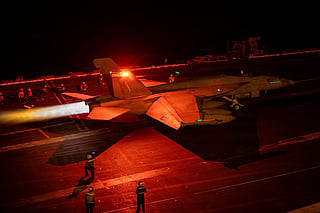
The Ford is returning to the Red Sea after more than a month in the Mediterranean following a major fire in a laundry space that forced the ship back to port for repairs and left 600 sailors without places to sleep. The carrier also broke the record for the longest aircraft carrier deployment since the Vietnam war this week.
The Ford’s arrival makes it the second aircraft carrier in the region in addition to the USS Abraham Lincoln in the Arabian Sea. The USS George H. W. Bush is also heading toward the region and is currently off the coast of South Africa, according to one defense official.
Trump says will bring Iran uranium 'back home to US'
President Donald Trump said that the United States and Iran would jointly remove uranium from Tehran's nuclear sites with excavators under any peace deal, before the material is transferred to US territory.
Trump's comment came despite Iran's foreign ministry saying earlier that the Islamic Republic's stockpile of enriched uranium would not be transferred "anywhere."
"Somebody said, how are we going to get the nuclear dust? We're going to get it by going in with Iran, with lots of excavators," Trump told a gathering of the conservative Turning Point USA movement in Phoenix, Arizona.
"We need the biggest excavators you can imagine," he added.
"But we're going to go in together with Iran. We're going to get it. We're going to take it back home to the USA very soon."
His remarks on Iran came during a speech to Turning Point USA, where he was introduced by Erika Kirk, the widow of the group's founder Charlie Kirk - a Trump ally who was assassinated in September.
Vessel movement remains constrained in Strait of Hormuz
Data firm Kpler said ship movement through the Strait of Hormuz remained confined to corridors requiring approval on Friday evening, hours after the US and Iran announced full reopening of the strategic waterway.
Iran’s state media reported the country’s conditions to reopen the Strait of Hormuz, which has been effectively closed since the beginning of the war, included that all commercial vessels transiting must go through a route designated by Iran and in coordination with the IRGC Navy.
Kpler said that “markets have responded with cautious optimism” to the reopening decision, but warned that underlying supply dynamics remain tight, and a “full normalization in trade and confidence is likely to take months, not weeks.”
Get updated faster and for FREE: Download the Gulf News app now - simply click here.
Sri Lanka sent home 238 Iranian sailors
A US submarine sank the IRIS Dena on March 4 while the ship was returning home after taking part in a naval exercise on invitation from India.
The Sri Lankan navy recovered 87 bodies and 32 were hospitalized. A second Iranian ship was brought to a southern Sri Lankan port after its crew reported technical problems.
Defense Ministry spokesman Brig. Franklin Joseph said Friday that everyone except for a few crew members from the second ship had been repatriated earlier this week.
The Iranian ship has been anchored in the eastern port of Trincomalee port and no decision has been taken on what should be done with it.
Iran navy chief calls US blockade ‘piracy’
The commander of the Iranian navy, Shahram Irani, said Friday evening that Trump “has blockaded his friends” and not Iran, as the U.S. said its blockade will remain in place after Iran declared the Strait of Hormuz open to commercial traffic.
In a statement carried by Mizan, Iran’s official judiciary news agency, the navy chief said Trump’s blockade is just “empty words” and that no one is listening to him.
The US military says it has turned 19 ships back to Iran since imposing the blockade earlier this week.
Get updated faster and for FREE: Download the Gulf News app now - simply click here.
US‑Israel war on Iran: Recent developments
Day 49: Trump says Iran agrees to 'never' close Hormuz strait again
Day 48: Trump: Iran agreed to hand over its enriched uranium
Day 47: US optimistic about reaching peace deal with Iran
Day 46: 2 days to US-Iran talks in Pakistan? Trump thinks so
Day 45: US, Iran discuss 'another round' of direct talks
Day 44: US to begin 'blockade' of Iranian ports on Monday
Day 43: 3-way talks with the US and Iran begin in Pakistan
Day 42: Trump says Iran has 'no cards' as Vance heads for talks
Day 41: Kuwait condemns drone attacks, US warns vs Hormuz toll