US hails Russia-Ukraine peace talks in Abu Dhabi as ‘very productive’; Rubio seeks wider European role
Rubio calls for bigger Europe role as Abu Dhabi hosts talks to end nearly 5 years of war
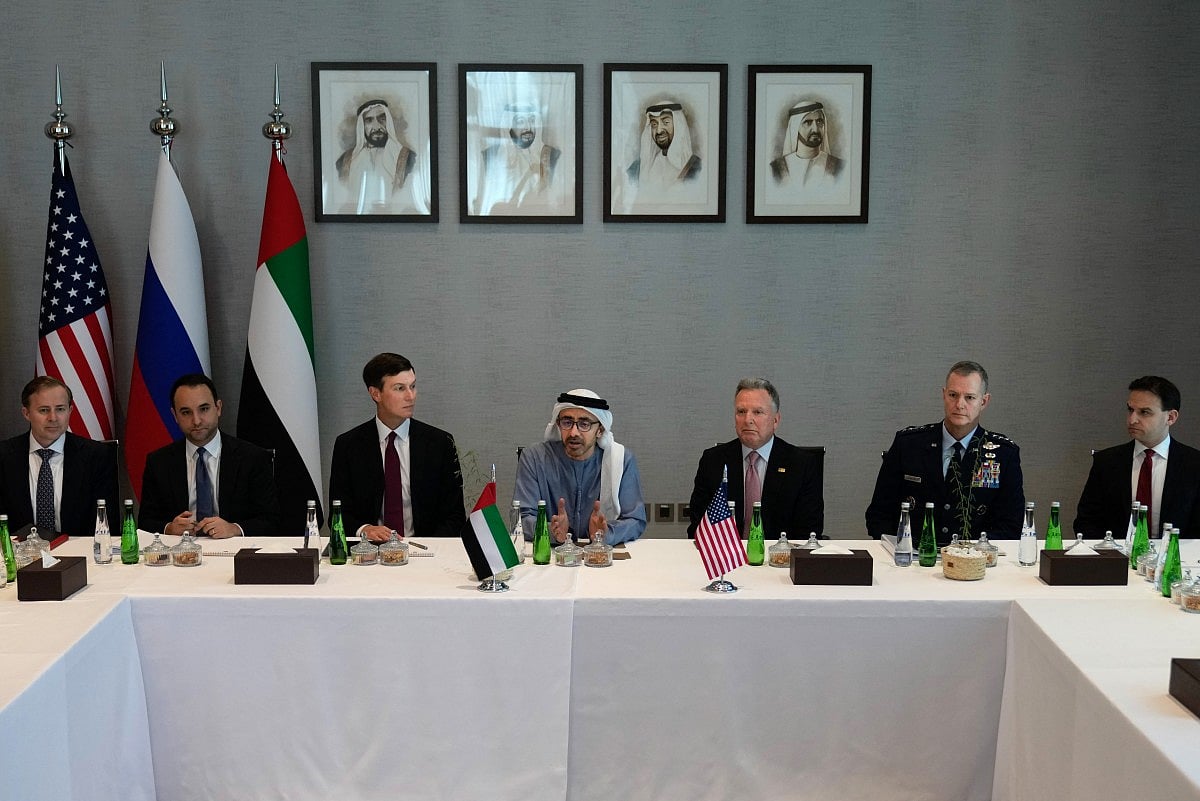
Abu Dhabi: US Secretary of State Marco Rubio described Russia-Ukraine peace talks in Abu Dhabi as “very productive” on Tuesday, as Washington pushed for a broader European security agreement aimed at ending nearly five years of war.
The first day of US-mediated negotiations concluded after nearly four hours, with Russian and Ukrainian delegations meeting American envoys Jared Kushner and Steve Witkoff. The talks, the first since February, are scheduled to resume on Wednesday.
Sheikh Abdullah bin Zayed Al Nahyan, UAE Deputy Prime Minister and Minister of Foreign Affairs, welcomed the third round of trilateral negotiations, reaffirming the UAE’s support for US efforts to promote dialogue and achieve a political settlement.
Sheikh Abdullah conveyed the greetings of President His Highness Sheikh Mohamed bin Zayed Al Nahyan to US President Donald Trump, Russian President Vladimir Putin and Ukrainian President Volodymyr Zelensky, as well as the participating delegations.
He praised their confidence in the UAE and reaffirmed the country’s commitment to bridging differences and supporting diplomatic efforts towards lasting peace.
Expressing hope that the negotiations would produce practical steps towards ending the conflict.
Rubio seeks European involvement
Speaking in Paris after the first day’s negotiations, Rubio called for European countries to participate in future discussions on the continent’s security.
“We think the trilateral (format) should eventually include our European partners at the table as well, because they are a part of solving this problem for the long term,” he said.
His remarks came as Washington sought to expand the negotiations beyond an immediate settlement between Moscow and Kyiv to address wider European security arrangements.
Opening the talks, Kushner said the US believed it had identified ways to narrow differences between the two sides.
He said Washington wanted to create a new security framework involving Russia, Ukraine and Europe, capable of securing “decades, if not centuries, of peace”.
Kushner acknowledged the difficulties but said negotiators had “some good ideas” for bridging their differences.
NATO’s senior military commander in Europe, US General Alexus Grynkewich, also attended the negotiations.
Russia-Ukraine war: Key milestones
February 2022: Russia launches a full-scale military offensive against Ukraine. Fighting spreads across several regions.
September–November 2022: Moscow declares the annexation of four Ukrainian regions. Ukrainian forces recapture Kherson city.
2023–2024: Heavy fighting continues. Ukraine launches a counteroffensive in 2023 and a cross-border operation into Russia's Kursk region in August 2024.
2025: Donald Trump renews US peace efforts. He meets Vladimir Putin in Alaska in August, but no ceasefire agreement emerges.
January–February 2026: Abu Dhabi hosts two rounds of US-mediated talks, producing a prisoner exchange but no peace settlement. Further negotiations take place in Geneva.
November 10, 2026: Russia, Ukraine and the US resume talks in Abu Dhabi. Washington calls the discussions “very productive” and seeks a wider European security agreement.
Russia seeks wider security deal
Moscow has indicated that it wants the discussions to address Europe’s broader security architecture, including longstanding disputes over NATO’s military presence in eastern Europe.
Russia’s delegation included Deputy Foreign Minister Sergei Ryabkov, who previously presented Moscow’s demands for NATO to roll back its military deployments.
A Russian delegation source told AFP that resolving the Ukraine conflict was only one item on the agenda, with broader European security arrangements a central objective.
Russia’s chief negotiator, Vladimir Medinsky, expressed hope that the discussions would advance efforts towards peace.
However, European governments remain concerned that a broader agreement could undermine Ukraine’s security or reshape Europe’s defence arrangements without sufficient European involvement.
Ukraine demands ceasefire
Ukraine’s chief negotiator, Rustem Umerov, said Kyiv’s priorities remained securing a ceasefire and reliable security guarantees.
“Our people are waiting to end this war,” he told delegates.
Kyiv wants an immediate halt to hostilities before negotiations on a wider settlement, while Moscow argues that a ceasefire would allow Ukrainian forces to regroup.
The two countries remain divided over territory. Russia demands Ukrainian withdrawal from four regions it claims, including areas it does not fully control. Kyiv rejects surrendering territory.
Trump has suggested that Ukraine might have to accept territorial changes, saying the country could emerge from a settlement with “a little bit different shape”.
Fighting continues
The negotiations unfolded against continuing attacks, with Ukraine reporting 162 Russian drones and a ballistic missile overnight, while Moscow claimed to have intercepted 155 drones.
The talks are expected to continue in Abu Dhabi on Wednesday.
— With inputs from AFP, AP & WAM
.

Sign up for the Daily Briefing
Get the latest news and updates straight to your inbox
Network Links
GN StoreDownload our app
© Al Nisr Publishing LLC 2026. All rights reserved.