The 147-km North-South Commuter Railway project in connecting Manila to central and southern Luzon also highlights continued infrastructure cooperation between the Philippines and Japan as the two countries mark 70 years of diplomatic relations.
Luzon Economic Corridor needs 5,875 engineers now: Does the Philippines have enough for ‘Pax Silica’?
Philippines, exporting $50B worth of electronics, could faces talent crunch for high-tech
Last updated:
6 MIN READ
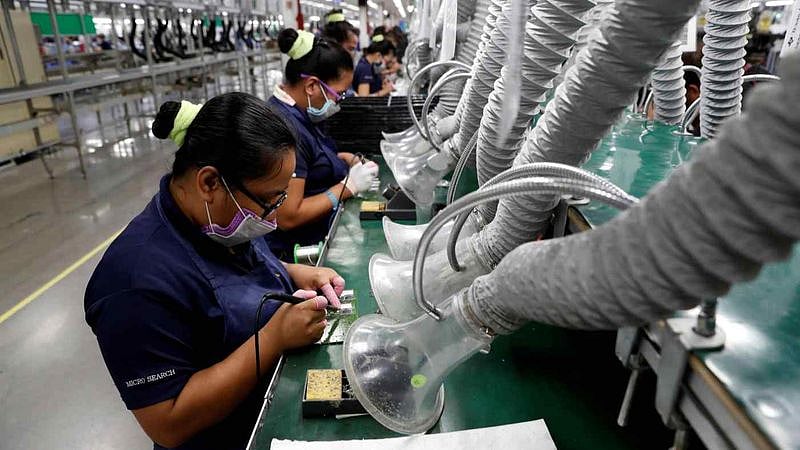
Filipinos work at the assembly line of Taiwan-based Kinpo Electronics' factory in Malvar, Philippines.
Reuters
Manila: The Philippines seeks to woo Apple, Nvidia, TSMC, Broadcom, Samsung and AMD in its own version of "Silicon Valley", the New Clark City in Tarlac, about an hour by car north of Manila.
Now, the Asian nation faces a diliemma: It claims to have the talent base to support the proposed chip making and critical minerals hub, known as Luzon Economic Corridor (LEC), framed as a pillar of the US-led "Pax Silica" alliance.
But industry and academic analysts warn: the country must rapidly scale up engineering, semiconductor and AI training if the LEC is to move beyond hosting foreign investments.
Semiconductor and Electronics Industries in the Philippines (SEIPI) estimates that as of 2026, the semiconductor and electronics sector needs 56,605 trained workers — including 5,875 engineers, 6,483 technicians and 44,247 operators.
SEIPI has also warned: the Philippines produces fewer engineers annually than Vietnam, according to SEIPI President Dr. Danilo Lachica.
What checks out
56,605 workers by 2026: Multiple reports say the local semiconductor and electronics industry will need 56,605 trained operators, technicians and engineers in 2026.
Government target: The government’s semiconductor and electronics workforce goal was previously 128,000 skilled professionals by 2028. This was adjusted to 2030, according to the Advanced Science and Technology Institute, a government research arm.
Vietnam comparison: SEIPI's Lachica said the Philippines produces fewer engineers annually than Vietnam, which he claimed has “10 times more engineering graduates every year.”
Get it: Fast, verified news for FREE ... download the Gulf News app — simply click here
Talent gap posed by 'Pax Silica'?
Pax Silica is a planned 4,000-acre high-tech manufacturing and innovation zone in New Clark City, Tarlac, under the Luzon Economic Corridor.
It is designed to host semiconductor design, fabrication and advanced packaging, AI computing, critical-minerals processing, data centres, energy infrastructure and research facilities.
It poses multiple challenges at the same time: water, electricity and talent.
The Bases Conversion and Development Authority (BCDA) estimates the project could generate more than 130,000 high-quality jobs, according to the Presidential Communications Office (PCO).
Industry estimates cited by the Manila Times project up to 180,000 direct professional jobs and 800,000 "supporting jobs".
Driven by decades of semiconductor assembly, test and electronics manufacturing, the Philippines has a large pool of electronics, electrical, mechanical and computer engineers.
The country's electronics manufacturing sector exported products valued at an estimated $50 billion in 2025.
278
Current number of companies in the electronics and semiconductor products industry in the Philippines.
One industry report lists 278 companies in the electronics and semiconductor products industry in the Philippines.
Bigger challenge
But Pax Silica requires deeper specialisation in chip design, fabrication, advanced packaging, AI systems, cybersecurity, cloud infrastructure and industrial automation.
A paper published by the School of Economics of the University of the Philippines (UP-Diliman) warned that the country risks becoming merely a host for foreign-led AI and semiconductor investments.
There's a caveat: it cited that the key challenge is to builds "stronger domestic technological and industrial capabilities".
It urged Manila to negotiate capability-building provisions while Pax Silica’s governance framework is still being finalised.
Finance Secretary Ralph Recto has also called for schools and training centers near manufacturing hubs, saying semiconductor and electronics zones within the Luzon Economic Corridor will sharply raise demand for highly skilled workers.
What must happen
Industry reports point to three priorities: expand university and technical-vocational programs in semiconductor engineering and AI; align curricula with fab, packaging, data-center and advanced-manufacturing requirements; and create industry-led apprenticeships in Clark, Tarlac and nearby corridors.
The Philippines has enough engineers to start, but not yet enough highly specialized talent to sustain a full-scale semiconductor, AI and advanced-manufacturing ecosystem without a major national upskilling push.
Sources: Presidential Communications Office/BCDA; Manila Bulletin citing UP School of Economics; BusinessWorld.
The Philippines produces roughly 87,000 engineering and technology graduates annually, but it does not publish a single current official figure that separately breaks out electrical and electronics engineers each year.
The latest widely cited CHED-based figure is 87,083 engineering and technology graduates in academic year 2018–2019; electronics-industry groups say the country still produces fewer engineers than regional competitors such as Vietnam.infobusiness.
Location map of Lima Estate, as it intersects the Luzon Economic Corridor (LEC), which represents the Philippines’ largest economic "engine", accounting for approximately 50% of GDP. The LEC offers a compelling platform for economic growth, supported by targeted fiscal and non-fiscal incentives, a skilled, English-proficient workforce, and opportunities to integrate into regional and global supply chains.
What the data show
Engineering and technology graduates: CHED data cited by the Philippine electronics industry show 87,083 graduates in AY 2018–2019, or 10.9% of more than 790,000 college graduates.
There's a broader engineering trend: Engineering graduates rose from 49,373 in 2010 to 87,083 in 2019, according to CHED figures cited in industry and academic reporting, according to LinkedIn.
Electrical engineering: CHED maintains historical graduate data for electrical engineering, but the publicly available FOI record covers 2005–2019 rather than a current annual total.
Electronics engineering: Program-level data show highly variable graduation numbers, and there's currently no available updated CHED breakdown for electronics engineering graduates.
TESDA: TESDA projects sustained demand through 2030 for electronics assembly and servicing, electrical installation and maintenance, semiconductor operations, renewable energy, automation and smart-systems support. It also expects rising demand for higher-level certifications and specialised micro-credentials.
Semiconductor and Electronics Industries in the Philippines (SEIPI): Industry projections estimate the semiconductor and electronics sector will need 56,605 trained workers by 2026, including 5,875 engineers, 6,483 technicians and 44,247 operators. SEIPI has also warned that the Philippines produces fewer engineers annually than Vietnam.
JobStreet/APCDA labour-market data: Engineering remains among the most in-demand occupations in Philippine job postings, while electrical and electronics is among the industries with the most hiring activity.
A drone shot of New Clark City, set to host an electronics hub under the "Pax Silica" initiative.
STEM challenge
A congressional commission (EDCOM 2) found that proficiency falls from 30% in Grade 3 to 0.47% in Grade 12, with a 5.5-year learning gap by age 15.
In its final report titled “Turning Point”, the 2022 PISA found that Filipino 15-year-olds scored 355 in math against an OECD average of 472, and fewer than 25% of senior high students enroll in STEM strands.
Vietnam, Malaysia, Thailand and Indonesia all outscored the Philippines. About half of science teachers did not major in science, according to the EDCOM 2 report.
The causes are mostly structural: The commission traces the decline to rapid post-1960s expansion without matching teacher training and classrooms. Other factors include stunting, mass promotion and lost instructional time.
What history shows
In the 1970s, Philippine universities were the hotbed of student activism. For example, the First Quarter Storm began at the University of the Philippines (UP).
After Martial Law in 1972, the mobilisation of students trained activists who later joined the underground New People’s Army, sucked into the communist promise.
The cost was a generation of talent pulled out of classrooms and careers, even while neighbours like China, Singapore, Taiwan and Malaysia pulled off economic miracloes.
This had a profound effect on the country's engineering manpower.
Now, there' a strange calm in the Philippine countryside.
The insurgency has withered: The military says the NPA is a spent force reduced to a “negligible” size, though veteran rebels dispute that. One estimate put it at around 1,100 fighters.
Peace, however, hasn’t produced a technical workforce.
Why 2028 looks like the tipping point
Several clocks run out together:
Marcos Jr.’s term ends in 2028.
The semiconductor industry’s target is 128,000 engineers and technicians by 2028, even as engineering enrollment has declined.
EDCOM 2’s plan frontloads reforms in 2026 to 2028.
The 2026 budget gave education P1.37 trillion, meeting the UN benchmark of 4.4% of GDP for the first time.
The stakes are high.
Vietnam expects electronics exports above $140 billion, and the World Bank warns that without major STEM gains by 2030 the Philippines risks being trapped in low-wage services.
Even existing engineers face a bottleneck: many end up on assembly lines because the sector’s hiring requirements are tight.
The bigger lesson
The Philippines has a large engineering pipeline — about 87,000 engineering and technology graduates a year at its recent peak.
Demand is strongest in semiconductors, renewable energy, automation, construction and advanced manufacturing, making specialised upskilling more urgent than simply increasing overall engineering enrollment.
Energy hasn’t vanished from Filipino youth, but it has shifted from armed struggle to anti-corruption marches.
The scandal involved flood-control projects allegedly substandard or never built, which is also a failure of technical competence and integrity.
Whether that energy goes into building schools, labs and engineering careers before Marcos Jr's watch is out in 2028 may decide the Philippines’ place in the global chip economy.
Sign up for the Daily Briefing
Get the latest news and updates straight to your inbox
Network Links
GN StoreAbout Gulf NewsTerms & ConditionsReach by GNSitemapContact usPrivacy PolicyGN FocusHave your sayWork with usAdvertise with usGulf News epaperPrinting Services
Download our app
© Al Nisr Publishing LLC 2026. All rights reserved.