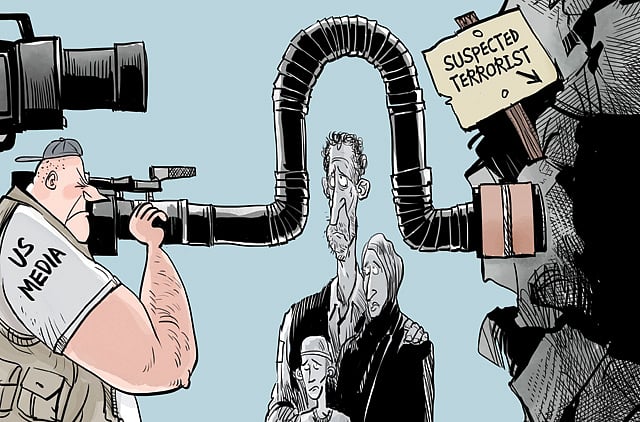
Yemen is only a ‘news story’ if ‘western interests’ are threatened. However, there is more to this country than this simplistic narrative. It is a country that goes back to the early traces of human civilisation and has now been reduced to that of a safe haven for Al Qaida militants in the imagination of the media. But the oversimplification of Yemen should not be merely understood as another example of media impartiality. It is an expression of persistent prejudice that values or devalues human life based on economic condition, political influence and military might. Yemen is utterly poor with nearly half of its inhabitants dependent on foreign aid. Its government and military are corrupt and hostage to foreign edicts. The lives of Yemenis do not even register on a western media scale.
In the media, news about Yemen appears and wanes based on its relevance to western powers. “In Yemen today, the US embassy is closed to the public. Officials are telling CNN there is credible information of a threat against western interests there,” read a CNN news anchor on the May 8 news bulletin. This is CNN’s Yemen. It is a Yemen that seems to exist for one single purpose and nothing else: Maintain western, and by extension, US interests in that part of the world. When these interests are threatened, only then does Yemen matter.
Every reference in that specifically tailored discourse serves a purpose. It is as if Al Qaida in the Arabian Peninsula (AQAP) exists to justify US military intervention and unending drone war. In April, 63 Yemenis were reportedly killed in US drone strikes allegedly targeting Al Qaida. No credible verification of that claim is available and none of the victims have been identified. We are told that “Signature” drone strikes do not require identification. It could take months, if ever, before rights groups shed light on the April killings, which are a continuation of a protracted drone war.
Even media that appears to be challenging the dominant narrative is partaking in the reduction of the Yemen story. Hunting Al Qaida: America’s Epic Yemen Fail, was published in the Daily Beast on May 15. At first glance, it seemed as if the article was questioning the wisdom of the protracted war on Yemen. It was not. It bashfully pushed the line that the US must do more to help Yemen using the same strategy of winning ‘hearts and minds’, the same intellectual refuse applied in Iraq and Afghanistan in total failure.
Few in the media will tell you that it is this mindset of ‘hunting’ militants that keeps pushing people over the edge. When people are subjected to extreme poverty and most punishing violence, the general reaction cannot possibly be the embracing of one’s poverty or one’s enemies. Yemen is no exception.
However, Yemen ‘experts’ in the West reject to acknowledge such a fact, as their views alternate between blindly supporting the ongoing US war in Yemen and pushing for balancing bullets with aid. These views are not driven by a lack of vision, but by the understanding that leaving Yemen to the Yemenis is not on the American agenda, as has been the case for years.
‘War on terror’
Even the very geography of Yemen is somehow defined in terms of interests. On May 7, when militants reportedly bombed an oil export pipeline, halting the crude flow that travels between the central Maarib Province to the Red Sea, Yemen’s geography precipitously shrunk in media consciousness to be a map that merely borders and follows the oil pipelines. Those who live, fight, starve and die beyond the confines of the ill-defined western interests often go unreported. Their share of the Yemen map is rarely highlighted. In fact, little was known about Yemen in the US before October 12, 2000, when US naval vessel USS Cole was damaged in a suicide attack, killing 17 US military men. The attack was later blamed on Al Qaida, paving the way for the opportune narrative, which continues to define US involvement in Yemen until this day.
The US “war on terror” had in fact reached Yemen even before the war in Iraq was unleashed a few years later. The people of that poor, divided, corruption-laden country were punished severely for crimes they did not commit. The reason that the “war in Yemen” has never morphed into a “war on Yemen” is because the ruling class of that country found a way to coexist with the ever prevalent US interests, including their violent dimensions. Just as the US began its military push against Yemen, the then president Ali Abdullah Saleh introduced a referendum to modify the constitution in order to boost his political power and extend his mandate.
Washington, however, did not seem to mind. Saleh knew the price expected of him to ensure the barter. In November 2001, he made a highly choreographed visit to then US president George W. Bush in Washington, declaring that Yemen had officially joined the US “war on terror”. Despite the military hardware, the military strikes, the drone attacks and the piled up bodies of rarely identified victims, the war simply did not exist, although the facts proved otherwise.
Yemen is very poor. It is a country of 25 million, where 54 per cent live below the poverty line and where unemployment among the youth exceeds 60 per cent. Millions of Yemenis are malnourished. Malnutrition levels are the second highest in the world; 4.5 million are food insecure. Nearly half of the country’s children suffer from stunted growth.
Fuelling divisions
Yemen is also politically divided, with a weak central government that is relying on handouts and support from its rich Arab neighbours and western countries. Abd Rabbo Mansour Hadi, who became President when Yemeni youth overthrew Saleh, appears sincere in his efforts to achieve national accord, between the rebellious north, the secessionist south and the militancy and poverty-infested rest of the country. But the recommendations and agreements that were adopted by the National Dialogue Conference, which concluded in January 2014 after 10 months of intense discussions, is unlikely to bear fruit if Yemen’s sovereignty is in the hands of outside forces, the US notwithstanding.
There is no denial that the problems of Yemen are not entirely invited by outside powers. These powers, however, fuel the country’s divisions and exploit its many weaknesses for their own suspect reasons.
But why are we so hesitant to tell the Yemen story as it is — with all of its complexities and details? Are we intimidated by the sheer intricacy of the story? Or is it because we remember Yemen whenever it is convenient to do so?
Long before Al Qaida came into existence and long after it is gone, Yemen will subsist, survive and hopefully someday prosper once the suppressed energies of its spirited youth is unleashed. Until then, it behoves the media to tell the story of Yemen with a degree of integrity and humanity.
Sign up for the Daily Briefing
Get the latest news and updates straight to your inbox
Network Links
GN StoreDownload our app
© Al Nisr Publishing LLC 2026. All rights reserved.