Five UAE destination stays where the hotel is the whole reason to go
Five places where the building is the trip, not the bed you return to at the end of it
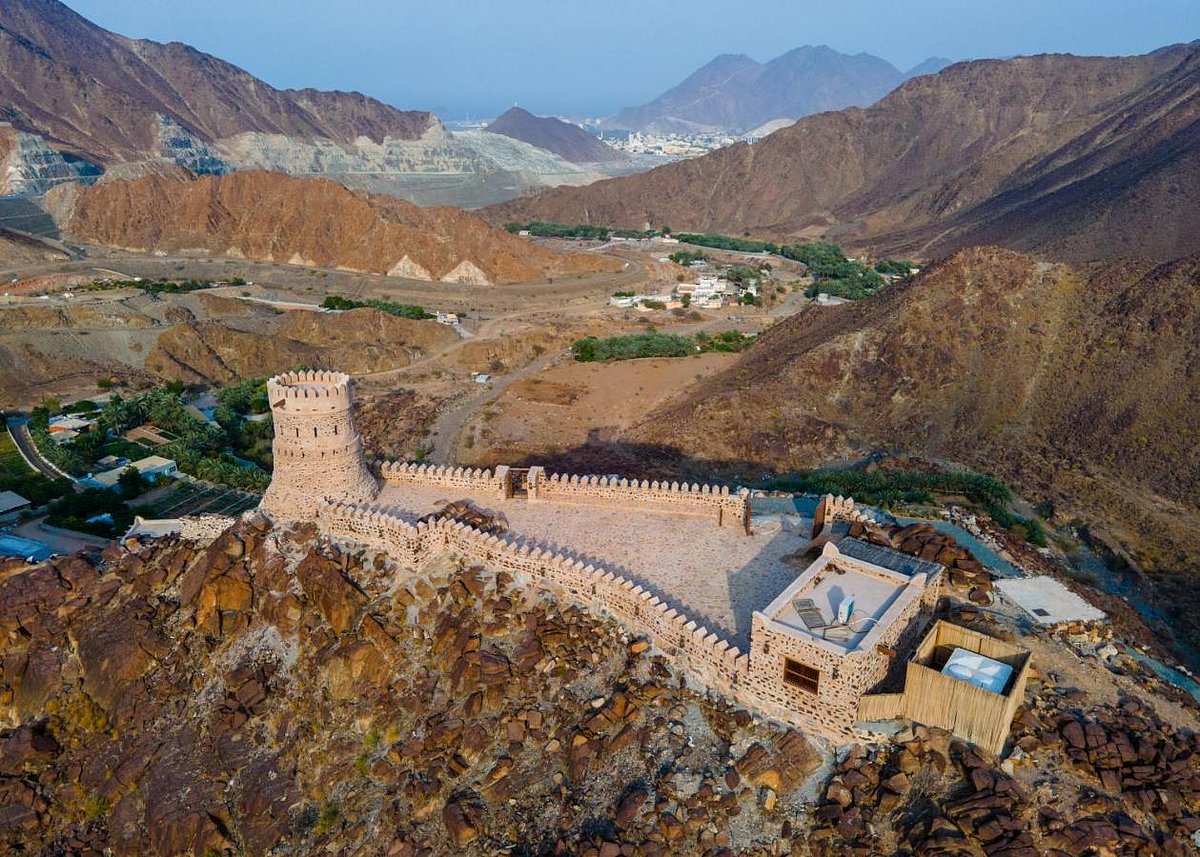
A destination stay is one where the hotel is the reason for the trip, not the base for it. You do not book it because it is near an attraction. The building is the attraction. You check in and the trip has already started.
There is a particular kind of building that refuses to behave like a hotel. It was something else first, or it sits somewhere nothing should sit, or it was built to look like a thing that no longer exists.
The UAE has more of these than its reputation suggests. Past the glass towers and the beach resorts, there is a Cunard liner tied up in Port Rashid, a 1960s grocery shop turned into a five-room lodge under a mountain, a village in the Hajar range that people left and someone else brought back, a line of tents on a beach in Kalba where the mangroves start, and a fort in the Empty Quarter that was finished in 2009.
Five stays, five landscapes, and not a single one of them built in the shape you would expect.
Queen Elizabeth 2, Port Rashid, Dubai
She was launched on the Clyde in 1967 and she still looks it. Thirteen decks, a black hull, the funnel, the sheer length of her against the low buildings of Mina Rashid. From the dock she reads as a ship that has stopped rather than a hotel that happens to float.
Inside, the QE2 keeps the language of the sea. Corridors run long and narrow with low ceilings and handrails at the walls. The stairwells are tight. Teak and brass appear where you would expect carpet and chrome. There are 447 rooms and suites across the decks, and the small square windows in the cheaper ones are the same portholes that looked out on the North Atlantic for nearly forty years.
The ship crossed between Southampton and New York for most of her working life. She was requisitioned in 1982 and carried troops to the Falklands. She was retired in 2008, bought by Dubai, and then sat for years while people argued about what to do with her. The restoration eventually ran to roughly 2.7 million person-hours.
What survived is the good part. The Golden Lion is a British pub of the kind that does not really exist any more. The Queens Grill still has its dining room. There is a theatre, a spa, an indoor pool, and a heritage tour that takes you up to the Captain's Bridge and through the Boat Deck, where the ship's own story is laid out deck by deck.
Why it is a destination stay: you are not staying near history, you are sleeping inside it. For the length of the stay you live the way passengers lived in 1969, walking the same decks, eating in the same rooms, waking up behind the same porthole. The city outside is optional.
When: year-round
Where: Mina Rashid, Port Rashid, Dubai
Price: from around Dh150 on promotional rates
Al Faya Retreat, Mleiha, Sharjah
Drive inland from Dubai for about an hour and the sand turns red. Fossil Rock rises out of it. At the foot of Mount Alvaah, near the site of the country's first petrol pump, there are two low stone buildings and a strip of tarmac, and that is the hotel.
The buildings went up in the 1960s. One was a clinic. The other was a grocery shop. In 2019 the architect Jonathan Ashmore and his practice Anarchitect turned them into a five-bedroom lodge and a restaurant, and added a third building for a spa.
The design does not pretend the old buildings are new. Corten steel, which rusts to a deep orange and then stops, marks everything that was added. The original stone stays visibly original. Teak, aluminium and plastered render do the rest. Ashmore has talked about choosing materials for a site that gets sandstorms, driving rain and cold nights as well as heat, and about iron having a long history in the region.
Each of the five rooms has a skylight cut into the ceiling for looking at stars from the bed. The luxe room gets its own roof terrace.
The spa is the strangest and best part. There is no staff in it. Guests use it themselves: an open-air saltwater pool, a heat room, a tropical shower walk and a salt inhalation room with glass running floor to ceiling, so the desert is the view while you sit there breathing.
Why it is a destination stay: with five rooms and nothing around it, the building has to be the entire experience, and it is built to be. There is no town to wander into and no attraction to drive to. You come to sit inside a piece of architecture in the middle of red sand and watch the light change on it.
When: best between October and April
Where: Mount Alvaah, Mleiha, Sharjah
Price: rates vary by season, book direct
Najd Al Meqsar, Khorfakkan, Sharjah
The road up into the Khorfakkan mountains climbs hard, and then there is a village on a ridge.
Seven stone houses, built in the kareen style from silt and stone with thatched roofs and hand-cut wooden beams, some of them more than a century old. People lived here, then left. The houses stayed. They have been restored into seven rooms, one per house, and the whole place is adults only.
The restoration keeps the rough surfaces. Stone walls stay stone. Rugs, vintage handicrafts and low furniture sit against them, and each house has an outdoor seating area facing out across the mountain passes and the wadis below. Wishi, the restaurant, has a terrace that does the same.
The site sits within the Wadi Shie archaeological area, which gives the place a longer timeline than the buildings themselves.
Why it is a destination stay: you do not get a room here, you get a house, and the houses together make a village. For a night or two you are living in a mountain settlement the way people did before it emptied out, with your own front door, your own roof and nobody on the other side of the wall.
When: October to March, when the mountains are cool
Where: Khourfakkan Road, Khorfakkan, Sharjah
Price: from around Dh460
Kingfisher Retreat, Kalba, Sharjah
You arrive by boat, which sets the tone.
Kalba sits on Sharjah's east coast, on the Gulf of Oman, where one of the oldest mangrove forests in Arabia meets the sea. The retreat is twenty tents along that stretch, each with a private plunge pool, arranged so the beach is on one side and the wetlands on the other.
The mangroves are protected, and the wildlife is the reason the place exists rather than a bonus attached to it. Sea turtles come to the water. The wetlands hold rare birds, including the kingfisher the retreat is named after. Guests kayak through the channels, birdwatch, cycle, do archery, or sit still.
The tents are properly built, not canvas gestures, with the interiors finished in the muted tones that run through the whole Sharjah Collection. Meals are arranged rather than served on a schedule.
What makes it different from the desert properties is the sound. Water, birds, wind through the mangroves. It is the only one of the five where the landscape is loud.
Why it is a destination stay: the reserve decides how the day goes. Tides, light and birds set the timetable rather than a restaurant booking, and because you came in on a boat, leaving is not a casual decision. You live at the pace of a wetland for as long as you are there.
When: November to March
Where: Kalba, east coast of Sharjah
Price: rates vary by season, book direct
Qasr Al Sarab, Liwa, Abu Dhabi
Two hours south of Abu Dhabi city the dunes get serious. This is the Liwa Oasis, on the northern edge of the Rub' al Khali, and some of the sand here rises 250 metres.
Qasr Al Sarab appears out of it as a sand-coloured fort. Turreted gates, a central tower, then walls, courtyards and balconies running out on either side for close to a mile. Hirsch Bedner Associates designed it. It opened at the end of 2009 after three years of building.
It is not old and does not claim to be. The reference is the historic forts of the region, rendered in earth tones and local materials, and the effect at distance is a building that looks like it grew out of the dune it sits on.
There are 206 rooms, suites and villas. The deluxe rooms start small by desert-resort standards, at around 45 square metres, with balconies or ground-floor terraces looking out at sand. The pool villas run much larger, with plunge pools, sun decks and butler service, and the Royal Pavilion villas sit apart from the main building entirely.
Dining is spread across the site: Al Waha for Middle Eastern and international food, Suhail on the rooftop for the view, Ghadeer by the pool, and Al Falaj, which is set up as a Bedouin camp with cushions around a fire.
The activities are the obvious desert list, camel trekking, dune driving, archery, falconry. The reason to come is simpler than any of them. There is almost nothing else out there.
Why it is a destination stay: it is a two-hour drive to the nearest anything, so the resort has to function as a small settlement, and it does. Food, water, shade, entertainment and a way out into the dunes all come from inside the walls, which is exactly how a fort in the Empty Quarter was always supposed to work.
When: October to April
Where: Qasr Al Sarab Road, Liwa Desert, Abu Dhabi
Price: from around Dh955 on seasonal offers
Five buildings, and only one of them was designed to be a hotel from the start.
Sign up for the Daily Briefing
Get the latest news and updates straight to your inbox
Network Links
GN StoreDownload our app
© Al Nisr Publishing LLC 2026. All rights reserved.