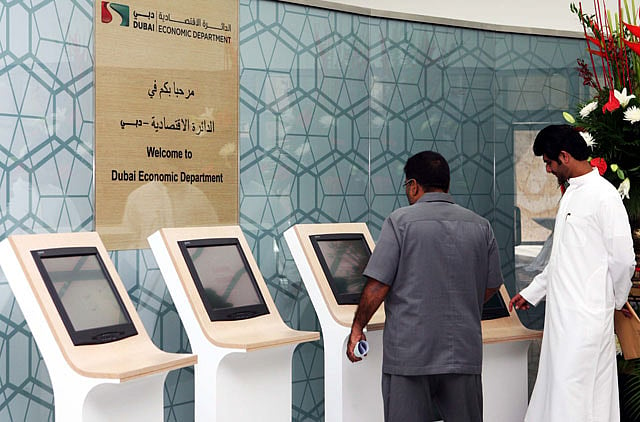
Dubai: The UAE improved its global ranking by two to reach 33 this year in the World Bank's annual Doing Business report published yesterday.
The new report by the World Bank and the International Finance Corporation (IFC) — Doing Business 2012: Doing Business in a More Transparent World — assesses regulations affecting domestic firms in 183 economies.
The report finds that 11 out of 18 economies in the Middle East and North Africa improved regulations for entrepreneurs in the past year, despite political and econ-omic uncertainty in the region.
"Saudi Arabia remained the regional leader with a ‘Global ease of doing business' ranking of 12. Qatar implemented its first reforms since 2005 and climbed to 36 on the global scorecard by improving its credit information system. The UAE further streamlined the requirements for business start-up, and improved its ranking to 33," the report said.
Electricity connections
The report ranks the economies in 10 areas of business regulation such as starting a business, resolving insolvency, and enforcing contracts.
The study's methodology expanded this year to include indicators for getting electricity connections.
The report finds that six of the region's 18 business regulatory reforms measured made it easier to start a business.
For example, Jordan reduced the minimum capital required to start a company, and Oman's new one-stop shop for entrepreneurs cut business registration time from seven days to three.
"[The] GCC needs to enhance micro-level information and knowledge sharing so that the individuals, firms and other related stakeholders can be well-informed about the privileges of the GCC Common Market," Dr Amzad Hussain, professor of economics at Al Ain University, told Gulf News.
"This in turn will enhance cross-border investment. It is to be noted that the GCC Common Market creates a single environment [that] provides citizens with equal rights and privileges: rights to move, settle, work, social protection, retirement, health, education and social services. It also calls for unrestricted economic activities, ownership of property and equity, movement of capital, and similar tax treatment."
Jitendra Gianchandani, investment adviser and chairman of Jitendra Consulting Group, said: "At present, [the biggest] challenge for all Arab countries [is creating] jobs for their citizens. Over the next decade or so, [the] population of [the] Arab world will reach 150 million or so."
"However, some Arab countries are not oil-rich countries. One method of rapidly creating a sustain-able increase in employment is through expansion of labour-intensive manufacturing or services exports."
New data show that the region can improve access to information on business regulations. "The region's entrepreneurs can be empowered by stronger institutions and better access to information," said Neil Gregory, senior manager, Global Indicators and Analysis, World Bank Group.
"In more than half of the region's economies, an entrepreneur must meet with an official to get fee schedules or documentation requirements for many business procedures. E-government initiatives, the global trend, can help relieve bureaucratic burdens on entrepreneurs by offering transparent and sustainable solutions."
Morocco improved its business regulation the most compared to other global economies, climbing 21 places to 94, by simplifying the construction permitting process, easing the administrative burden of tax compliance, and providing greater protection to minority shareholders.
Since 2005, Morocco has implemented 15 business regulatory reforms. Over the last six years 17 economies in the Middle East and North Africa have made their regulatory environment more business-friendly.
"Making business regulations more efficient and accessible increases opportunities for economic growth," said Augusto Lopez-Claros, director, Global Indicators and Analysis, World Bank Group. "By helping businesses get started, the economies of the Middle East and North Africa can offer hope to entrepreneurs, who are the engine behind job creation."
The global report shows that governments in 125 economies out of 183 measured, implemented a total of 245 business regulatory reforms — 13 per cent more reforms than in the previous year. In sub-Saharan Africa, a record 36 out of 46 economies improved business regulations this year. Over the past six years, 163 economies have made their regulatory environment more business-friendly.
Most improved
China, India, and the Russian Federation are among the 30 economies that improved the most over time.
This year, Singapore led on the overall ‘Ease of doing business', followed by Hong Kong, China; New Zealand; the United States; and Denmark. The Republic of Korea was a new entrant to the top 10.
The 12 economies that have improved the ease of doing business the most across several areas of regulation as measured by the report are Morocco, Moldova, the former Yugoslav Republic of Macedonia, São Tomé and Príncipe, Latvia, Cape Verde, Sierra Leone, Burundi, the Solomon Islands, the Republic of Korea, Armenia, and Colombia. Two-thirds are low-income or lower-middle-income economies.
"At a time when persistent unemployment and the need for job creation are in the headlines, governments around the world continue to seek ways to improve the regulatory climate for domestic business. Small and medium businesses that benefit most from these improvements are the key engines for job creation in many parts of the world," Lopez-Claros said.
Dubai The UAE is trying to bring all free zones under one umbrella by creating a council of free zones, according to Jitendra Gianchandani, chairman of Jitendra Consulting Group.
"But the World Bank doesn't consider free zones for ranking purposes. So it will not help much in improving the ranking of the UAE," he says.
There are a number of factors that are considered in this report — cross-border trade, dealing with construction permits, registering property, where you have to improve in order to attract more long-term investors to sustain economic growth. "The UAE should speed up the reforms, such as: investment protection and Insolvency Law.
Saudi experience
Saudi Arabia started reforms to improve the business environment long ago and its overall rank in Ease of Doing Business is better compared to the UAE. Saudi Arabia is scoring better in almost all the key indicators, such as protection of investors, insolvency law, starting a business, etc, he explains. He said the UAE should speed up the reforms, such as investment protection and Insolvency Law, to improve its ranking. Getting credit for SMEs is still challenging in the UAE. Banks should start lending. This will boost investor confidence.
"For the formation of limited liability companies (LLC), the UAE should consider linking immigration and labour services with licensing, similar to what is done in the free zones. The free zones operate as a single window. Why can't the Department of Economic Development (DED) officer the same?," he asks.
New data show that improving access to information on business regulations can aid entrepreneurs. Fee schedules and documentation requirements are most easily accessible in Organisation of Economic Cooperation and Development (OEC)D economies and least accessible in Sub-Saharan Africa and the Middle East and North Africa. However, e-government initiatives are on the rise. "More than 100 economies use electronic systems for services ranging from business registration to customs clearance to court filings," said Sylvia Solf, lead author of the report.
Sign up for the Daily Briefing
Get the latest news and updates straight to your inbox
Network Links
GN StoreDownload our app
© Al Nisr Publishing LLC 2026. All rights reserved.