US-Iran peace efforts continue; Saudi Arabia reports 3 killed in Riyadh airport attack
Trump delays strikes on Iran, Strait of Hormuz remains a conflict hotspot
Highlights
We are closing this live coverage. For the latest updates, click here.
UAE condemns Houthi attacks on Saudi airport, Saudia aircraft
The UAE has strongly condemned Houthi attacks on Saudi Arabia’s King Khalid International Airport and a Saudia aircraft, which killed three Saudi nationals and injured several civilians.
The Ministry of Foreign Affairs reaffirmed the UAE’s solidarity with Saudi Arabia and support for measures to protect its security and stability, while extending condolences to the victims’ families and wishing the injured a speedy recovery.
US Treasury temporarily allows Russian diesel imports
US President Donald Trump said Friday that he had secured Russian leader Vladimir Putin's agreement to release diesel into US and global markets, vowing this will help cool surging energy costs amid war with Iran.
"Russia will immediately supply over 300,000 Tons of Diesel Fuel to the American and Global Marketplace, another 500,000 Tons during the month of November," Trump said on social media following talks with Putin.
The US Treasury Department added that it is issuing a temporary license for Russian diesel to flow to global markets.
US forces redirect 133 commercial vessels: CENTCOM
US Central Command (CENTCOM) said on October 9 that US forces had redirected 133 commercial vessels to ensure compliance with restrictions imposed in the region.
The command shared the update on social media but did not provide further details about the vessels or their destinations in the statement.
Trump says Iran conflict will end soon, predicts oil price drop
US President Donald Trump has said the conflict involving Iran will end soon, claiming a US naval blockade and military operations have severely weakened Tehran’s military capabilities.
Trump also predicted a sharp fall in oil prices once the conflict ends, saying petrol prices in the United States could return to $1.85 to $1.95 a gallon.
The President defended US strikes on Iranian nuclear facilities, insisting Tehran would not be allowed to acquire nuclear weapons. However, he did not announce a ceasefire or provide a timeline for ending the conflict.
Iran Guards say struck tanker transiting Hormuz via 'illegal route'
Iran's Revolutionary Guards said on Friday that they had struck a tanker attempting to take an "illegal route" through the Strait of Hormuz, which Tehran has sought to blockade since the outset of the Middle East war.
Iranian forces "have taken control of the administration of the strait", the Guards said in a statement carried by the state news agency IRNA.
"In carrying out this mission, a few hours ago, a giant LPG carrier named NV Sunshine, owned by NatWit, which was attempting to transit via the illegal route south of the Strait of Hormuz, was struck".
Strait of Hormuz shipping down 75%, UKMTO says
Shipping through the Strait of Hormuz remains around 75 per cent below pre-conflict levels, with maritime attacks, security threats and navigation interference continuing to disrupt commercial vessels, according to a UKMTO report published on October 9.
Here are the key developments:
Shipping traffic: 129 outbound and 146 inbound transits were recorded over the past seven days.
Vessel attacks: 11 attacks were reported in a week — 10 in the Strait of Hormuz and one in the Arabian Gulf.
Damage to vessels: Seven of the 11 vessels attacked in the Strait sustained minor damage but continued their voyages.
Route risks: Since July 6, 41 of 59 commercial shipping incidents in the Strait have occurred along the southern route.
Threat levels: The risk remains severe in the Strait of Hormuz and moderate in the Arabian Gulf and Gulf of Oman.
Navigation interference: UKMTO recorded nine GNSS interference reports in seven days and 18,881 anomalous AIS positions.
Red Sea and Gulf of Aden: No attacks were reported in the defined reporting area during the latest seven-day period, although security risks remain.
Piracy: 41 piracy-related incidents have been recorded in the Gulf of Aden, Arabian Sea and off the Somali coast this year. One vessel remained under pirate control as of October 7.
The report highlights the continued challenges facing commercial shipping, as vessels navigate security threats, disrupted routes and unreliable navigation signals across key regional waterways.
Riyadh attack prompts fresh EASA airspace warning
The European Union Aviation Safety Agency (EASA) has advised airlines against operating in additional areas of Saudi Arabian airspace following the Houthi attack on Riyadh airport.
In an update to its September 30 conflict zone bulletin, the regulator said recent attacks had demonstrated the Houthis’ capability and intent to strike targets deeper inside Saudi Arabia, including the capital, Riyadh.
US Embassy in Jordan issues security warning
The US Embassy in Jordan has urged American citizens across the region to exercise caution amid escalating tensions linked to the conflict involving Saudi Arabia and the Houthis.
The embassy warned of possible flight cancellations, airspace closures and travel disruptions, advising US citizens to remain alert to changing conditions.
It also cautioned that Iran and its allies could target US interests overseas, including American businesses and institutions, as well as locations associated with the United States and its citizens.
The embassy urged Americans to monitor security updates from the Jordanian government and follow official instructions, including alerts issued through sirens and other warning systems.
It also advised citizens to keep track of travel advisories and guidance issued by US embassies.
Get updated faster and for FREE: Download the Gulf News app now - simply click here.
Pakistan says its troops in Saudi Arabia are in a defensive role
Pakistan’s Foreign Ministry said Pakistani forces are already deployed in Saudi Arabia and are there in a defensive capacity, as Islamabad reaffirmed its backing for the kingdom after a series of Houthi attacks on Saudi airports. Prime Minister Shehbaz Sharif condemned the strikes on King Khalid International Airport in Riyadh and Abha International Airport, saying Pakistan stands firmly with Saudi Arabia under the Mecca Joint Defence Agreement and supports its right to protect its people, cities and critical infrastructure. According to Reuters, Pakistan’s military deployment is being presented as defensive support rather than involvement in offensive operations in Yemen.
Iran president says peace talks will only succeed without 'pressure, threats'
Iranian President Masoud Pezeshkian said Friday at a regional summit in Turkmenistan that peace negotiations will only succeed without "pressure and threats", with the months-long Middle East war locked in a stalemate.
"Dialogue holds meaning and a chance of success only when based on mutual respect and mutual commitments, and when devoid of pressure and threat," he said during his speech at the Commonwealth of Independent States (CIS) summit.
US urges Americans in Middle East to stay vigilant
The US Mission to the UAE has urged Americans in the Middle East to exercise heightened vigilance, citing a complex security environment and the risk of flight cancellations, airspace closures and travel disruptions. In a post on X, the mission said Iran-backed Houthis have carried out attacks on Saudi Arabia, including on civilian airports and critical infrastructure, causing civilian casualties, and warned the hostilities could escalate rapidly. It advised Americans travelling to and from the region to monitor airport and airline updates, adding that Iran and groups supportive of it may target US interests overseas, including American businesses and institutions.
Three Saudis killed in Houthi attacks on Riyadh airport
Saudi Arabia’s General Authority of Civil Aviation (GACA) said King Khalid International Airport in Riyadh was targeted in two attacks on Thursday, October 8. The first hit airport facilities, while the second struck a Saudi Arabian Airlines (Saudia) aircraft. Three Saudi nationals were killed and several Saudi citizens and residents of various nationalities were injured, with injuries ranging from minor to serious. The injured were taken to hospital for treatment, and the attacks also caused some material damage. GACA said emergency teams and the relevant authorities responded immediately in line with approved emergency plans.
Kuwait Army disposes of shrapnel, explosive remnants
Kuwait’s Army General Staff said its inspection and disposal team from the Land Force Engineering Branch would handle remnants of shrapnel and explosives on Friday, October 9, from 5am until 7am. In a post on X, the army said any sounds of explosions heard during this period would be the result of the disposal operation.
UK strongly condemns Houthi militia attacks on Abha, King Khalid airports
The United Kingdom strongly condemned the attacks targeting infrastructure at Abha International Airport and King Khalid International Airport, which resulted in several casualties and injuries among citizens and residents.
In a statement issued yesterday, the UK's Foreign, Commonwealth and Development Office (FCDO) affirmed that the United Kingdom stands alongside Saudi Arabia in the face of reckless attacks by the Houthi militia.
Libya condemns continued Houthi attacks on facilities in Saudi Arabia
The Ministry of Foreign Affairs and International Cooperation of the Libyan Government of National Unity has condemned the Houthi militia's continued targeting of civilian and economic facilities in the Kingdom of Saudi Arabia. The ministry strongly denounced the attacks, which targeted Abha and King Khalid airports, causing casualties and injuries among citizens and residents.
In a statement issued yesterday, the Libyan Foreign Ministry affirmed Libya's full solidarity with the Kingdom and its support for all measures taken to defend its territory, ensure the safety of its citizens and residents, and protect its national assets.
The ministry affirmed that targeting civilian infrastructure and endangering innocent lives constitutes a flagrant violation of international law and international humanitarian law, underscoring that these attacks represent a dangerous escalation threatening the Kingdom's security and stability.
The ministry reiterated its categorical rejection of all forms of violence, affirming its backing of international efforts aimed at de-escalation and consolidating regional security and stability.
The ministry emphasized Libya's steadfast support for the Kingdom in confronting attacks directed against its civilian and economic facilities and the safety of its citizens and residents.
CENTCOM briefs shipping partners as Hormuz traffic picks up
US Central Command (CENTCOM) held a virtual briefing with international shipping partners on the Strait of Hormuz on Thursday, saying momentum is building for freedom of navigation as commercial traffic through the waterway increases. In a post on X, CENTCOM said its commander, Admiral Brad Cooper, thanked industry leaders and other US government agencies for their support, and acknowledged the sacrifices made by civilian crews affected by what it described as unwarranted Iranian attacks
Asian stocks mixed amid AI concerns, oil dips after surge
Asian stocks headed into the weekend on a mixed note on Friday with tech weighed by renewed concerns about the AI investment boom, while support came from a drop in oil prices after Donald Trump ruled out a pre-election strike on Iran.
The outlook for artificial intelligence has provided a fresh boost to the tech sector in recent weeks, with some optimism for the upcoming earnings season. Chip titan Nvidia this week hit a record high and closed in on the $6 trillion market capitalisation.
That was dealt a blow by a Financial Times report saying OpenAI, the maker of ChatGPT, expected to make $50 billion in annualised revenue this year, far less than the $70 billion flagged previously.
Iranian intelligence targeting US bases in Germany: report
German business weekly WirtschaftsWoche reported that Iranian intelligence services are focusing on US military installations in Germany —especially Ramstein Air Base and Spangdahlem Air Base — amid fears of possible covert attacks tied to the ongoing Iran conflict.
The report, citing several unnamed Western intelligence officials, said Israel warned US and German partners about three weeks ago of a potential threat, with concern centered on bases that support American operations and logistics linked to the Iran war.
Ramstein Air Base hosts the headquarters of US Air Forces in Europe – Air Forces Africa and NATO Allied Air Command, making it a key command, control, and logistics hub for US and allied air operations. Spangdahlem Air Base is a major NATO air base that has supported US fighter deployments and strike operations in Europe and beyond. Both are viewed as critical nodes for projecting US air power and sustaining operations tied to the Iran conflict, which is why they feature in threat assessments.
Iran reviews US response to 7-day plan: Araghchi
Iranian Foreign Minister Abbas Araghchi has said that Tehran was reviewing Washington’s response to its proposed “seven-day plan” to reopen the Strait of Hormuz and would reply within the next few days.
“The negotiation process is still ongoing, and messages are being exchanged through mediators,” Araghchi said, according to Iran’s official IRNA news agency.
The proposal calls for Washington to take agreed steps during the first four or five days, allowing normal navigation through the strategic waterway to resume on the 6th day and negotiations on a broader agreement to begin on the 7th. Iran’s demands include an end to hostilities, the release of frozen Iranian assets, the lifting of restrictions on Iranian oil exports and the termination of the US naval blockade of Iranian ports.
The diplomatic exchange comes as US President Donald Trump said Washington was holding “productive discussions” with Tehran and would not resume attacks on Iran before the November 3 US midterm elections.
However, the US blockade remains in place, and Washington has imposed fresh sanctions targeting Iran’s oil-shipping networks.
The outcome, however, will depend on whether Washington and Tehran can reconcile their competing demands over maritime access, sanctions, security and Iran’s nuclear programme.
Hegseth says US not seeking nation-building or ground occupation in Iran
US Secretary of War Pete Hegseth said Washington does not seek nation-building or a ground occupation in Iran, but warned that any military action ordered by President Donald Trump would be “swift and decisive”.
In an interview with Real America’s Voice aboard the USS Abraham Lincoln, Hegseth said Washington's goal was to prevent Iran from acquiring nuclear weapons. He warned Tehran it could take the “easy way or the hard way”, adding that the decision ultimately rested with Trump.
Hegseth has previously declined to rule out deploying US forces inside Iran.
'Productive' talks with Iran underway: Trump
US President Donald Trump said Washington was holding “productive discussions” with Iran and pledged not to attack the country before the November 3 US midterm elections. His statement signals a possible diplomatic opening, though it does not mean a peace deal or ceasefire has been reached.
Trump made the announcement on Truth Social on Thursday, October 8, saying the US would not attack Iran before the November 3 midterm elections. The statement came amid continued indirect negotiations over ending the war, which began in February 2026 with US and Israeli strikes on Iran.
The announcement may reduce the immediate risk of another US attack before the elections, but it does not establish a ceasefire or guarantee a diplomatic settlement. The war and disruption to shipping through the Strait of Hormuz continue to threaten energy supplies and keep oil prices volatile.
Iran’s southeast rocked by four attacks: over 12 security personnel killeds
More than a dozen Iranian military and police personnel were killed or wounded in four armed attacks across southeastern Iran within 24 hours, the Baluch rights group Haalvsh reported Thursday.
The attacks occurred between Wednesday and Thursday in Nikshahr and Nosratabad in Sistan-Baluchestan province, as well as Faryab and Jalq.
In Nikshahr, Mohammad Reza Okati was killed and five other personnel wounded when two vehicles carrying military personnel came under attack, Haalvsh reported as cited by Iran International. Iran’s army separately confirmed Okati’s death and said three others were wounded.
In Nosratabad, Haalvsh reported at least three personnel killed and two wounded, identifying two of those reportedly killed. Iranian police separately confirmed the death of one officer. Major Mehdi Jamshidi was shot dead while travelling in a private vehicle in Faryab, according to Haalvsh.
The group also reported casualties in an attack on police headquarters in Jalq on Wednesday night, although the final toll remained unverified.
The Popular Fighters Front claimed responsibility for the attacks in Nikshahr, Nosratabad and Jalq, Haalvsh said. The group had not claimed responsibility for the killing in Faryab.
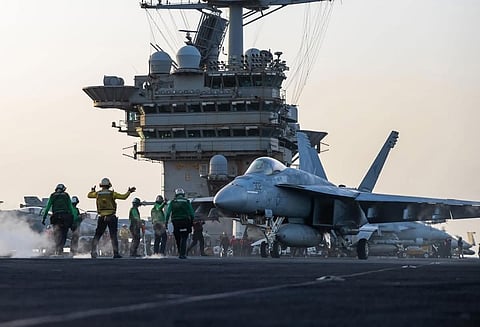
USS Lincoln back in home port after troubled Gulf deployment
The USS Abraham Lincoln aircraft carrier, whose lengthy deployment in the Gulf supporting President Donald Trump's war on Iran sparked fears for the health of its huge crew, arrived back in its home port Thursday.
Families of servicemen and women lined the quayside in San Diego, California, to welcome home loved ones they have not seen for almost a year.
The massive nuclear-powered warship left California in November 2025 for duty in the South China Sea and was rerouted to the Middle East before US-Israeli attacks on Iran that began in late February.
Putin tells Iran leader will 'do everything' to help end war
Russian President Vladimir Putin held talks with Iranian counterpart Masoud Pezeshkian on Thursday and promised to "do everything" to help end the Middle East conflict, Russian news agencies reported.
"We are ready to do everything that is in our power to contribute to the settlement of this situation," said Putin ahead of a regional summit in the Central Asian nation of Turkmenistan, adding that Iran had made "real efforts to end the war" since US-Israeli attacks started on February 28.
Putin noted the "positive evolution" in relations between Iran and Russia.
The two have reinforced diplomatic and military links since Russia launched its offensive in Ukraine in February 2022, becoming increasingly reliant on each other.
Both leaders arrived Thursday evening ahead of the summit of the Commonwealth of Independent States (CIS) - a grouping of former Soviet nations - in the resort of Avaza on the Caspian Sea.
The presidents last met on the sidelines of the Shanghai Cooperation Organisation summit in Kyrgyzstan in September.
Ukraine and Western countries have accused Iran of supplying Russia with Shahed drones and short-range missiles for use in the military campaign.
Russia has been accused of supplying targetting data to Iran for its strikes on US interests in the Middle East.
The meeting came as talks between Tehran and Washington appear to be at an impasse. Pezeshkian said this week that negotiations with Washington were "meaningless".
US‑Israel war on Iran: Recent developments
Day 223: Trump: No Iran attack before midterm elections
Day 222: Trump warns US may finish Iran war in a ‘not-so-nice’ way
Day 221: Iran warns US, Israel: Response to attack will be ‘devastating’
Day 220: Mecca Alliance could be 'NATO of Mid-East’ vs Houthis
Day 219: Trump weighs ‘easy or hard’ option as Iran holds firm
Day 218: Iran's IRGC warns US of 'more lethal' response
Day 217: US sends 9,000 more troops, third carrier to Middle East
Day 216: US sends 9,000 more troops, third carrier to Mid-East
Day 215: Iran says received US response to its proposal to end war
Day 214: Iran threatens strikes as it awaits US response to Hormuz plan
Day 213: Iran supreme leader says US will be forced out of Middle East
Day 212: Trump expects talks with Iran to resume in coming week
Day 211: US military activity surges around Strait of Hormuz


