UAE launches nationwide anti-drug campaign, urges families, schools to take part
National Drug Enforcement Authority unveils new identity, social handles, unified drive
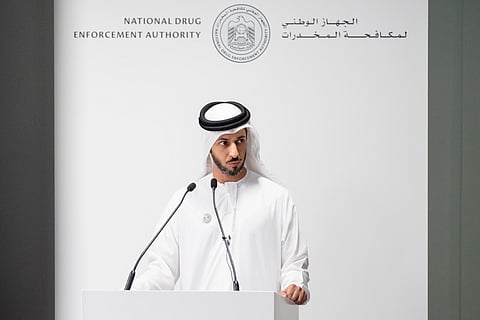
Dubai: The UAE on Wednesday launched a landmark national campaign against drug abuse and trafficking during which experts warned that organised criminal networks were deliberately targeting the country's youth.
The campaign was announced by Sheikh Zayed bin Hamad bin Hamdan Al Nahyan, chairman of the National Drug Enforcement Authority (NDEA), at an event in Dubai on Wednesday, ahead of the International Day Against Drug Abuse and Illicit Trafficking, observed on June 26.
Get updated faster and for FREE: Download the Gulf News app now - simply click here.
Sheikh Zayed said the UAE’s fight against drugs is rooted in a core pillar of the leadership’s vision, which places human well-being above all else and prioritises community security and family safety.
To this end, the UAE remains resolute in its efforts to combat drugs through a comprehensive framework of prevention, public awareness and legislation, in addition to law enforcement, treatment and rehabilitation support, he noted.
Sheikh Zayed stated: “The fight against drugs is not the responsibility of a single entity, but rather a shared national and civic duty that requires public awareness, solidarity and collaboration. Safeguarding our people is the foundation for any nation’s progress and stability.”
He noted that the campaign, running under the theme “United as One to Eradicate the Threat,” rests on three pillars: the family as the first line of defence through trust and support; youth empowerment through awareness and informed choices; and schools as key partners in shaping values and behaviour.
He highlighted growing, sophisticated drug threats targeting youth, stressing proactive prevention over reaction, and affirmed the campaign aims to embed awareness in daily life across homes, schools and institutions.
The event carried added significance: it marked the unveiling of the NDEA's new identity. The authority was originally established by the President His Highness Sheikh Mohamed bin Zayed Al Nahyan in August 2025 under the name National Anti-Narcotics Authority (NANA) before being rebranded.
The authority's official social media platforms were also launched at the event, with new handles revealed across major channels.
'We have to destroy them'
The warning from the panel was stark and direct: the UAE, along with other GCC nations, is a target and the threat is intentional.
Dr Khalifa Al Suwaidi, Secretary-General and Executive Director of the Hamdan bin Rashid Al Maktoum Foundation for Medical and Educational Services, recounted a revealing interview he conducted with a drug trafficker in an Arab country as part of his programme, Khatwa (Step).
"I asked him where his market was. He said it is the GCC — they are successful in everything, and we have to destroy them. If we target the youth, we can do that."
Speaking to Gulf News on the sidelines of the event, another panellist, Dr Abdullah Hassan Matar Al Khayat, Awareness and Prevention Adviser at the NDEA, confirmed the pattern.
"Every successful country has people who want to undermine it. Drug trafficking is not just a criminal activity. It can be used to damage societies and economies."
He added that trafficking networks rarely operate alone. "This is not only an individual issue. It is also a crime against society and the country," he said, noting their frequent links to money laundering and wider organised crime.
Another panellist, Brigadier Dr Abdulrahman Sharaf Al Maamari, Director of the Hemaya International Centre at the General Department of Anti-Narcotics at Dubai Police, was equally blunt. "It is a crime against the nation, not just the individual. They put the nation in challenges."
Record global crisis
The campaign comes as global drug use reaches alarming new heights. Major Fahad Abdullah Haikal, Spokesperson for the NDEA, who unveiled the new online platforms of NDEA, cited the United Nations Office on Drugs and Crime's World Drug Report 2025.
The report found that an estimated 316 million people — around 6 per cent of the world's population aged 15 to 64 — used drugs in 2023, marking a 28 per cent increase over the past decade.
The domestic cost is equally sobering. Brig. Gen. Al Ghaffari revealed that rehabilitation treatment costs the government as much as Dh70,000 per person. He highlighted that the bill not covered by insurance but borne entirely by the state.
One umbrella, one mission
The announcement also follows a structural transformation in how the UAE coordinates its anti-drug response. The NDEA will now serve as a central body, bringing all entities involved in prevention, enforcement, rehabilitation and treatment under a single unified framework.
Dr Al Khayat put it plainly. "Today we are unveiling the new identity. The authority is bringing all efforts under one umbrella."
Speaking as a panellist, he called it a long-held national aspiration. "This is a dream — to be able, as a nation, to unify all the efforts of treatment, anti-trafficking and protection for UAE society."
He also highlighted unified database, coordinated decisions and joint measures.
Toll free helpline
The NDEA's toll-free helpline — 80044 — is available to anyone seeking support, with full confidentiality guaranteed. "It is a law that keeps secrecy and privacy, not to punish. We are here to offer all the support that they need,” said Major Haikal.
Dr Mohammed Al Jneibi, Consultant Psychiatrist at the National Rehabilitation Centre in Abu Dhabi, said stigma remains among the biggest barriers to seeking help, particularly in Arab communities. "Confidentiality is the most important factor. We protect the identity of every patient."
He also called for a wider review of treatment capacity. "Yes, we do need more rehab centres," he said.
Paid leave for family members?
Dr Al Khayat was unequivocal: no family is immune. "It could happen to your wife, your husband, your son or your daughter. What matters is that families stay united, remain strong and know how to respond when they see warning signs."
He revealed to Gulf News that he is considering putting forward an initiative that would allow family members to take paid leave from work while supporting a relative through rehabilitation.
"If you take your son or husband to a rehabilitation centre, you need to be involved in the process — visiting, following up and supporting them. Without family support, the journey becomes much harder," he said, stressing that the idea remains under consideration and would require further study and consultation with relevant authorities before any implementation.
Confidence as the cure
Speakers converged on a single truth: the most durable protection against drug abuse is self-confidence and life skills, built long before any encounter with drugs.
Dr Al Suwaidi called for schools to introduce a dedicated life skills subject. "Only when they have confidence can they say no. We need to build confidence among students and train them to refuse."
Dr Al Khayat reinforced the message. "We want people to be able to say 'no'. If somebody tells you to try drugs, even once, you must be confident enough to refuse. If a person lacks confidence, others can exploit that weakness."
Brigadier Dr Al Maamari urged the entire community to see itself as part of the solution, identifying three groups requiring targeted intervention: those already affected by addiction, those at risk — including young people who have lost a parent or lacked proper education — and the broader public.
The campaign, launched in partnership with the UAE Government Media Office calls on families, schools, influencers and institutions to unite.
"If we want to save the next generation, we must work together. Prevention, awareness, rehabilitation and family support all have to go hand in hand,” said Dr Al Khayat.


