The Ash Shaqqah 002 Lunar meteorite is illuminated at the Natural History Museum in Saadiyat Cultural District, in Abu Dhabi.
Touch a piece of the moon in Abu Dhabi: Natural History Museum offers a rare experience
Journey through time at the Middle East's largest natural history museum
Last updated:
4 MIN READ
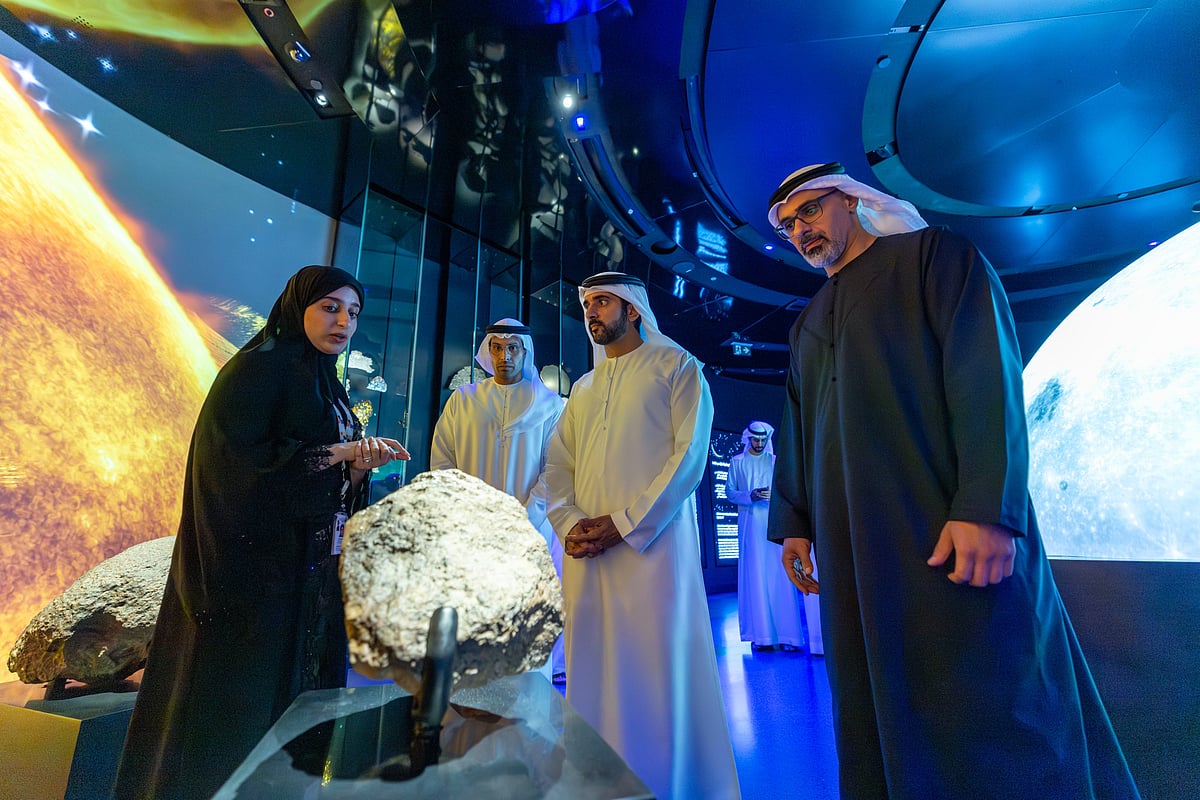
Khaled bin Mohamed bin Zayed and Hamdan bin Mohammed bin Rashid tour Natural History Museum Abu Dhabi, located in the Saadiyat Cultural District.
@DXBMediaOffice/X
Abu Dhabi: There is a piece of the Moon in Abu Dhabi that you are allowed to touch.
It lies in the Story of Earth gallery in The Natural History Museum, and a short text beside it explains that it was thrown off the lunar surface by an asteroid, drawn towards Earth by gravity, and set down in the Libyan desert, where it rested for a very long time before anyone understood what it was.
Only in 2024 was its origin established. It is the largest piece of the Moon that a human hand can lay itself upon, and one is struck by how little the museum has needed to add to make this feel like an event: a cold stone, a hand, and the faint vertigo of knowing where the stone has been.
The Natural History Museum Abu Dhabi, which opened in 2025 on Saadiyat Island, is built on that vertigo. It is the largest museum of its kind in the Middle East, 35,000 square metres of galleries, laboratories and public space on a site of 82,000, designed by the Dutch firm Mecanoo between 2020 and 2022 and realised over the following three years.
It tells a story
The museum tells the story of the natural world from the origins of the universe and the Big Bang to the challenges facing humanity today, including climate change. Visitors can follow this timeline from start to finish.
The tour begins in The Story of Earth. The gallery has an illuminated model of the Sun and displays of meteorites. Here visitors can touch a piece of the Moon, Ash Shaqqah 002.
A man walk past the Ash Shaqqah 002 Lunar meteorite.
The Evolving World is the gallery of the dinosaurs. It is home to Stan, a Tyrannosaurus rex that died 67 million years ago. The museum calls him the last ruler of the Cretaceous. It says the scars on his skull come from a fight with a larger Tyrannosaurus rex over a Triceratops meal.
The Natural History Museum Abu Dhabi officially opened to the public on November 22, 2025, in the Saadiyat Cultural District. Spanning 35,000 square metres, it became the largest museum of its kind in the region, featuring iconic exhibits such as the Tyrannosaurus rex skeleton ‘Stan’ and the Murchison meteorite.
The Lost World of Abu Dhabi moves closer to home. It shows a reconstructed four-tusked elephant, Stegotetrabelodon emiratus, which lived in Abu Dhabi seven million years ago. The exhibit describes a herd that moved together and looked after its members. It presents the animal’s social bonds and distinctive looks as traits passed on to modern elephants.
The Abu Dhabi Natural History Museum offered visitors a breathtaking journey through billions of years of Earth’s history, bringing together rare fossils, meteorites and lifelike wildlife displays under one roof.
Human Story follows the evolution of humans. Its best-known exhibit is Lucy, an Australopithecus afarensis who lived 3.2 million years ago. She was found in Ethiopia’s Afar region in 1974 by an international team led by Professor Donald Johanson. Her skeleton showed that she could walk upright on two legs, which changed the understanding of human ancestors. Her name comes from a Beatles song.
A general view of one of the galleries hosting dinosaurs fossils and other creatures at the newly opened Natural History Museum in Saadiyat Cultural District of Abu Dhabi on November 22, 2025.
Our World is about biodiversity, with immersive displays. A blue whale skeleton hangs above an underwater scene. The whale grows up to 30 metres long and weighs nearly 200 tonnes. It feeds on krill and migrates thousands of kilometres each year between polar and tropical waters.
A replica of an whale fossil is displayed at the newly opened Natural History Museum in Saadiyat Cultural District, in Abu Dhabi on November 22, 2025.
Resilient Planet is the last of the main galleries. It deals with the environment and with the challenges facing the planet today.
A building that looks like a hillside
From outside, the museum hardly looks like a building at all. The Dutch architects Mecanoo have shaped it as a cluster of sculpted volumes, inspired by the geology and dry riverbeds, the wadis, of the region. The pentagonal patterns that run through the design are borrowed from the cell structures of living things.
A dynamic entrance plaza, framed by indigenous trees and striking architecture, welcomes visitors to explore “Nature’s Greatest Story” at the Natural History Museum Abu Dhabi — a landmark cultural destination celebrating the wonders, history and future of our planet.
The most generous gesture is the one that costs nothing. Three public paths run through the grounds, linking the waterfront with the neighbouring cultural institutions. They are open to everyone, ticket or no ticket. You can walk through the museum’s landscape without ever seeing a dinosaur, and the architects clearly regard that as a feature rather than a flaw.
Three public paths run through the grounds, linking the waterfront with the neighbouring cultural institutions.
Inside, the entrance lobby is cut like a void out of the mass of the building, with deep skylights letting in shafts of daylight. The effect is of descending into a rock formation rather than entering a hall.
The director is Peter C. Kjærgaard, who has led several of Europe’s major natural history institutions.
Next to the galleries is the Immersive Theatre, which requires a separate ticket.
The museum also houses research laboratories. They will work in palaeontology, geology, marine biology, entomology, earth sciences and molecular research, including ancient DNA and proteomics.
The director is Peter C. Kjærgaard, who has led several of Europe’s major natural history institutions.
Sign up for the Daily Briefing
Get the latest news and updates straight to your inbox
Network Links
GN StoreAbout Gulf NewsTerms & ConditionsReach by GNSitemapContact usPrivacy PolicyGN FocusHave your sayWork with usAdvertise with usGulf News epaperPrinting Services
Download our app
© Al Nisr Publishing LLC 2026. All rights reserved.