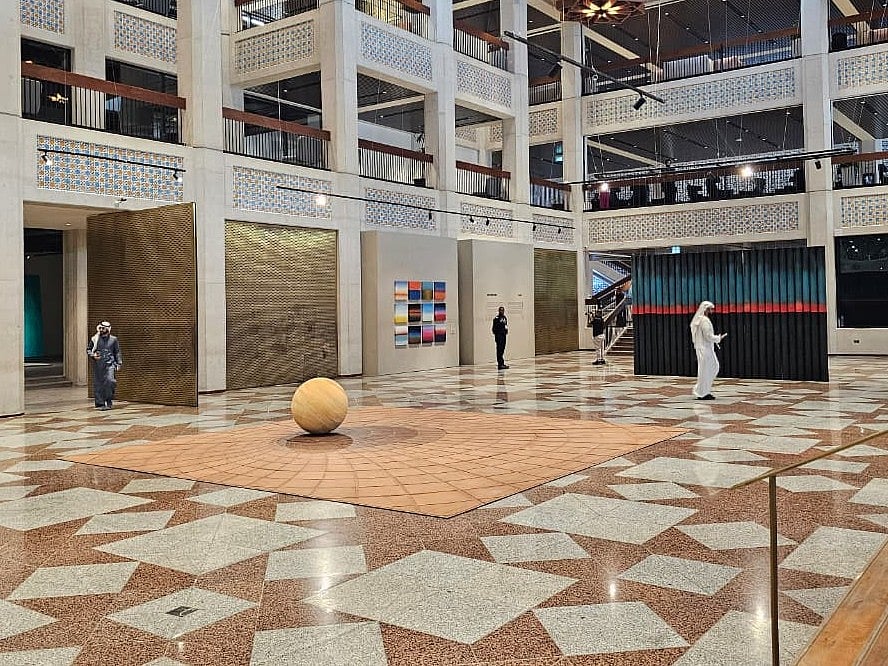
Shaikh Al Mazrou's On the verge of Appearance, 2026, is displayed at the Exhibition.
"That Line is never a line", Shaikha Al Mazrou’s Two Horizons in Abu Dhabi
Transforming Rigid Materials into Fluid Forms is Al Mazrou's Artistic Vision
Last updated:
4 MIN READ
Abu Dhabi's Cultural Foundation Opens 'Shaikha Al Mazrou: Two Horizons' Exhibition
Hamna Iqbal/ Gulf News
Abu Dhabi: Emirati artist Shaikha Al Mazrou transforms ideas about water, landscape, and the horizon into sculptures that challenge how we see materials and form.
At Abu Dhabi’s cultural foundation, displayed was her works- Two Horizons which brings together significant works and new commissions by the artist, known for her experimentation across steel, marble, glass, resin, and copper.
"The horizon is never a straight line, but our eyes deceive us into believing it is,” Al Mazrou said as she looks at her own works.
That tension runs through Two Horizons. Known for her material experimentation across steel, marble, glass, resin and copper, she transforms ideas of water, landscape and the horizon into sculptures that challenge how we see materials and form.
When I stood amid the art works, looking to understand what I see, the feeling felt different, still as if time has slowed down and as if I was poetic myself.
A poem, but not a poem
At the heart of the atrium is a work that began far from Abu Dhabi.
Al Mazrou first made it for the Aichi Triennale in Japan. With no fixed location in mind, she toured Nagoya, moving between white-cube spaces and open-air sites, until one place seemed to call to her- a dried-up fountain outside a cultural institution. She had been reading Mallarmé at the time, and the proposal was born for that specific site.
Speaking on the sidelines of her exhibition, she described the thoughts behind her work, which to me was a piece in poetry.
The work takes its title from the French poet's A Throw of the Dice Will Never Abolish Chance, a poem often credited with beginning the deconstruction of how poetry is read, she says.
Made in black jade marble, it reads from above as two ripples. "I always claim that I'm not a poet, and this is not a poem," Al Mazrou says. "My work doesn't necessarily reflect poetry, but it's heavily influenced by poetry."
For her, Water, is both an object of longing and a source of unease. Poets use it to describe feeling, she noted, tides, currents, desire, and today, the journeys of refugees and immigrants.
"As much as I romanticize it, as much as it scares me," she says, she is drawn to the possibility the title holds. Even its colour resists definition. "We say it's blue, but it's never blue. Water was always clear."
Making rigid things move
Al Mazrou is a sculptor first, and the work is driven by material. What she describes as the dichotomy and opposition within each material is where she begins.
She takes marble, a rigid stone cut from mountains by heavy-duty water jets and makes it feel fluid. She takes mass-produced industrial metal and folds it until it looks like paper.
The difference matters. "You can take a piece of paper and fold it as much as you want, but you can spread that paper back to its A4 size," she says. "With metal, it does not obey you. You can fold it, and it holds its shape."
She says the process used to changes a metal's surface through oxidation, adds another layer of meaning to- them concealment, sealant, constraint, permanence and temporality at once.
Form remains central to her works. Cylinders, circles, grids and squares recur in her work, but she resists the idea that she favours particular shapes.
"I think through form," she says. "These forms originate from words," and the work begins when an idea or emotion needs a visual language it does not yet have.
Metaphor in shapes
Some of her works have a tint of metaphor in them. One of her works come in blue, and in numbers. She called that piece “Despite the weather”. It made me pause and look once again- and for a fleeting moment, I read it as a comment on the internet age, with its illusion of codes.
But she described it differently and the difference ran deep. The works carry numbers: coordinates, phone numbers, the suggestion of countless possible lives and places.
She calls the work metaphorical, a statement that things will happen again, despite the weather. The themes that run through it, as with much of her work, are perception, hope and belonging.
Lost in translation
She is equally open about how viewers meet the work. Texts and titles guide, but she does not want to fix meaning.
"The translation is constantly redefining and defining," she says. The exhibition is not meant to resolve her questions. She sees herself as in constant quest, sometimes expanding a work, sometimes departing from it, sometimes revisiting it a decade later.
"Maybe you would say it's not a horizon, and this is where conversation falls into a dialogue." What she hopes visitors take with them is "a bit of that landscape."
Learning in practice
As she embarks on her journey through her career, she remembers how she began at first. Now an associate professor at NYU Abu Dhabi, she was once a student at University of Sharjah.
As a teenager she wanted to be an architect, and she still likes to blur the lines between language, architecture and sculpture, thinking, she says, "as a poet, an architect and an artist."
Her art journey, she says, truly began as an undergraduate, absorbing art history, media theory, Islamic and South Asian art, and cinema. "I am still hungry to learn."
That includes learning from what does not work. "I love failure," she says. "I've only learned from failure." When a line of poetry fails to find its form in one sculpture, she rereads it and translates it again in another medium.
Two Horizons
Curated by Reem Fadda, Director Culture Programming, DCT Abu Dhabi, the exhibition is co-curated with Noor AlMehairbi, Curator, Cultural Foundation, and Paz Monge, Head of Exhibitions, Cultural Foundation, with Cultural Foundation Assistant Curator Afra Saif Almazrouei.
Considered among the most dynamic artists of her generation in the UAE, Al Mazrou is an Assistant Professor of Arts Practice at New York University Abu Dhabi. Running until 18 July 2027, her works are open to everyone that wants to see the world translate boundaries into boundaryless notions.
Sign up for the Daily Briefing
Get the latest news and updates straight to your inbox
Network Links
GN StoreAbout Gulf NewsTerms & ConditionsReach by GNSitemapContact usPrivacy PolicyGN FocusHave your sayWork with usAdvertise with usGulf News epaperPrinting Services
Download our app
© Al Nisr Publishing LLC 2026. All rights reserved.