The company’s chief executive told Gulf News that the system is meant to close a gap in the first critical minutes after an injury.
LifeBot unveils medical command network at Abu Dhabi military medicine congress
New tech connects paramedics, physicians, and command centers in real time
Last updated:
3 MIN READ
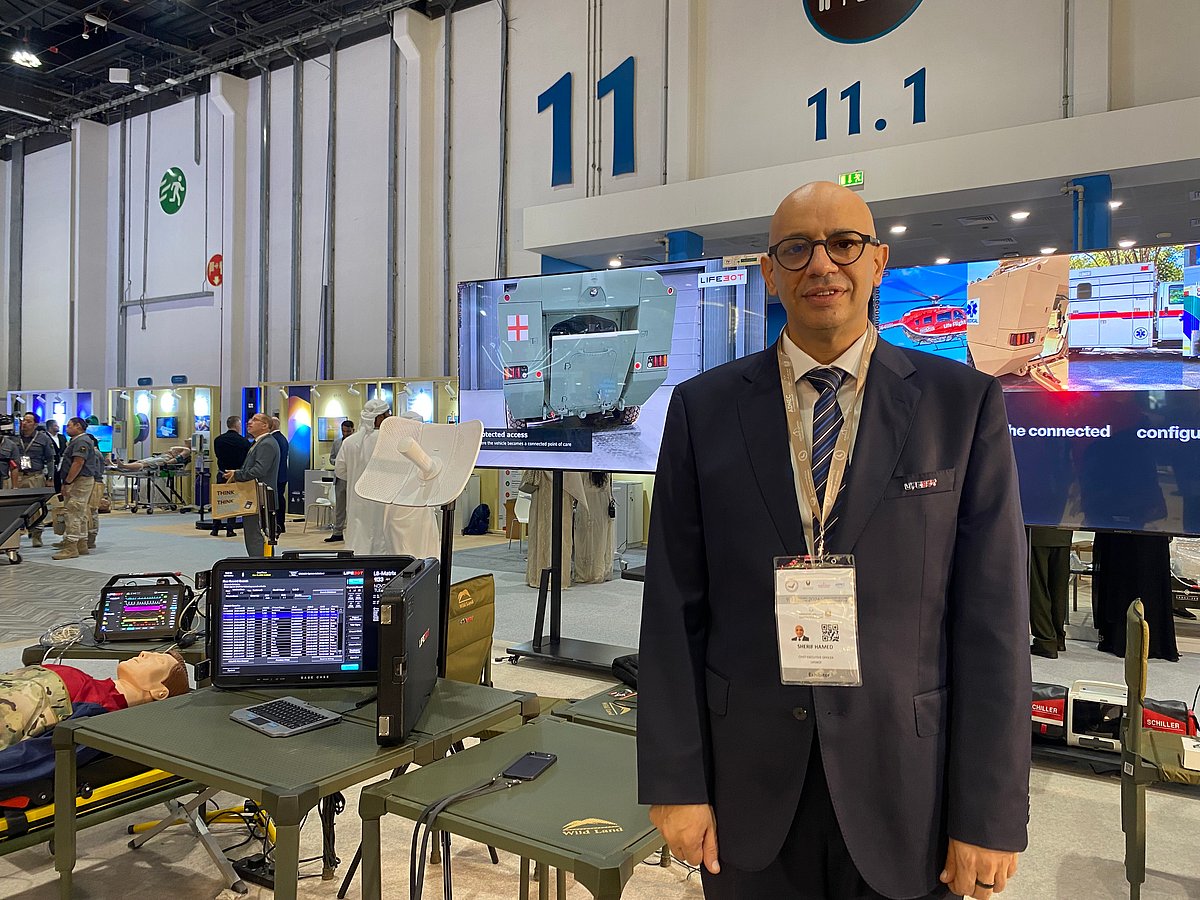
Sherif Hamed, CEO at LifeBot Inc. at the 46th ICMM World Congress of Military Medicine in Abu Dhabi.
Rahf Youssef
Abu Dhabi: A remote area after midnight. A critically injured person lies on the ground. One medic is kneeling beside them. The nearest specialist is hundreds of kilometres away, evacuation has not yet arrived, and the mobile signal comes and goes.
This is the scenario the American company LifeBot Inc. has used to present its new Medical Command Network, launched today at the 46th ICMM World Congress of Military Medicine in Abu Dhabi.
The company’s chief executive told Gulf News that the system is meant to close a gap in the first critical minutes after an injury.
“It connects the patient at the point of injury with the physicians, and the physicians with the paramedics in the field, on one level,” the Sherif Hamed, CEO at LifeBot Inc. told Gulf News.
A second layer, he said, links everything to a national command centre, where the authorities can see what is happening on the ground and act on it.
The gap at the point of injury
The CEO described the problem as one of expertise. The person with the injured patient is often not qualified to make life-saving decisions. “The paramedic is left alone with the patient,” he said.
According to the company, LifeBot retrieves physiological data, vital signs and images from the patient and transmits them in real time to a remote physician, who can then guide the paramedic. Sherif described the data as “ICU-level”, which he said lets the doctor make a full assessment and prepare the receiving hospital.
The patient’s data continues to stream to the facility during transport.
Three stages of the journey
Sherif described the network as covering three stages: The point of injury, where data goes to remote physicians, who guide the person caring for the patient.
The field hospital, where the same patient data follows the patient on arrival. Treatment can be supervised by physicians who are not at the same location.
The system includes a decision-support function based on the company’s Apollo model family. According to LifeBot, the clinician must start every task and approve its results before they are shared, and treatment decisions remain with people.
And the transport and allocation, where authorities get an overview of available beds, specialities and blood stocks at hospitals. They also see how many people injured, so they can decide where to send patients and how to allocate resources.
AI as support
The system includes a decision-support function based on the company’s Apollo model family. According to LifeBot, the clinician must start every task and approve its results before they are shared, and treatment decisions remain with people.
The company also says that some image and signal analysis models are still being assessed. Which models are enabled on a delivered station, and their validation status, will be specified with each order
Why a unified platform
The CEO acknowledged that many good technologies already exist. His argument was that most solve a problem at one location and do not follow the patient through the whole chain. “They are unable to continue the journey in one unified platform,” he said.
Asked why the company chose the UAE, the CEO called Abu Dhabi one of the leading markets for adopting new technology. He said the country’s leaders have a clear vision for medical and military medical technology and encourage companies to operate there. This, he said, is why LifeBot chose to launch from the capital.
He described the launch as the start of a new phase after around 20 years. The company was founded in 2009, and the CEO traced its roots to a government-funded project that began in 1998.
Sign up for the Daily Briefing
Get the latest news and updates straight to your inbox
Network Links
GN StoreAbout Gulf NewsTerms & ConditionsReach by GNSitemapContact usPrivacy PolicyGN FocusHave your sayWork with usAdvertise with usGulf News epaperPrinting Services
Download our app
© Al Nisr Publishing LLC 2026. All rights reserved.