Larry Page's space prediction wins Elon Musk's praise: Will AI data centres move into orbit?
Larry Page once considered leaving his fortune to Elon Musk, investor recalls
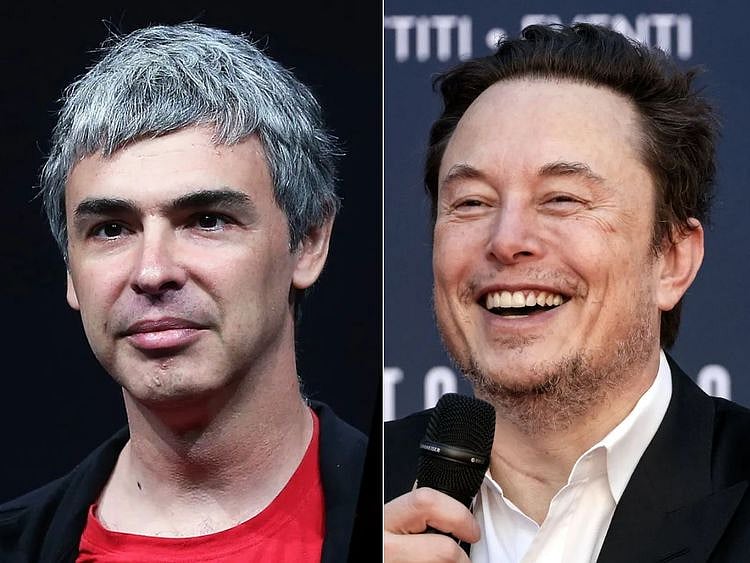
Google co-founder Larry Page is back in the tech spotlight after Elon Musk praised his prediction that virtually all computing could eventually take place in space.
The comment has revived the debate over the future of artificial intelligence (AI) infrastructure.
Musk, the SpaceX and Tesla chief, said Page had made "many accurate predictions" in a November 10, 2026, post on X, responding to a video recounting the Google billionaire's vision of moving computing power beyond Earth.
The video featured investor Patrick O'Shaughnessy recalling a conversation in which Page was asked how much computing capacity would eventually be located in orbit.
Page reportedly answered "five nines" — a reference to 99.999%.
Get it: Fast, verified news for FREE ... download the Gulf News app — simply click here
Page's prediction comes as tech companies face growing pressure to expand computing capacity for increasingly sophisticated AI systems.
Conventional data centres require enormous amounts of electricity, land and water for cooling, while communities and regulators are increasingly scrutinising their environmental and infrastructure costs.
Space-based data centres could offer an alternative, using solar energy in orbit and satellite networks to process AI workloads.
However, the technology faces substantial engineering and economic challenges, including radiation protection, heat dissipation, communications, maintenance and launch costs.
Google is already exploring the concept through Project Suncatcher, an initiative to test its Tensor Processing Units (TPUs) in orbit with satellite partner Planet Labs.
Its initial experiments are designed to establish whether powerful AI chips can operate reliably in space.
Page, who co-founded Google with Sergey Brin in 1998, stepped away from executive leadership at Alphabet in 2019 but remains a board member and influential shareholder.
Musk's renewed praise also recalls their once-close friendship, which deteriorated partly over disagreements about artificial intelligence (AI).
The latest exchange puts Page's futuristic vision back into focus as tech leaders search for ways to sustain the rapidly growing computing demands of AI.
What it means
Musk's endorsement highlights a possible new frontier in the AI infrastructure race. If orbital computing becomes commercially viable, it could reduce dependence on land-based data centres, electricity grids and water resources, while creating new opportunities for satellite, semiconductor and aerospace companies.
What's next
Google's Project Suncatcher experiments will help establish whether AI processors can operate reliably in orbit. SpaceX is also pursuing orbital computing demonstrations. Launch costs, cooling technology, radiation protection and satellite maintenance will determine whether Page's prediction becomes commercially realistic.
Page once suggested leaving his entire fortune to Elon Musk because he believed Musk’s companies could advance goals he shared, according to an account by investor Steve Jurvetson.
Jurvetson recounted the conversation to Musk, who said he had not heard the story before.
At a Google event, Page unexpectedly raised the question of how much money he had, Jurvetson recalled. After mentioning a figure, Page said that if he were hit by a bus that day, he should "leave it all" to Musk.
Musk asked whether Page had really said that. Jurvetson confirmed the account and joked that his immediate reaction was to get the statement in writing.
Musk welcomed the sentiment, describing Page as a good friend. He said they had known each other since around 1997, before Page secured venture funding.
According to Jurvetson, Page believed companies pursuing objectives such as curbing oil dependence and establishing settlements on other planets could accomplish more with his money than a nonprofit organisation.
Jurvetson said Page shared those ambitions and wished he could pursue more of them himself.
The anecdote describes Page’s reported thinking. While it is not a confirmed inheritance arrangement or commitment to transfer his wealth, the account shows the thinking and stated personal missions of two of the world's tech tycoons.
Sign up for the Daily Briefing
Get the latest news and updates straight to your inbox
Network Links
GN StoreDownload our app
© Al Nisr Publishing LLC 2026. All rights reserved.