Nazmin holding her calligraphy portrait of Sheikh Zayed at the Abu Dhabi International Book Fair, created live in front of visitors.
From a crayon wall to Sheikh Zayed in gold: Meet the 12-year-old calligrapher
Ajman schoolgirl Nazmin on learning Diwani, live art at ADIBF and her UAE wildlife series
Last updated:
6 MIN READ
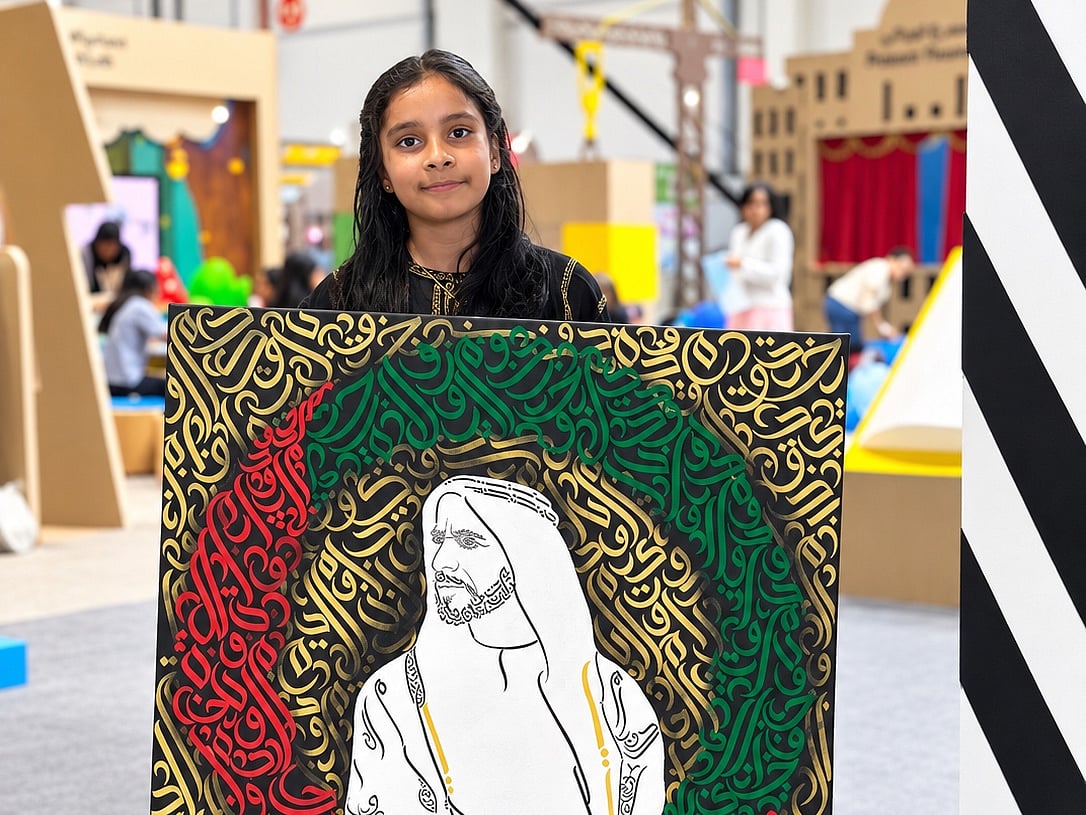
Nazmin holding her calligraphy portrait of Sheikh Zayed at the Abu Dhabi International Book Fair, created live in front of visitors.
supplied
Dubai: When Nazmin's little brother scribbled on a wall at home, her mother, Sumayya Ashraf, didn't stop the drawing. She let Nazmin carry it on.
"My mom said I could continue it. So I took my crayons and turned that wall into my own imaginary world," the 12-year-old said. "I think that was one of the moments when I realised how much I loved creating."
Years later, the Ajman schoolgirl stood beside a calligraphy portrait of Sheikh Zayed at the Abu Dhabi International Book Fair, created live in front of visitors. It was her first time performing calligraphy in public.
A winner at five
Nazmin's first big moment was when she was...only five years old, and she entered an art competition as the youngest participant, up against older children.
"Becoming the winner was completely unexpected. I still remember that feeling," she said.
Nazmin started drawing on the wall when she was 5 years old.
Painting became her comfort zone, and Islamic architecture became one of her favourite subjects. That is how she discovered calligraphy.
"When I started painting Islamic architecture, I became really interested in the patterns and the Arabic writing that I saw in it. I started searching about them and discovered that there were so many different calligraphy scripts," she said. "That made me want to learn calligraphy properly, so I started from the basics."
Nazmin's art on the wall
Learning the letters
She first tried teaching herself, but it didn't feel right.
"When you're learning something new, you don't always know whether you're forming the letters correctly. You need someone who can correct you and guide you," she explained.
Her mother had always guided her painting, but calligraphy needed a different kind of teacher, so she joined classes with Liyakh Sir, a professional Arabic calligraphy artist and school teacher based in the UAE. "He taught me the basics, corrected me and continues to guide me. I'm still learning from him."
For now, she is drawn to Diwani-inspired forms. "I really enjoy working with them because of their beautiful curves and flowing movement," she said. She also experiments with contemporary, abstract lettering in her backgrounds, and plans to begin Thuluth next, a script known for its strict proportions.
"I want to understand the structure and discipline of the script properly."
Nazmin's arabic calligraphy
Paint markers, gold leaf and a qalam
Rather than keeping calligraphy separate from fine art, Nazmin brings the two together on large canvases, using acrylic paints, textured paint markers, fine brushes and, at times, gold leaf.
"For very precise details, I really like acrylic markers because I can create crisp lines over textured backgrounds," she said. "But now I'm also experimenting with traditional calligraphy tools like the qalam and ink, because I want to understand the traditional side of calligraphy as well."
The hardest part, she says, is consistency.
"Even a small difference in the pressure, angle or spacing can change the way a letter looks. When I'm working on a painting, I can be more expressive and spontaneous, but calligraphy needs much more control and patience. I'm still training my hand to become more precise."
She looks up to Vincent van Gogh for his use of colour and brushwork. In calligraphy, she admires artists including Mohammed Mandi and eL Seed for the way they blend Arabic letters with contemporary art.
Words that bring peace
Among the phrases she returns to most are "Alhamdulillah" (all praise is due to God) and "Wasbir 'ala ma asabak" (and be patient over what befalls you).
"The meanings themselves give me a feeling of peace," she said.
She is now working on the Asmaul Husna, the 99 names of Allah, a project she wants to see through. "For me, calligraphy isn't only about making beautiful letters. When I'm writing, I feel very peaceful and completely focused."
A tribute to Sheikh Zayed, live
The book fair, held at Adnec Centre Abu Dhabi from September 13 to 18, gave her a stage. The opportunity came through the Mohamed bin Zayed Species Conservation Fund team. When Azhar Ma'am told her about it, she knew right away what she wanted to make.
"The first thing that came into my mind was doing a live calligraphy artwork as a tribute to Sheikh Zayed, the Father of the UAE," she said.
She built his portrait out of Arabic calligraphy, set the UAE's colours around it and continued the lettering across the background in gold.
"I had done live paintings before, but this was my first time doing live calligraphy, so yes, I was a little nervous at the beginning. But once I started writing, I became completely focused on the artwork," she said. "Standing beside the finished artwork with the UAE flag was a very special feeling of pride for me."
Visitors were often surprised by her age, and many asked how she had learned. What stayed with her was quieter than any compliment.
"Sometimes you don't need to explain everything about your art. When people stop, look at it carefully and become curious, you feel that your artwork has communicated something to them."
Freedom and calm
Painting and calligraphy give her two very different feelings, she explained.
"With painting, sometimes I spend weeks with one artwork. I become so connected to it because I'm living with that painting until it is finished. Calligraphy feels more concentrated. I can sometimes complete a piece in a day, but every letter and every verse needs so much attention."
"So painting gives me a different kind of freedom, while calligraphy gives me a different kind of calm. I don't want to choose between them."
She looks up to Vincent van Gogh for his use of colour and brushwork. In calligraphy, she admires artists including Mohammed Mandi and eL Seed for the way they blend Arabic letters with contemporary art.
At school, her friends are among her biggest supporters. "One thing that makes me really happy is seeing some of my friends becoming interested in art because of me," she said.
Painting and calligraphy give her two very different feelings.
School still comes first
A student at Cosmopolitan International Indian Private School in Ajman, Nazmin practises during free evenings and on weekends, with no fixed weekly target.
For her mother, Sumayya Ashraf, the signs that art was more than a hobby appeared early.
"She is actually a quiet child, but when the conversation turns to art, she becomes completely different. Her eyes light up and she can talk endlessly about an idea, a painting or a place she wants to paint," she said.
"I remember her painting Turkey because she wanted to visit there. After finishing it, she told me that she felt as if she had already been there. Those little moments showed me that art isn't just something she does. It is one of the ways she experiences the world."
The family is careful not to turn that into pressure.
"We don't force her to study art, and we don't force her to paint. We want her to have the freedom to explore, experiment and find her own space without unnecessary stress," added her father Rasheed. "What matters to us is nurturing her confidence in her own ideas and supporting her step by step."
Eight paintings, eight species
Her main focus now is Voices of Silent Nature, an eight-painting series with the Mohamed bin Zayed Species Conservation Fund, inspired by UAE species and their conservation stories.
"I want each painting to tell the story of a species and help people notice and care about the nature around us," she said. She is also continuing art classes at home with her mother, entering competitions and preparing for upcoming exhibitions.
Voices of Silent Nature, an eight-painting series with the Mohamed bin Zayed Species Conservation Fund, inspired by UAE species and their conservation stories.
Her advice for other children who want to try calligraphy is simple.
"Just start. You don't have to be perfect when you begin. I wasn't happy with my first attempts either, and that's completely normal. Find someone who can guide you, practise the basics again and again, and don't be afraid of making mistakes."
"And most importantly, don't compare your first steps with someone else's years of practice."
Nazmin's advice for other fellow students is to just start.
Network Links
GN StoreAbout Gulf NewsTerms & ConditionsReach by GNSitemapContact usPrivacy PolicyGN FocusHave your sayWork with usAdvertise with usGulf News epaperPrinting Services
Download our app
© Al Nisr Publishing LLC 2026. All rights reserved.