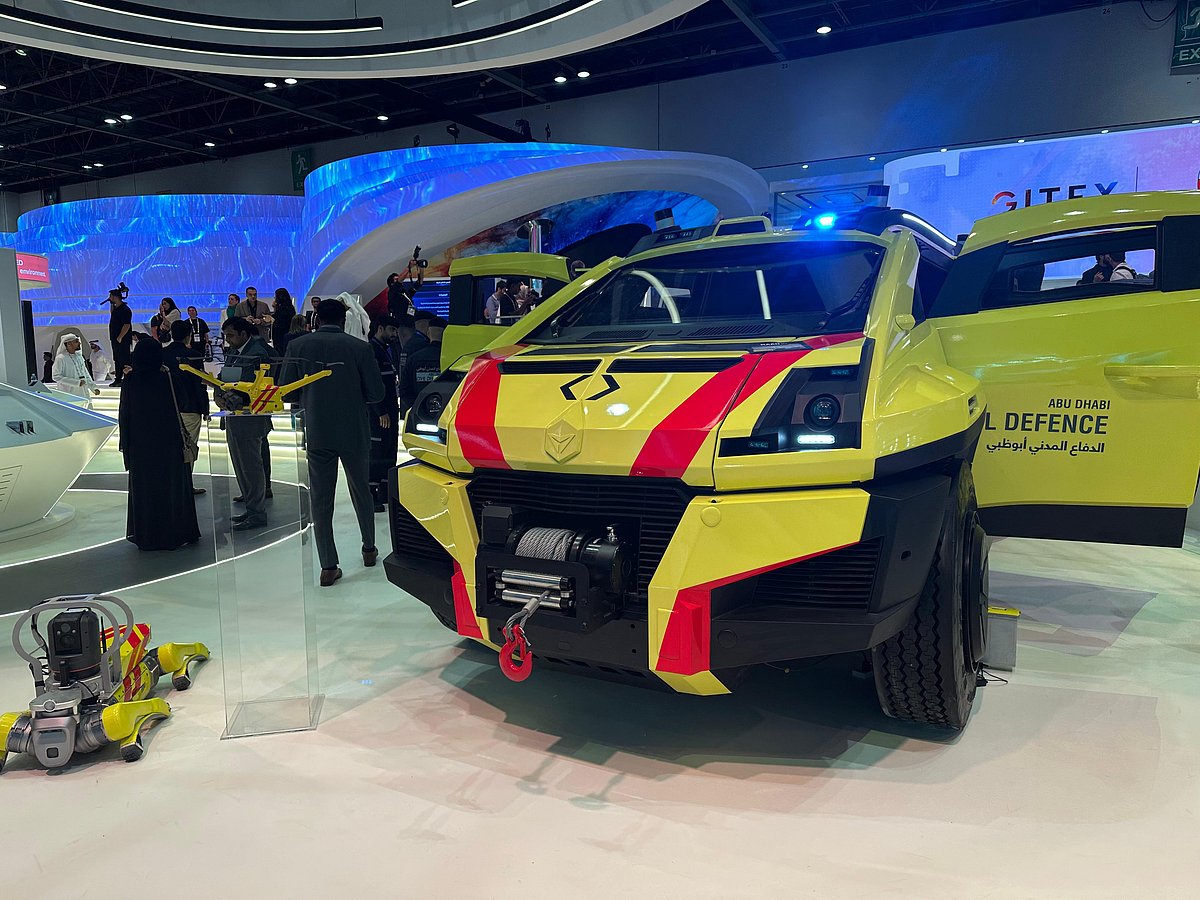
Dubai: Abu Dhabi Civil Defence is building a new generation of emergency-response technology with RAAD, an AI-powered command vehicle that can patrol, inspect and coordinate operations in real time. The name, meaning thunder in Arabic, also stands for Reconnaissance, Autonomy, Analytics and Directive, a fitting description for what officials call the most advanced vehicle in its fleet.
“RAAD is a vehicle that’s first of its kind because it gives us operational capabilities unlike before,” said Major Engineer Ali Hassan Al Madfai, Head of Executive Affairs at the Abu Dhabi Civil Defence Authority.
Command centre on wheels
In non-emergency situations, RAAD acts as a smart patrol car. It scans buildings across the city via QR codes to identify whether they comply with inspection and safety requirements. If a property requires further review, a robot dog stored in the vehicle’s rear compartment can deploy autonomously.
“The Robo Dog that is available in RAAD just jumps out the boot, goes into the building and does its own inspection autonomously, checking for any infractions, checking if the exit routes are blocked, checking if there’s any violations in the corridors or anything that might jeopardise the health and safety of the occupants,” said Al Madfai.
Previously, such inspections required manual coordination between Civil Defence and the Civil Protection sector, which dispatched human inspectors on site. The new system is designed to accelerate that process, allowing immediate assessment from the field.
Eyes on every firefighter
RAAD’s full capability comes into play during incidents. Once a fire or emergency is detected, the vehicle transforms into a mobile command and control unit. A drone mounted on the system provides an aerial view of the scene, while built-in dashboards display live feeds and data from firefighters’ helmets and field sensors.
“We have visibility of every single firefighter in the scene. We can see what they see, two-way communications in a way that doesn’t depend on traditional telecommunication networks,” Al Madfai said.
The vehicle generates its own network in the field, bypassing any signal disruption and allowing Civil Defence to monitor multiple incidents at once. It can track equipment such as fire trucks, water levels and resource deployment in real time. “If there is a fire truck and we notice that the water levels are low, we can get alerted, send additional units, reinforcements and backup, all from a single source command and control unit based on RAAD,” he added.
Unmanned in future?
The vehicle is currently driven by officers, though future models may operate autonomously. “In its current iteration, RAAD will be driven,” Al Madfai said. “Future iterations of the car can see it being autonomous, but we see it better serving for mission efficiency and effectiveness to be driven with the crew.”
Deployment is scheduled for the fourth quarter of 2026. Al Madfai said the technology could eventually be extended beyond Abu Dhabi. “Applying emerging technologies and innovative advanced solutions across the UAE only increases readiness and enhances operational effectiveness,” he said.
Al Madfai noted that the project signals a new phase for public-safety innovation. “It gives us operational capabilities unlike before,” he said. “Once RAAD is in the field, it will change the way we manage emergencies from the street to the command room.”

Sign up for the Daily Briefing
Get the latest news and updates straight to your inbox
Network Links
GN StoreDownload our app
© Al Nisr Publishing LLC 2026. All rights reserved.