Emaar’s Mohamed Alabbar on why the UAE is winning, Europe is stalling and China is thinking decades ahead
Mohamed Alabbar shares candid insights on why the UAE is the ultimate hub for success
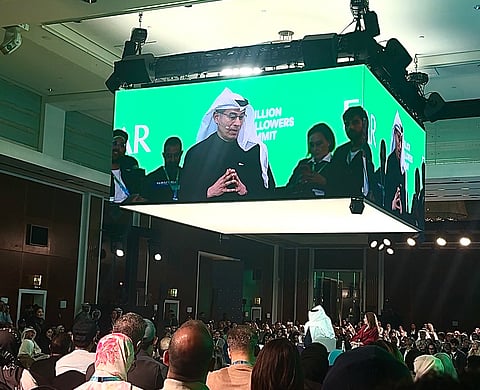
Dubai: Mohamed Alabbar, the founder of Emaar Properties and one of the UAE’s most influential entrepreneurs, rarely pulls his punches. Speaking at Dubai’s 1 Billion Followers Summit on Saturday, Alabbar offered a candid assessment of global leadership, economic priorities and why he believes the UAE continues to outpace much of the world.
In a wide-ranging conversation that touched on business failures, political decision-making and urban decline, Alabbar argued that success is less about individual brilliance and more about the systems that enable or restrict growth.
‘The UAE spoils you’
“It’s humbling for us as businessmen,” Alabbar said. “We think we’re so capable and so successful, but I’ve failed in certain countries. I failed in America.”
Those failures, he added, highlight how uniquely supportive the UAE’s business environment is.
“This country spoils you. It’s almost autopilot to get rich because the regulations are incredible, the environment is supportive, and government policies help businesses grow. This country makes it easy to succeed. In other countries, you can barely breathe without losing money.”
To illustrate the contrast, Alabbar pointed to Europe’s regulatory bottlenecks, recalling an attempt to develop housing in Berlin.
“There’s a housing shortage, but the mayor said we first need to study the snails living in the area,” he said. “I said, ‘In 20 years I’ll be 85.’ I told them, ‘Take care of the snails and let the Germans sleep on the streets.’”
The lesson, he said, is humility. “When people think they’re smart because they’ve succeeded in the UAE, I say: we’re not smart. This country makes it easy for us to succeed and grow.”
Why China is thinking differently
Alabbar also shared his views on China’s long-term trajectory, arguing that the West underestimates the seriousness of its leadership.
“The smartest people come out of schools and universities in China,” he said. “These are the people who run the country. They don’t run technology companies, they run China. They are the sharpest minds, and they’re incredibly serious, in a way the West doesn’t even understand.”
Unlike democracies preoccupied with short electoral cycles, he said China’s leaders are focused on decades, not years. “They’re looking at the world with a lot of wisdom and saying, ‘We’re going to take a breather.’ They’re not worried about elections.”
A tower built in 12 days
That long-term thinking, Alabbar said, was evident during a recent visit to China to study rapid-construction technologies, a trip prompted by UAE President His Highness Sheikh Mohamed bin Zayed Al Nahyan.
The result was, in Alabbar’s words, “mind-blowing”: a 15-storey building assembled in just 12 days.
The project, developed by Eagle Hills, where Alabbar is chairman, is being constructed in Abu Dhabi using prefabrication, robotics and highly automated processes. The building uses no traditional concrete and was assembled by around 200 robots working with extreme precision.
“That tells you how our leadership thinks,” he said. “Why is nobody else in the world ordering buildings from this factory?”
He added that mass adoption of the technology could significantly reduce costs while offering a more sustainable alternative to conventional construction.
Europe’s cities and a leadership problem
Despite his criticism, Alabbar said he wants Europe’s great cities to succeed.
“The world would be so boring without cities like London, Tokyo and Los Angeles,” he said. “These are cities loved by everyone, and we want them to be great.”
London, in particular, he said, should be thriving but public safety and governance are eroding its appeal. “It’s a shame that people don’t feel secure, that someone can snatch your phone while you’re walking. It all comes down to leadership. Something is failing.”
‘You have no money, yet you talk about war’
Alabbar was even more blunt about Europe’s geopolitical priorities.
“You want to go to war, but you don’t have money to fund the police in London,” he said. “You’re deeply in debt, and yet you talk about war. Are you awake?”
He recalled a recent NATO conference where, he said, officials appeared disconnected from economic realities. “Europe is the history of the world. Seventy per cent of tourists go there because of its history. But if you don’t fix your problems, people will go elsewhere.”
By contrast, he said, the UAE’s growth reflects strong leadership and social cohesion. “We’re busy, we’re full, and we don’t have space. I’m not being snobbish, the UAE is succeeding because of leadership, wisdom and the people who live here.”
Why Egypt stands out
Alabbar also spoke warmly about Egypt, where Emaar has invested heavily, including in the Marassi Red Sea development.
“I love Egypt. The people are incredible,” he said, describing them as warmer and more welcoming than many Europeans.
“You land in Europe and there’s no smile at immigration,” he said. “‘Why are you coming? How long are you staying?’ It feels like the first thing they do is insult you. You go to Egypt and they love you from the moment you step off the plane.”
Inequality, unrest and Iran
Alabbar also warned of the widening wealth gap between rich, middle- and low-income groups, calling it a source of growing global instability.
“That’s what’s happening in Iran,” he said. “People want to live and eat, but that’s a much bigger and deeper discussion.”
Iran is currently facing widespread anti-government protests that began over soaring prices and economic hardship and have since expanded into a broader challenge to the political system established after the 1979 Islamic Revolution.
The US-based Center for Human Rights in Iran has reported receiving credible accounts that hundreds of protesters have been killed during the ongoing internet shutdown.
When asked whether Emaar could one day develop projects in Iran, Alabbar was unequivocal. “We will go anywhere where it is our duty to develop and participate in the evolution of society,” he said. “Yes, of course.


