US–Iran tensions: Key developments on Diego Garcia military base
Activity intensifies in strategic US forward military base in the Indian Ocean
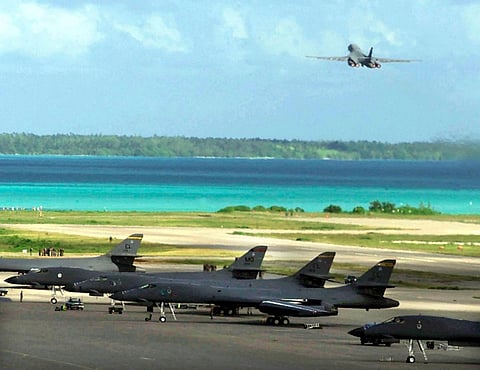
Amid the simmering standoff between Washington and Tehran, the remote atoll of Diego Garcia has emerged from obscurity into sharp focus — a linchpin of American power.
Smack dab in the middle of the Indian Ocean, it's now the world's most strategically-placed speck of sand.
And a potential bullseye.
The joint US–UK military base, long prized for its strategic reach, now stands as both a sledge hammer and a looming target for retaliation, underscoring how even the most distant outposts can be drawn into the heart of a volatile confrontation.
In the past, Iran has threatened to hit US military facilities, including Diego Garcia, with “preemptive” strikes.


Here’s what we know about it and what it means based on the latest strategic assessments and reporting:
What is Diego Garcia?
Diego Garcia, an island in the middle of the vast Indian Ocean, is strategically vital.
This horseshoe-shaped coral atoll sits in the central Indian Ocean and serves as a joint UK-US military base.
Though the territory is British (part of the Chagos Islands), the United States has full operational control of the installation.
Known as the “Footprint of Freedom”, Diego Garcia is the largest island in the Chagos Archipelago and acts as a crucial, isolated hub for naval and air power across the Middle East, South Asia, and Africa.
It reflects both operational necessity and geopolitical calculation.
What is its strategic value?
Diego Garcia is considered a key location for operating in the Middle East, with distances allowing for strategic military flights.
It hosts airfields, deep-water ports, logistics hubs, surveillance systems, air refuelling tankers, and long-range strategic bombers — making it one of the most strategically versatile US forward bases in the world.
The base was used in past operations in Afghanistan (similar distance to Iran).
What is Diego Garcia's distance to Tehran?
Diego Garcia is potentially a flashpoint for escalation: Iranian officials have in the past threatened to hit Diego Garcia.
The straight-line distance from Diego Garcia to Tehran, Iran, is approximately 3,795 kilometers (2,358 miles). A B-52H Stratofortress has a cruising speed of about 525 mph (845 km/h).
The base has historically supported US bomber missions across the Middle East — including B-1B, B-2 and B-52 strategic bombers — capable of hitting targets thousands of miles away.
Its runway and refueling assets have the capability to allow aircraft to strike deeply into Iranian territory or to provide air support without needing access to Gulf airspace or local bases.
This is especially important if Gulf allies decline to provide basing rights.
Social media posts show that Pentagon's assets deployed to Diego Garcia, now also include 3× KC-135R aerial refueling tankers, 2× C-130/HC-130J transports, and a P-8A Poseidon maritime patrol and reconnaissance aircraft.
Staging ground
If Washington decided on military strikes against Iran, Diego Garcia could serve as a launch point for long-range air operations.
The base has historically supported US bomber missions across the Middle East — including B-2 and B-52 strategic bombers — capable of hitting targets thousands of miles away.
Deployments to Diego Garcia: What do they mean?
Deployments to Diego Garcia — aren’t just operational; they send a message. The presence of those assets signals readiness and resolve to Tehran and regional actors.
Beyond the immediate conflict zone, it demonstrates an ability to project power even if US bases in the Middle East are politically or diplomatically constrained.
Is Diego Garcia a magnet for escalation?
Diego Garcia’s importance also comes with risks.
Iranian officials have publicly warned they may consider the base a legitimate target if the US attacks Iran, given its role in enabling such strikes.
Tehran’s long-range missiles and upgraded drone systems have been touted, in Iranian statements, as capable of reaching facilities like Diego Garcia should conflict erupt — underscoring how the base could become part of the conflict, not just a launch point.
Diego Garcia is much more than a remote outpost.
It could well be a major part of a significant military campaign — especially one aimed at Iran.
FACT FILE
Geography: It is a 17-square-mile (44-square-km) tropical island with an average elevation of just four feet. History & controversy: In the 1960s and 70s, the UK government forcibly removed the native population (Chagossians) to establish the base.
Sovereignty dispute: While the UK has managed it as part of the British Indian Ocean Territory (BIOT), international pressure has led to recent agreements to transfer sovereignty to Mauritius.
Current status: It remains a key military installation, with the US lease currently set to expire in 2036.


