Strait of Hormuz: What's happening now, progress made so far
US presses other states to 'step up': Shipping creeps back into Hormuz, threats remain
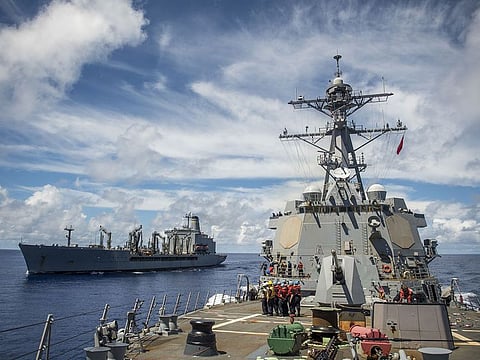
The assassination of Iran's top naval commander in Bandar Abbas has cast a long shadow over the ongoing Middle East conflict.
As the world watches the war front with bated breath, one measure is beginning to stand above the noise: how many ships are willing to pass through the Strait of Hormuz — the pressure valve of the global energy system.
That single number may offer the clearest signal of reality in and around the strait.


Chicken-and-egg situation
Amid mixed signals and renewed diplomatic feelers, even a modest uptick in vessel traffic is carrying outsized significance — hinting at either easing tensions or growing confidence in military protection.
Currently, the situation remains dicey: The strait has been effectively shut for nearly four weeks, after a wave of threats and attacks on ships linked to Iran.
The risk level is now so high that most commercial vessels have stopped transiting, choking off a major artery of global energy trade.
It has become a classic chicken-and-egg standoff — one where action on the water and progress at the negotiating table are each waiting on the other to move first.
On one side, the US is pressing allies to step in and help secure Hormuz through escorts and joint patrols.
On the other, those same allies are holding back, urging Washington, Israel, and Iran to "de-escalate" first and hammer out a ceasefire before any major commitment is made.
The result: a deadlock
Without a ceasefire, allies are reluctant to commit forces; without a credible coalition, pressure on Iran remains constrained.
That hesitation is rooted first in the fear of escalation.
Many US partners — particularly in Europeans and East Asians — see escort missions not as defensive manoeuvres, but as a potential trigger for direct confrontation with Iran.
Several Nato members have already balked at joining offensive operations, exposing a widening transatlantic divide.
For most, pushing for a ceasefire is the far less risky path than sailing into a contested chokepoint.
Mounting economic pressure is reinforcing that diplomatic instinct: the longer Hormuz remains disrupted, the more severe the consequences.
As much as 13 to 14 million barrels of oil per day could be affected in a prolonged closure, while prices have already surged past the $100-per-barrel mark.
The knock-on effects — higher inflation, food, tighter supply chains, slower growth — are being felt far beyond the region.
For energy-importing allies in particular, the priority is clear: stabilize flows quickly through diplomacy, rather than gamble on a drawn-out and uncertain military solution.
Why does geography favour Iran?
The strait is only about 24 miles (≈39 km) wide at its narrowest, and actual shipping lanes are even tighter. That creates a natural bottleneck:
Ships can’t reroute like they would in open ocean
Traffic is predictable and slow-moving
Attackers don’t need to hunt targets — they can simply wait.
Add to this:
Nearly 1,609 km (1,000 miles) of Iranian coastline
Rugged terrain (mountains, islands, inlets) that helps hide missile systems
This turns the area into what analysts call a “kill zone” — where reaction times can be measured in seconds.
What threats do ships face?
Even if some capabilities have been degraded, the threat remains complex and persistent:
Sea mines (cheap, hard to detect)
Drones and unmanned explosive boats
Fast attack craft that can swarm tankers
Coastal anti-ship missiles
Small 'midget' submarines
These are relatively low-cost but highly disruptive—making them ideal for asymmetric warfare.
Why can’t the US or allies easily secure the strait?
The United States and partners like the United Kingdom and France are considering naval escorts — but it’s not simple.
A modern escort mission would require:
Mine-clearing operations
Air and satellite surveillance
Drones and patrol aircraft
Carefully controlled safe shipping lanes
Even then, risk can’t be reduced to zero — and insurers and shipping firms may still refuse to sail.
Why is Iran holding out?
Iran has built its asymmetric defence and military doctrine, funded by its massive oil wealth (No. 5 in the world), for nearly 50 years.
There are three main reasons why it's holding out:
1. Asymmetric strategy
Iran doesn’t need a superior navy — just enough tools to make transit too dangerous or expensive.
2. Economic leverage
Reports suggest some vessels are paying large sums for safe passage, called a "toll fee". That means disruption can also become a revenue stream.
3. Unique geography
Iran’s advantage in Hormuz is rooted less in raw military power than in geography. Sitting along the northern coast, Iran overlooks a narrow chokepoint. Key shipping lanes run within range of its coastline, islands, and bases, allowing Tehran to project force cheaply using missiles, mines, and drones.
Has shipping completely stopped?
Not entirely — but it’s heavily restricted.
Some ships linked to countries like China, India, and Pakistan have passed
Others reportedly paid millions in transit fees
A number of vessels are using deceptive tactics (like false identities)
Still, traffic is a fraction of normal levels.
Allies must act: Rubio
Meanwhile, US Foreign Affairs Secretary Marco Rubio points to early signs of recovering, but urging allies to act and share the burden of securing commercial traffic through one of the world’s most critical energy chokepoints.
Speaking at Joint Base Andrews, he called on global partners, including G7 nations, to “step up” efforts to secure the vital waterway,
“It’s in their interest to help,” Rubio said, noting that “the other countries get far more of their fuel from there than we do.”
Early signs of 'recovery'
His remarks is a direct message to European and Asian allies.
It comes as insurers continue to price in risk while shipping volumes remain below normal levels following weeks of military action that rattled global markets.
There are early signs of recovery, Rubio pointed out.
“There’s a growing amount of energy that’s been flowing through the strait — not as much as should be flowing, but some of it has picked up,” Rubio added.
Progress made so far
The Secretary, however, reiterated that Washington does not intend to shoulder the burden alone.
“It’s not help for us… very little of our energy comes through the Strait of Hormuz. It’s the world that has a great interest in that, so they should step up and deal with it.”
At the same time, diplomacy continues. “There are intermediary countries that are passing messages and progress has been made.
Some concrete progress has been made,” Rubio revealed, while cautioning: “That’s an ongoing and fluid process… We’ll see how it turns out. I don’t want to prejudge it.”
He also underscored how quickly the crisis could turn: “It could be open tomorrow if Iran stops threatening global shipping, which is an outrage and a violation of international law.”
What is the US doing about it?
President Donald Trump has:
Pushed diplomatic efforts to reopen the strait
Ordered deployment of additional troops and naval forces
Explored escort missions for oil tankers
Units like Marine Expeditionary Groups and amphibious forces are moving into the region — raising the possibility of broader contingency operations, though ground war remains officially off the table.
What happens next?
Three scenarios are currently in play:
1. Diplomatic breakthrough
Shipping resumes gradually—but clearing the backlog could take weeks.
2. Controlled reopening with escorts
Traffic resumes under heavy military protection, but at higher cost and risk.
3. Prolonged disruption
Energy prices spike further, supply chains tighten, and the crisis spreads globally.
Threats amid shift in
As long as the threat remains — even without constant attacks — fear alone is enough to keep oil from flowing, giving Iran outsized influence over global markets.
For now, the picture remains fluid.
The narrative is shifting — from near-total disruption to a fragile reopening— where every additional tanker passing through Hormuz is not just commerce, but a signal of whether the conflict is tightening its grip or slowly beginning to loosen.


