In Iran attack, Trump pursues what he once rejected — regime change
Trump’s rhetoric moves beyond nuclear limits toward political change, raising stakes
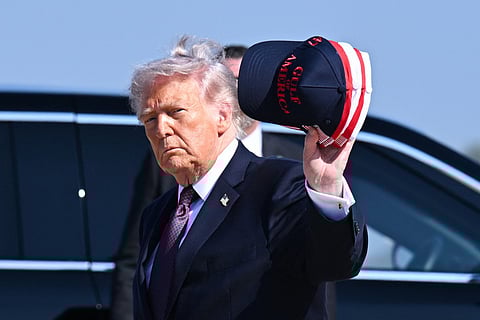
Dubai: Launching what he described as a “massive and ongoing” military campaign alongside Israel against Iran, US President Donald Trump appears to be pursuing a goal he once publicly rejected: Regime change.
In a video address posted early Saturday, Trump framed the operation as necessary to protect American national security and prevent Iran from threatening US forces and allies. But his language went further than previous justifications centred on nuclear containment.
“When we are finished, take over your government. It will be yours to take,” Trump told the Iranian people. “This will be, probably, your only chance for generations. The hour of your freedom is at hand.”
CNN reported that Trump’s remarks laid bare a dramatic shift in his objectives, moving beyond nuclear containment toward open calls for political change inside Iran. AFP also noted that the president’s rhetoric marked a significant evolution from his earlier public posture, in which he had emphasised forcing Tehran into a new nuclear agreement rather than seeking to remove its clerical leadership.
The campaign — which US officials have said could last several days — represents the largest American military buildup in the Middle East since the 2003 invasion of Iraq. According to CNN, the strikes followed weeks of deliberation inside the White House, as officials weighed military risks and the possibility of Iranian retaliation.
From deal-making to regime pressure
For weeks, Trump had suggested his objective was limited: Compel Iran to abandon its nuclear ambitions and missile capabilities. In public appearances, he said Tehran simply needed to state it would not pursue nuclear weapons.
“They should make a deal,” Trump said Friday. “They don’t want to say the key words: ‘We’re not going to have a nuclear weapon.’”
Yet Iran has repeatedly said it is not seeking nuclear weapons, even as Western intelligence agencies have raised concerns over its uranium enrichment levels.
In his latest remarks, however, Trump shifted emphasis away from diplomacy and toward dismantling Iran’s military infrastructure and encouraging internal political change.
AFP reported that Trump described plans to “obliterate” Iran’s missiles and “annihilate” its navy. CNN noted that the explicit call for Iranians to “take over your government” places the United States closer to an openly stated regime-change posture — something Trump had long criticised in past US interventions.
A break from Trump’s earlier rhetoric
Trump has frequently condemned US attempts to remake the Middle East.
In a speech last year in Riyadh, he denounced previous American leaders for seeking to impose new systems in Iraq and Afghanistan.
“In the end, the so-called nation-builders wrecked far more nations than they built,” he said.
During the 2024 campaign, his allies portrayed him as the candidate of restraint. Senior adviser Stephen Miller wrote at the time that “Trump = Peace,” contrasting him with what he called “warmongering neocons.”
Now, Trump is overseeing sustained strikes inside Iran for the second time in his second term, following limited attacks on Iranian nuclear facilities last June.
Domestic and military risks
The decision carries significant political and military risk.
Thousands of US troops remain stationed across the Middle East and could become targets of Iranian retaliation. CNN reported that Iran has already fired missiles across the region, including targeting areas near the US Navy’s Fifth Fleet headquarters in Bahrain.
US intelligence officials remain uncertain about what would follow any destabilisation of Iran’s leadership, according to reporting cited by AFP. Historical examples of air campaigns alone producing regime collapse are limited.
Behind the scenes, CNN reported, Trump and senior advisers debated strike options for weeks. Military officials, including Chairman of the Joint Chiefs of Staff Gen. Dan Caine, warned of the potential for prolonged conflict and unpredictable escalation.
Despite that, Trump pressed forward, ordering a substantial military mobilisation in the region.
He acknowledged the potential cost.
“The lives of courageous American heroes may be lost and we may have casualties — that often happens in war — but we’re doing this not for now. We’re doing this for the future, and it is a noble mission,” he said.
Vice-President JD Vance has sought to reassure Americans that the operation would not resemble the prolonged wars in Iraq or Afghanistan, saying the administration intends to avoid repeating past mistakes.
A changing equation inside Iran
The context inside Iran has also shifted.
Mass demonstrations that began over economic grievances late last year posed one of the most significant internal challenges to the Islamic Republic in decades. Authorities suppressed the protests forcefully, with thousands reported killed.
AFP noted that Trump’s rhetoric toward Iranian protesters earlier this year signaled sympathy for their cause. At the time, he warned that the US was “locked and loaded” should Tehran escalate its crackdown.
Still, whether external military pressure can translate into internal political upheaval remains uncertain.
An uncertain endgame
Trump’s objectives — stopping Iran’s nuclear programme, dismantling its missile arsenal, weakening its regional proxy network, and potentially encouraging regime change — are ambitious and overlapping.
How the current military campaign advances those goals remains unclear.
As CNN noted, the strikes mark a defining geopolitical gamble for Trump. With Iran already firing back, the uncertainty now centres on the scale of escalation — and how long Washington is prepared to sustain the fight.


