Three weeks on, weakened but defiant: Why Iran may prolong the war despite heavy losses
Strategy shifts from survival to raising costs as conflict drags on
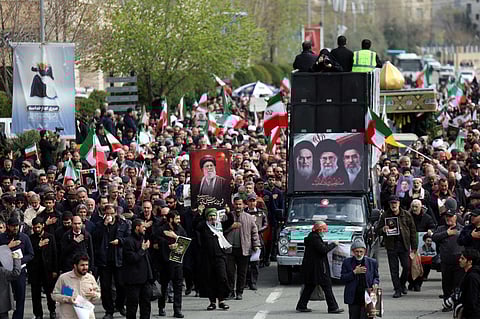
Dubai: The losses at the top of Iran’s power structure have been staggering.
The Supreme Leader is dead. His successor, Mojtaba Khamenei, has not been seen in public since the strike that killed his father — raising fresh questions over who is actually running the country.
Ali Larijani, the regime’s key wartime strategist and de facto decision-maker, has been killed.
Senior figures across defence, intelligence and security ministries have been wiped out, along with some of the most important commanders of the Islamic Revolutionary Guard Corps.
Yet, even after this decapitation of its leadership, Iran is not stepping back. Instead, it is signalling a willingness to prolong the war — betting that endurance, not immediate victory, could reshape the conflict in its favour, according to an analysis by CNN.
In its latest rhetoric, a senior Iranian commander warned that even “parks, recreational areas and tourist sites” could be targeted — remarks carried by Lebanon’s Al Jadeed — signalling a possible expansion beyond traditional military targets.
At first glance, the strategy appears counterintuitive. Iran has suffered heavy battlefield losses, its command structure has been disrupted and its economy is under growing strain. But analysts say prolonging the war may be a calculated decision driven by survival, strategy and leverage.
Survival over surrender
For Iran’s leadership, the greater danger may not be defeat on the battlefield, but the perception of defeat at home. A rapid de-escalation under pressure could embolden internal dissent and weaken the regime’s grip on power.
By continuing the fight, Tehran can project resilience — reinforcing a narrative it has long relied on: that it can withstand pressure from more powerful adversaries.
Why Iran may prolong the war
Regime survival: Backing down risks internal instability
Attrition strategy: Sustained attacks to raise long-term costs
Wider escalation: Threats extend beyond military targets
Time to regroup: Leadership losses force recalibration
Leverage later: Longer war may improve negotiating position
“Iran’s leadership has long prioritised survival of the system above all else,” analysts say, pointing to a strategy built on absorbing pressure rather than yielding to it.
A war of attrition
Unable to match the United States and Israel in direct conventional warfare, Iran appears to be leaning into a war of attrition.
This involves sustained, lower-cost attacks — including drones, missiles and allied groups — designed to gradually raise the cost of the conflict.
Over time, even a weaker actor can impose significant strain by forcing its adversaries into a prolonged, resource-intensive confrontation.
Expanding the battlefield
Iran is also signalling an intent to widen the conflict geographically. Threats to shipping routes, energy infrastructure and even distant or symbolic targets — such as its attempted missile strike on the US-UK base in Diego Garcia — suggest a deliberate effort to spread the impact far beyond its borders.
That risk was underscored when a Revolutionary Guard commander warned that even “parks, recreational areas and tourist sites” worldwide could be targeted — signalling a potential shift beyond traditional military targets.
“The idea is to make the cost of this war global, not just Iranian,” one regional analyst told CNN, reflecting a broader assessment of Tehran’s approach.
By increasing disruption beyond its borders, Iran raises the stakes — potentially drawing in international pressure for de-escalation.
Buying time to regroup
A prolonged conflict also gives Iran time — a critical factor after successive leadership losses.
Stretching the timeline allows space to reorganise command structures, stabilise internal control and adapt strategy. Iran’s decentralised networks, particularly through the Revolutionary Guard, allow it to continue functioning even after major disruptions at the top.
Forcing negotiations on better terms
There is also a diplomatic calculation.
“Time is not necessarily on the side of Iran’s adversaries if the conflict drags on,” Ellie Geranmayeh of the European Council on Foreign Relations told The Guardian in earlier remarks on Tehran’s negotiating posture.
A longer war could shift leverage by raising costs for all sides — potentially allowing Iran to enter any future negotiations from a less disadvantaged position.
Endurance as strategy
Underlying all of this is a deeper ideological framework. Iran’s leadership has long framed endurance as strength — the ability to absorb punishment while continuing to fight.
Even heavy losses can be recast as proof of resilience.
That does not reduce the risks. A prolonged war raises the danger of escalation and economic strain. But for now, Iran appears willing to take that gamble — betting that a drawn-out conflict may ultimately serve it better than a swift resolution shaped by its adversaries.


