Trump threatens to sink Iranian vessels as US strikes oil tanker, Ghalibaf calls for lasting security
CENTCOM chief concludes regional meetings as Gulf security concerns intensify
Highlights
The Trump administration has issued new Iran-related sanctions
The Treasury Department on Monday imposed sweeping new sanctions against more than two dozen Iranian exchange houses, overseas front companies and financial operatives accused of moving billions of dollars through a global "shadow banking" network to keep Iran connected to international trade, according to Fox News.
The action, carried out by the Treasury’s Office of Foreign Assets Control (OFAC), targeted "financial plumbing" spanning Iran, Hong Kong, Turkey among others that officials say enables Tehran to bypass US restrictions, sell oil and petrochemicals, and settle transactions in Russian rubles and Chinese yuan.
"Iran’s economy is underwater, and its leaders are panicking," Treasury Secretary Scott Bessent wrote in a statement Monday before the news release. "Iran’s shadow banking system is the last financial lifeline of a bankrupt regime. Treasury will continue dismantling these illicit networks until we have buried the head of the snake."
Israel's transport ministry approves flydubai flights
Israel's transport ministry said on Monday it had approved the resumption of flydubai flights pending final confirmation after a co-pilot tried to crash one of its planes in September.
"Minister (Miri) Regev approved the return of the airline flydubai, subject to the approval of the security authorities. This step constitutes a significant move in renewing air connectivity between Israel and the United Arab Emirates," the transport ministry said in a statement after a delegation visited the UAE.
US oil contract WTI falls below $80 for first time since August
The main US oil contract slid below $80 a barrel Monday for the first time since August as investors anticipated a return to an oversupplied market, despite the ongoing Middle East war.
West Texas Intermediate tumbled more than four per cent to $79.95 a barrel, and the main international benchmark, Brent North Sea crude, dropped 4.1 per cent to $88.75 a barrel.
Israel leadership rivals clash over Iran threat ahead of coalition talks
Gadi Eisenkot, who is tasked with forming the next Israeli government, said he saw no immediate reason for attacking Iran on Monday, contradicting caretaker Prime Minister Benjamin Netanyahu who warned against downplaying "grave threats".
The remarks from both politicians came hours before their parties were due to meet for the third time to discuss possible coalition-building, after lengthy negotiations the day before delivered no breakthrough.
Eisenkot has until December 6 — a deadline which can be extended by 14 days — to form a government to replace Netanyahu after the October election failed to deliver a clear majority for either bloc.
Iran seeks $290 billion in damages against the US
Iranian courts have demanded that the United States pay $290 billion in damages, a judiciary official said on Monday.
"We have secured court rulings in domestic courts awarding $290 billion in damages against the Americans," said Hassan Abdolianpour, head of the judiciary’s centre for lawyers, according to state television.
He also said that several lawsuits have been filed against the Gulf Arab nations for "allowing their territory to be used by America to launch attacks against Iran".
According to state TV, the damages cover US actions going back decades.
Israel charges east Jerusalem man over alleged suicide attack plot
Israeli prosecutors have indicted a Palestinian man accused of planning a suicide attack at a flashpoint site in the occupied Old City of Jerusalem, and helping another person prepare a separate attack, the justice ministry said Monday.
The State Attorney's Office said Abdallah Jamjum, 22, a pharmacy student from Israeli-annexed east Jerusalem, planned to carry out a suicide attack at the Al-Aqsa Mosque compound, known to Jews as the Temple Mount, with the aim of killing Jewish visitors and deterring future visits.
The compound, the most sacred site in Judaism and the third-holiest in Islam, has long been the epicentre of tensions in Jerusalem's Old City.
According to the indictment, Jamjum "underwent a process of ideological radicalisation" in his neighbourhood "in which messages encouraging suicide attacks and the killing of Jews were conveyed".
Netanyahu says Israel faces 'grave threats', warns against downplaying them
Israel's caretaker prime minister Benjamin Netanyahu warned on Monday of "serious and grave threats" facing Israel and the danger of downplaying them, shortly after his opponent Gadi Eisenkot said there was no immediate need for military action against Iran.
"Anyone who belittles or downplays these immediate, serious and grave threats surrounding us does so for political reasons," Netanyahu said at a briefing in Israel's parliament in which he called for a unity government, as Eisenkot attempts to form a new ruling coalition.
10 dead in Saudi attack on Yemen port city: Houthis
Houthi media said Monday that a Saudi attack had killed 10 people and wounded more than 20 in Yemen's key port city of Hodeida.
The Iran-backed fighters, who control swathes of Yemen including Hodeida, are battling a Saudi-led coalition that supports Yemen's internationally recognised government.
The strike targeted a building belonging to Yemen's Public Telecommunications Corporation, the Houthis' Almasirah television channel wrote on X.
The channel had earlier reported the toll as four dead before raising the number several hours later.
Saudi Arabia did not immediately comment on the report.
Israel defence minister says police, not army, should handle settler violence
The defence minister in Israel's caretaker government on Monday said the police, not the military, should deal with violent settlers in the occupied West Bank, after Palestinian vehicles and properties were torched over the weekend.
It is not the first time Israel Katz, who serves in the right-wing caretaker government of Benjamin Netanyahu, has spoken about transferring civilian law enforcement over West Bank settlers to the police.
If implemented, the measure could constitute a step towards Israeli annexation of the Palestinian territory.
Iran says will use 'all available means' to counter US blockade
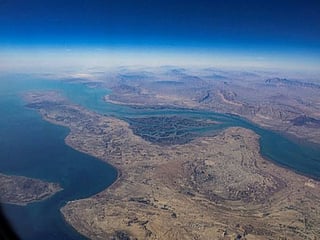
Iran said it would use all means at its disposal to counter a US naval blockade that was imposed in retaliation for its own push to block the Strait of Hormuz.
"We will certainly not tolerate these actions and will use all available means to counter US aggression," said foreign ministry spokesman Esmaeil Baqaei in a weekly press briefing.
In response, the US imposed its own counterblockade of Iranian ports. It later announced a raft of economic sanctions, and launched a task force to disrupt land routes into Iran.
"You should bear in mind that what the Americans have described as economic sanctions, an economic blockade and a naval blockade undoubtedly constitutes an act of military aggression against Iran," said Baqaei.
"Under these circumstances, Iran is entitled, pursuant to Article 51 of the UN Charter, to use any means at its disposal to defend itself."
Iranian forces have made multiple announcements in recent weeks of ships catching fire attempting to use routes that Tehran considers off-limits.
Diplomatic efforts to resolve the crisis remain stalled, especially since the collapse of a June deal that laid out a pathway to a permanent settlement.
Iran has said Hormuz could be open within two days but only if Washington agreed to its list of demands which include the lifting of the blockade.
"If the American side fulfils its commitments, security can be restored to the Strait of Hormuz and the region in the shortest possible time," said Baqaei.
Iran claims US plans to destroy its military failed
Major General Mostafa Izadi, deputy commander-in-chief of Iran's Islamic Revolutionary Guard Corps (IRGC), has claimed that US efforts to defeat Iran's military have been unsuccessful.
He said Washington had sought to destroy Iran's armed forces, including the IRGC, the army, the Law Enforcement Command (Faraja) and popular forces.
However, Izadi said none of these plans had succeeded, crediting the military's leadership and public support for resisting the US campaign.
He also attributed Iran's claimed success to what he described as the close connection between the battlefield and the public.
Iran says Pakistan-led mediation efforts are ongoing
Iranian Foreign Ministry spokesman Esmaeil Baghaei says mediation efforts by Pakistan and Qatar to end the war are continuing, despite what he described as a lack of seriousness from Washington.
Accusing the US of failing to recognise the rights of the other side, Baghaei said diplomacy must involve a fair exchange of positions.
He said Pakistan, in particular, along with Qatar, was continuing its mediation efforts because both countries were concerned about the situation.
“Mediators, in any circumstances, continue their efforts and good offices,” he said.
Iran says US threats will only strengthen its resolve
Iran has brushed aside the latest threats from Washington, with Foreign Ministry spokesman Esmaeil Baghaei saying repeated US claims of victory have become an almost daily occurrence.
Baghaei said threats would not force Iranians to give up their homeland or national dignity. Instead, he argued, such warnings would strengthen the country's resolve and unity.
His remarks came hours after US President Donald Trump said he would be inclined to restart the war with Iran if no agreement is reached by the New Year.
Iran says it can reopen Strait of Hormuz within hours
Iran can quickly restore security in the Strait of Hormuz if the US meets Tehran’s conditions, Foreign Ministry spokesman Esmaeil Baghaei has said.
Asked whether the vital waterway could be fully reopened within two hours of a deal, Baghaei said Iran could “act very quickly”.
“Iran remains steadfast in honouring its commitments and will fulfil them as soon as possible, provided the other side complies with the relevant conditions,” he said.
However, Tehran would not back down from defending what it considers the rights of the Iranian people.
“Iran knows its objectives and the rights of the Iranian people. It will not retreat from defending these rights,” Baghaei added.
Egypt steps up regional de-escalation efforts
Egyptian Foreign Minister Badr Abdelatty has held separate phone calls with Qatar's Prime Minister and Foreign Minister Sheikh Mohammed bin Abdulrahman bin Jassim Al Thani and Saudi Foreign Minister Prince Faisal bin Farhan Al Saud.
Discussions focused on efforts to de-escalate regional tensions, strengthen coordination and support mediation initiatives, Abdelatty said in posts on X.
British athlete swims Hormuz to highlight war’s impact
British endurance swimmer Lewis Pugh has swum in the North Pole and Antarctica to draw attention to environmental causes.
But battling freezing waters and extreme conditions hasn’t prepared him for his latest challenge: swimming the Strait of Hormuz while tankers are attacked and blown up nearby.
Houthi media says four dead in Saudi attack
Houthi media said Monday that a Saudi attack killed four people and wounded 18 in Yemen's key port city of Hodeida.
The Iran-backed fighters, who control large swathes of Yemen including Hodeida, are battling a Saudi-led coalition that backs Yemen's internationally recognised government.
The strike targeted a building belonging to Yemen's Public Telecommunications Corporation, the Houthis' Almasirah television channel wrote on X.
Riyadh did not immediately comment on the report.
Iran war escalation: Trump's warning before US midterms
US President Donald Trump has accused Iran of becoming more aggressive following the Democrats' victory in the November 3 midterm elections, claiming Tehran views the party as weak and ineffective.
In a series of posts on his Truth Social platform, Trump said he had predicted increased Iranian aggression after the election. He also accused Democrats and Iran of trying to keep oil prices high before the vote, while linking the subsequent decline in crude prices to the election outcome.
Trump separately blamed Democrats for the downturn in US stock markets, criticising the party's economic policies.
His comments come amid continuing tensions between Washington and Tehran, with Trump also indicating that he is inclined to resume military strikes against Iran after the New Year if negotiations fail.
Read more here.
CENTCOM chief wraps up Middle East tour
US Central Command chief Admiral Brad Cooper has concluded a weeklong Middle East visit, meeting senior civilian and military leaders in Israel, Qatar and Saudi Arabia to discuss regional security and continued cooperation.
He also met US troops deployed across the region, thanking them for their service and recognising their bravery and contributions during combat operations against Iran’s Islamic Revolutionary Guard Corps (IRGC).
Iran's double missile launcher: What to know
Iran says it has a launcher that can fire two liquid-fuel missiles at once, and showed it inside an underground base.
The claim comes from state media, in clips shared by state controlled IRIB and PressTV, a state-funded network based in Tehran.
No independent source has verified the system’s performance.
State news agency IRIB said the Revolutionary Guards unveiled the launcher and a new missile base during a visit by IRGC commander Ahmad Vahidi and aerospace chief Seyed Majid Mousavi.
Read more here.
US struck tanker amid blockade standoff
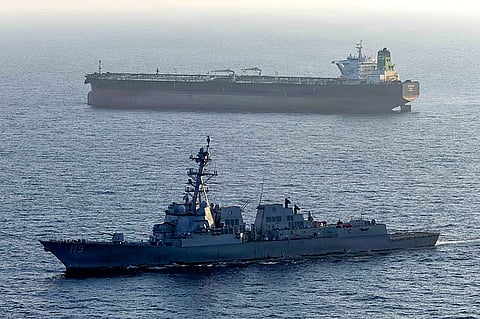
The US struck a tanker exporting Iranian oil as part of its blockade, according maritime security analyst. There is no official confirmation from either the US or Iran.
UKMTO, however, reported on Sunday evening that a tanker was involved in an incident with "military forces" in the Gulf of Oman, east of the Strait of Hormuz, near the Iranian city of Chabahar. It didn’t identify the vessel or link it to the reported Iranian convoy.
The location is close to the US blockade line. Central Command hasn’t formally commented on the strike. It rejected Iranian claims of successful attacks. Maritime security analyst reported about the US attack in an X post.
Iran has threatened for days that any US attempt to stop its tankers would draw a “fierce military response” and immediate strikes on Gulf energy infrastructure. Deputy Foreign Minister Kazem Gharibabadi called the blockade an "act of war".
A report by Hamshahri, a Tehran-municipality-linked outlet, claimed 14 tankers were preparing to move at Kharg Island. A UANI adviser, however, called a 14-ship breakout almost logistically impossible and based on propaganda. Another report stated 31 laden tankers will attempt to cross the blockade line. There is no independent confirmation of the Iranian tankers' movement. The blockade is currently being enforced by the US Central command, with two US carrier strike groups currently in the region.
Trump warns Tehran against 'testing' naval blockade
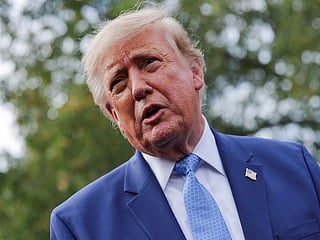
US President Donald Trump has threatened to sink Iranian vessels attempting to breach the American naval blockade, as reports emerge of a fresh US strike against a tanker exporting Iranian oil.
The developments raise the risk of a wider confrontation in the Gulf, particularly after Iran warned that attacks on its shipping could trigger retaliation against energy infrastructure across the region.
In an interview with Fox News chief foreign correspondent Trey Yingst on Sunday, November 22, Trump was asked about reports that Iran was preparing to test the US naval blockade.
His response was blunt: "I hope they do, they'll all be at the bottom of the sea like the rest of the navy," Trump said.
Yingst also reported that Trump was inclined to resume military strikes against Iran after the New Year if diplomatic negotiations failed to produce an agreement.
Trump accused Iranian negotiators of prolonging discussions without making meaningful concessions, describing them as "professional tap dancers".
The comments signal that Washington is keeping military escalation on the table even as indirect diplomatic contacts with Tehran continue.
'Tanker swarm' from Iran: 31 tankers already beyond Hormuz to challenge US blockade, says report
Iran may not need to send another convoy from Kharg Island to test the US naval blockade. At least 31 laden, sanctioned tankers have already passed through the Strait of Hormuz and are positioned outside the waterway, potentially within reach of the US blockade line.
According to maritime intelligence firm Windward AI, its Maritime Intelligence Operations Centre (MIOC) identified 31 tankers positioned beyond the Strait between November 13 and 20.
Four are crude oil tankers carrying an estimated 4.9 million barrels of oil. Their positions were confirmed through satellite imagery.
The closest vessel is the Suezmax tanker TOUR 2 (IMO 9364112), spotted off Chabahar, approximately three to six hours' sailing from the blockade line.
The remaining 27 vessels are carrying liquefied petroleum gas (LPG) or refined petroleum products. Twenty are positioned at the Shinas and Sohar anchorages.
Saudi, Pakistani foreign ministers discuss regional diplomacy amid Iran tensions
Saudi Foreign Minister Prince Faisal bin Farhan and Pakistani counterpart Ishaq Dar discussed regional developments and diplomatic efforts in a phone call on Sunday, Saudi Arabia’s Foreign Ministry said on X.
The call came amid rising tensions between Iran and the United States. The two ministers also discussed ways to strengthen cooperation between their countries.
The ministry did not release further details of the conversation. Saudi Arabia and Pakistan are seeking closer coordination as regional tensions continue to rise. The call signals a push for diplomatic engagement amid the Iran-US standoff. The two countries play key roles in regional security and could help shape diplomatic efforts.
Iranian missiles are displayed next to a banner with a picture of Iran's Supreme Leader, Mojtaba Khamenei, on a street in Tehran, Iran, September 27, 2026. (via Reuters)
Ghalibaf calls for 'sustainable deterrence' to ensure lasting security
Iranian Parliament Speaker Mohammad Bagher Ghalibaf has warned that the country cannot remain indefinitely in a situation of "neither war nor peace", calling for what he describes as sustainable deterrence to prevent another military confrontation.
Ghalibaf argued that the only way to eliminate the threat of war is to remove the underlying security threat against Iran. "If we do not want the current situation to continue, we must remove the threat from our country," he said, adding that this could only be achieved through "sustainable deterrence".
UAE, Oman continue search for missing Jordanian sailor after Hormuz tanker attack
The United Arab Emirates and Oman are searching for a Jordanian sailor missing after an ADNOC Logistics and Services tanker was attacked in the Strait of Hormuz. The attack is part of a series of incidents involving seven oil tankers in the area since November 16.
The search follows a series of attacks on commercial vessels in the strait since November 16. The Joint Maritime Information Centre said seven oil tankers have been hit, including three vessels struck near Oman’s coast between November 20 and 21. The latest attacks targeted outbound tankers between 8 and 17 nautical miles from Khasab, Oman.
US‑Israel war on Iran: Recent developments
Day 264: US says blockade of Iran reaches 130 consecutive days
Day 263: US strikes near Iran’s Qeshm Island as tensions escalate
Day 262: Iran war has cost US more than $48 billion: Pentagon
Day 261: Iran rejects claims of possible chemical attack on US
Day 261: Third US carrier enters Middle East as Iran blockade widens