Lebanon, Israel and US sign trilateral deal in Washington
Rubio calls deal a framework for lasting peace and security between Lebanon and Israel
Highlights
We are closing this coverage now. For the latest updates, click here:
Israel and Lebanon hail Washington deal, rejected by Hezbollah
Israel and Lebanon hailed an agreement signed Friday with the United States to pave a way towards peace on their front in the Middle East war, while Iran-backed Hezbollah warned the deal would thwart plans to resolve the broader conflict.
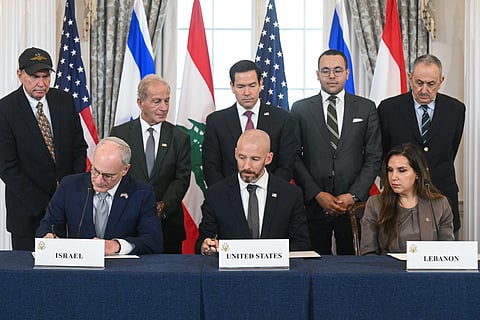
At the signing ceremony in Washington, US Secretary of State Marco Rubio -- flanked by envoys from Israel and Lebanon -- said the trilateral agreement "begins to put in place a framework for lasting peace and security."
"It's the beginning of the beginning. There's a lot of work ahead," he said.
Lebanon president says Israel deal first step to restoring sovereignty
Lebanese President Joseph Aoun said a deal signed with Israel on Friday was a first step towards fully restoring his country's sovereignty after the latest war between Israel and the Iran-backed Hezbollah.
"The framework agreement signed today is a first step" that will enable Lebanese "to return to their fully liberated lands, and to their certainly rebuilt homes... under the sovereignty of the Lebanese state that has no partner in its sovereignty over its land and people," Aoun said according to a statement released by his office.
"We swear to continue to work until this is fully achieved. There will be no more occupation, prisoners, subordination or tutelage," he added.
Netanyahu says Israel to remain in south Lebanon until Hezbollah disarms
Israeli Prime Minister Benjamin Netanyahu said on Friday that Israel would remain in south Lebanon until Hezbollah disarms, shortly after the announcement in Washington of a framework agreement with the United States and Lebanon.
"The most important thing is, first of all, that Israel remains in the security zone in southern Lebanon. This is a major achievement, and we will maintain it as long as Hezbollah has not disarmed," Netanyahu said in a pre-recorded video shared with Israeli media shortly after the trilateral framework agreement was announced.
Netanyahu says Lebanese displaced from 'security zone' not allowed home under new deal
Israeli Prime Minister Benjamin Netanyahu said on Friday that Lebanese civilians displaced from the so-called "security zone" that Israeli forces established in south Lebanon won't be allowed to return home after new deal was announced with Lebanon and the US.
"We are maintaining the original security zone at all times, outside the range of anti-tank fire. We are not allowing Hezbollah to enter it, nor are we allowing the civilian population to enter," Netanyahu said in a pre-recorded video shared with Israeli media shortly after a trilateral framework agreement was announced in Washington.
Netanyahu says Israel will allow Lebanese army to take control of 'pilot areas'
Lebanon, Israel, US sign trilateral framework agreement in Washington
Lebanon, Israel and the United States on Friday signed a trilateral framework agreement aimed at paving the way for a peace deal between the two long-time Middle East adversaries.
"We are happy to announce a framework agreement between the sovereign government of Lebanon and of course the government of Israel, with a mediation and support of the United States of America," US Secretary of State Marco Rubio said at the signing ceremony.
The agreement "begins to put in place a framework for lasting peace and security," Rubio added.
Ships crossing Hormuz use Oman passage despite Iran warnings
Traffic levels in the Strait of Hormuz fell back from Wednesday's high, but vessels continued to use a non-Iranian-approved passage despite a ship being struck by a projectile, tracking platforms showed Friday.
At least 42 commodity vessels -- including tankers carrying oil, gas, and dry bulk such as fertilisers -- crossed on Thursday, Kpler's tracking platform showed, down from a high of 57 on Wednesday.
Ten of those vessels entered the Gulf, while 32 exited. Half of the 42 vessels used a southern passageway hugging the coast of Oman.
Another 29 commodity vessels had already crossed the strait by Friday afternoon, 10 coming into the Gulf and 19 leaving, according to Kpler.
Trump: Iran fired four drones at Hormuz ships, one hit cargo vessel
President Donald Trump said on Friday that Iran fired at least four one-way attack drones at ships transiting the Strait of Hormuz, with one striking the upper deck of a large cargo vessel, causing damage before it was able to continue on its way. Three other drones were intercepted and shot down. Trump called the incident a "foolish violation" of the ceasefire agreement.
14 seafarers killed, more than 600 vessels remain stranded in the Strait of Hormuz
The International Maritime Organization (IMO) said 14 seafarers have been killed since the current regional tensions began, while more than 600 vessels remain stranded in the Strait of Hormuz, despite ongoing efforts to ease the maritime bottleneck.
IMO Secretary-General Arsenio Antonio Dominguez stressed that shipping must not be used as leverage in geopolitical conflicts and called for the protection of navigation through the Strait of Hormuz. He said around 150 vessels carrying about 4,000 seafarers had been safely evacuated over the past four days, while the organisation has launched an urgent investigation into an attack on a vessel after it transited the southern shipping lane.
115 vessels, 2,500 seafarers evacuated from Strait of Hormuz
A total of about 115 vessels and 2,500 seafarers have been evacuated from the Strait of Hormuz since Tuesday, the head of the UN maritime body said Friday.
International Maritime Organization secretary-general Arsenio Dominguez gave the update after the IMO on Thursday suspended its efforts to evacuate some 600 ships and 11,000 sailors, following an attack on a vessel in the Gulf of Oman.
Dominguez told an online press conference that "115 (vessels) have evacuated in the last three and a half days, representing around 2,500 seafarers that have now safely left the Strait of Hormuz".
In the memorandum of understanding signed by Iran and the United States last week aimed at ending the war, Tehran committed to clearing the mines from the area within 30 days.
NCEMA resolves early warning system glitch
The National Emergency Crisis and Disaster Management Authority (NCEMA) said a technical fault in the UAE's early warning system on Friday evening resulted in incorrect emergency alerts being sent to residents.
The authority said the problem was identified shortly after the alerts were issued, with specialist teams moving quickly to fix the malfunction and restore normal service. It said the corrective measures were carried out in line with approved emergency response procedures to minimise any disruption.
UAE, Iran discuss regional developments following US-Iran agreement
Sheikh Abdullah bin Zayed Al Nahyan, Deputy Prime Minister and Minister of Foreign Affairs, has discussed with Iranian Foreign Minister Abbas Araghchi regional developments following the agreement and signing of a memorandum of understanding between the United States and Iran.
During a phone call, the two ministers reviewed the overall situation in the region and the latest regional developments in the aftermath of the agreement.
UAE urges public to disregard earlier emergency alert
Residents across the UAE received an unexpected emergency alert on Friday, prompting swift action from authorities. The UAE authorities shortly after urged the public to disregard the notice, confirming that the situation was safe and there was no cause for alarm.
Get updated faster and for FREE: Download the Gulf News app now - simply click here.
Hezbollah chief says Israel must 'unconditionally' leave Lebanon
Hezbollah leader Naim Qassem on Friday said Israel has "no option" but to withdraw from Lebanese areas it occupies, adding that the Iran-US deal that reduced fighting with Israel was an American-Israeli defeat.
His televised speech was made as Shia Muslims across the country were marking Ashura, a day of mourning for the death of Hussein, a key figure in Shia Islam.
Tens of thousands of supporters participated in a ceremony in Beirut's southern suburbs waving Hezbollah and Iranian flags in the largest gathering organised by the pro-Iran group since the outbreak of war in March.
"Israel has no option but to withdraw completely from every inch of our Lebanese land... Israel must leave unconditionally," Qassem said.
Hezbollah drew Lebanon into the regional war on March 2 with rocket fire at Israel to avenge the killing of Iran's supreme leader in US-Israeli strikes.
Israel issues first evacuation order in Lebanon since ceasefire
Israeli forces dropped leaflets over the southern Lebanese town of Mansouri on Friday, instructing residents to evacuate, marking the first such directive since a ceasefire between Israel and Hezbollah came into effect, according to Lebanese state media.
A senior Lebanese military official confirmed that Israel had recently incorporated the town into a zone currently under Israeli military occupation in southern Lebanon. Lebanese officials added that Israeli troops have been enforcing the zone's northern boundary by opening fire on anyone who approaches, including civilians and Lebanese army personnel, as reported by Reuters.
Iran issues stark warning over Hormuz control
Iran reasserted its authority over the Strait of Hormuz on Friday, warning Gulf states against aligning with Washington, a day after an attack on a vessel near Oman cast doubt over a fragile preliminary deal to end the Iran war. Tehran was responding to a joint statement by the US and six Gulf nations that rejected Iran's demand to levy tolls on ships passing through the strait, which it labeled "interventionist, irresponsible and provocative."
Deputy Foreign Minister Kazem Gharibabadi stressed that safe passage through the waterway could not be guaranteed without recognizing Iran's role as a coastal state. As per Reuters, Iranian state TV reported that the Revolutionary Guard turned back three foreign tankers it claimed had attempted an unauthorised transit of the strait, though no further details were provided.
Hormuz traffic drops
Vessel traffic through the Strait of Hormuz declined on Friday compared to earlier in the week, following an Iranian strike on a Taiwanese-operated cargo ship. Ship tracking data confirmed fewer vessels made the transit than in previous days.
In response to the attack, which damaged the vessel near Omani waters, the UN's maritime agency suspended its voluntary program aimed at helping stranded ships and their crews exit the Gulf.
Despite the heightened security concerns, tanker movements into the Gulf continued. At least four tankers, among them three very large crude carriers, each capable of holding up to two million barrels of oil, entered the Gulf on Friday to take on cargo, according to tracking data from LSEG and MarineTraffic, as reported by Reuters.
Get updated faster and for FREE: Download the Gulf News app now - simply click here.
Iran warns on Hormuz parallel shipping routes
Iran has warned that safe passage through the Strait of Hormuz cannot be guaranteed for vessels using “parallel routes” or operating under arrangements it considers unclear or outside its coordination.
Kazem Gharibabadi, Iran’s deputy foreign minister, said such transit plans must align with Iran as the coastal state and comply with paragraph five of the Islamabad Memorandum of Understanding.
In a statement posted on X, he added that any framework lacking coordination with Tehran could lead to the suspension of designated alternative shipping routes.
Taiwan ship operator says vessel hit in Hormuz 'unharmed'
Taiwan’s Evergreen Marine said one of its container ships was struck by an “unidentified object” while transiting the Strait of Hormuz, but confirmed that the vessel, crew and cargo were unharmed.
The Singapore-registered ship, Ever Lovely, sustained minor damage to its bridge area and windows but continued its voyage without disruption, according to the Maritime and Port Authority of Singapore.
The incident was previously described by the UK Maritime Trade Operations as a projectile strike, with some reports attributing it to Iran, though no confirmation has been made.
Authorities called the attack “unprovoked” and said it occurred as tensions remain high in the region, prompting concerns over maritime security in the strategic waterway. The United Nations has also suspended evacuation efforts for mariners in the area following the incident.
South Korea to acquire 20,000 low-cost military drones
South Korea unveiled a plan to acquire 20,000 military drones to fend off North Korean threats, citing lessons learned from wars in Ukraine and the Middle East.
A small number of high-cost weapon systems dominated the battlefields of the past, but the mass deployment of low-cost drones is transforming the nature of warfare.
"Recent conflicts in Ukraine and the Middle East clearly demonstrate that drones have emerged as game changers on the battlefield," Defence Minister Ahn Gyu-back told reporters in Seoul.
South Korea remains technically at war with the North after their 1950-53 conflict ended in an armistice, not a peace treaty.
"North Korea is also continuing to develop a wide range of unmanned aerial capabilities, posing growing threats not only to South Korean military facilities but also to critical national infrastructure and civilian targets," Ahn said.
He said the government will push to rapidly deploy its Korean Long-range Uncrewed Combat Attack System (K-LUCAS) - a domestically developed munition believed to be similar to the US LUCAS developed by reverse-engineering Iran's Shahed attack drones.
The military also plans to acquire more than 20,000 low-cost expendable drones, Ahn said, without disclosing where from.
Hezbollah chief says Iran deal a declaration of US-Israeli defeat
Hezbollah leader Naim Qassem said that the US-Iran deal signed last week was a declaration of defeat by Israel and America, after the agreement also reduced fighting between his group and Israel.
"They wanted a major war... to eliminate our existence," Qassem said in a televised address to mark Ashura, a day of mourning for the death of a key figure in Shia Islam.
"We were able to stop this aggression and achieve a great victory... We have shattered the Israeli-American project and entered a new phase," he added. Iran "was able to reach the memorandum of understanding, which is an official declaration of the defeat of America and Israel".
Iranian national sought by US on hacking charges arrested in Montenegro
An Iranian national who is wanted by the United States for mass hacking attacks that caused damage of $3.4 billion was arrested in Montenegro, police in the Balkan country said.
The 39-year-old man, who holds both the Iranian and Turkish citizenship, is wanted by a court in New York on multiple charges, including conspiracy to commit computer fraud, hacking, and identity theft, a statement said.
Police located the man in the coastal Montenegrin town of Kotor, where he was arrested Thursday by request of the US and its Federal Bureau of Investigation, Montenegrin police added.
The suspect "from 2013 onward ... carried out mass hacking attacks on the infrastructure of the United States of America," including at more than 150 universities, the statement said.
The illegally obtained data was used by Iran's Islamic Revolutionary Guard Corps and Iranian universities, police said. A court in the capital Podgorica will handle the extradition proceedings, the statement added.
Montenegro is a US ally and a member of NATO. The small Adriatic Sea country of just 620,000 people is seen as the next in line to join the European Union.
Iran and Oman discuss 60-Day Strait of Hormuz traffic plan
Iranian Foreign Minister Abbas Araghchi and Omani Foreign Minister Sayyid Badr Albusaidi held discussions regarding maritime traffic in the Strait of Hormuz.
According to Tasnim news agency, the leaders discussed the 60-Day Strait of Hormuz traffic plan.
Earlier, Iranian Foreign Minister Abbas Araghchi said that he held a "productive call" with his Omani counterpart, adding that the duo discussed "future administration and maritime services in the Strait of Hormuz."
'Very strong' nuclear verification needed in Iran after war: IAEA head
A "very strong" verification system is needed in Iran following the Middle East conflict to ensure that the country does not develop nuclear weapons, the UN atomic watchdog chief said Friday.
"I think the objective of this (recent US-Iran) agreement is to ensure that there is no development of nuclear weapons in Iran. The government of Iran has declared quite clearly that this is not their intention," Rafael Grossi told reporters in Japan.
"But of course intentions are not enough. We have to have a very strong verification system in place... as soon as is practicable," Grossi said.
India ends restrictions on commercial gas
India has removed restrictions on supplies of commercial liquified petroleum gas imposed during the Middle East war when energy supplies were hit by the closure of the Strait of Hormuz.
The government ended the restrictions late Thursday on "non-domestic packed LPG and restored supplies to the levels prevailing prior to the West Asia crisis", the petroleum ministry said in a statement.
"The supply of bulk LPG, which had been suspended at the onset of the crisis, has been relaxed by 50 percent of the pre-crisis consumption levels," the statement added.
"The restoration follows the recent improvement in the LPG supply situation."
The decision follows improved energy cargo passing through the Strait of Hormuz after Iran and the US signed a deal that included opening the strategic waterway.
Saudi Aramco resumes oil loading at Ras Tanura
Saudi Aramco has restarted crude loading at its Ras Tanura terminal in the Gulf after a near four-month pause, shipping data from LSEG shows, Reuters reports.
Two Very Large Crude Carriers (VLCCs) were seen loading at the facility, while another waited nearby. Each vessel can carry around two million barrels of crude.
The restart marks a return of activity at the key export terminal operated by Saudi Aramco at Ras Tanura.
'Iran having hard time with food': Trump claims
US President Donald Trump on Thursday (local time) claimed that the US will take money from Iran as it is having a hard time with food.
Trump, while addressing Rose Garden Club Dinner with American Farmers, said that Iran will be a new market for the US.
"We have another one a new market coming up and that's called the lovely country of Iran. It's a beautiful place. Would anybody like to go there? The Islamic Republic of Iran is having a hard time with food and we're going to be taking some of their money and we'll spend it and we're going to be buying wheat, soybeans and corn a lot of it. And that process is going to be starting pretty soon. It's going to be pretty big too. I think it's going to be very big," he said.
Israel-Lebanon talks extended another day
US-mediated talks between Israel and Lebanon that were slated to end Thursday will go on for another day, the State Department said.
It said this fifth round discussions that began this week will resume Friday morning. "Israel and Lebanon talks remain ongoing as we continue to facilitate," the department said in a statement.
These talks come amid a fragile ceasefire between Israel and Iran-backed Hezbollah, an offshoot of the Mideast war that the United States and Iran are negotiating to bring to a definitive end.
US says wants deal with Iran, but not 'at any price'
Washington's top diplomat said there are limits to what it would accept in any Iran deal, as an attack on a ship in the Strait of Hormuz led the UN to suspend an effort to evacuate trapped mariners.
Secretary of State Marco Rubio - in Bahrain as part of a regional tour to reassure Gulf partners hit hard by the Middle East war - also dismissed the idea of allowing Tehran to charge fees in the strait, saying it would open the door to "total chaos".
The United States and Iran have signed a preliminary deal to end the conflict launched by the United States and Israel in late February, embarking on negotiations expected to address Tehran's nuclear programme, sanctions relief and global energy flows through the strait, where Iran has repeatedly targeted civilian vessels.
But Gulf countries and Israel also have longstanding concerns about Iran's support for proxies in the region and its missile programme, and it remains unclear whether those topics will be handled in the talks.
After meeting with Rubio on Thursday, foreign ministers from the Gulf Cooperation Council emphasised that "lasting regional peace and security requires addressing the full spectrum of Iran's threats, including its ballistic missiles, drones and support of proxies".
Hezbollah says Israel killed 3 civilians in Lebanon
Iran-backed Hezbollah on Thursday accused Israel of a "flagrant" ceasefire breach, saying it launched a drone and killed three civilians in southern Lebanon.
The group said the strike was a "direct attack" on "civilians," while Israel had earlier said it had killed fighters from Hezbollah ranks.
Hezbollah said it was the third "flagrant violation" by Israel "of the ceasefire to which it has committed itself so far".
US‑Israel war on Iran: Recent developments
Day 118: Oil price spikes after IRGC strike on ship in Hormuz
Day 117: Iran-Gulf reconciliation talks expected in Saudi Arabia
Day 116: Rubio lands in UAE on first leg of Gulf tour
Day 115: Iran will agree to allow weapons inspection: Vance
Day 114: Iranian military says halting offensive vs Israel
Day 113: Trump threatens US tolls on Hormuz strait if Iran talks fail
Day 112: Israeli strike hits south Lebanon despite truce deal
Day 111: Iran leader approves US deal despite 'different view'
Day 110: Trump signs surprise interim deal with Iran to pause war