Iran war or peace? Qatar presents new deal to Iran as Trump says ‘anything is possible’
Tehran expected to respond this week as Trump keeps strikes on table, Netanyahu warns
Dubai: Qatar has presented Iran with a new peace proposal aimed at averting another major military confrontation, even as US President Donald Trump refused to rule out fresh strikes and Israeli Prime Minister Benjamin Netanyahu called for eliminating the Iranian threat “once and for all”.
Qatari mediators delivered the draft agreement in Tehran on Sunday, with Iran expected to respond by the end of the week, Reuters reported on Wednesday, citing an official briefed on the negotiations.
The proposal outlines a seven-day process requiring both sides to take daily confidence-building measures. The process could begin early next week, with several countries acting as guarantors, the official said, without identifying them.
The diplomatic initiative comes amid fears that renewed US-Israeli military action against Iran could trigger wider regional retaliation and further disrupt global energy supplies.
Trump: ‘Anything is possible’
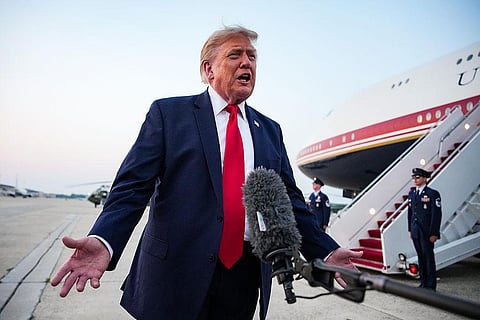
Trump added to the uncertainty on Wednesday when he declined to say whether he intended to order military strikes against Iran after the US midterm elections.
“I can’t tell you that,” Trump told reporters after arriving at Joint Base Andrews in Maryland. “But anything is possible.”
He claimed Tehran wanted an agreement but suggested Iranian leaders might be delaying negotiations until after the American elections, warning that waiting would not improve their position.
“We’ve decimated their military. We’ve decimated the finances. They have no money. They have inflation the highest in the world, 300 percent. The government is gone. But we’ll see what happens,” Trump said.
His comments left open the possibility of either a negotiated settlement or renewed military action if diplomacy fails.
Netanyahu sees ‘historic opportunity’
Netanyahu struck an even more forceful tone, declaring that Israel had an exceptional opportunity to work with Trump to eliminate the Iranian threat.
“Israel is facing a historic, one-time opportunity along with our friend President Trump,” Netanyahu said, calling for the threat to be removed “once and for all”.
“We have been able to overcome our enemies, and we will be able to in the future,” he added.
His remarks came amid political uncertainty following Israel’s general election, with neither Netanyahu’s bloc nor the opposition led by former military chief Gadi Eisenkot securing a parliamentary majority.
With 66 per cent of votes counted, Netanyahu’s bloc was projected to win 54 seats in the 120-member Knesset, compared with 48 for Eisenkot’s opposition alliance. Non-aligned Arab parties accounted for a projected 18 seats.
Both leaders have pledged to form a government, although neither has secured the 61 seats required for a majority.
The political deadlock adds another layer of uncertainty as Washington considers its next steps against Iran.
Britain has issued fresh travel warnings for 16 countries across the Middle East, urging travellers to prepare for possible flight cancellations and airspace closures amid concerns over a sudden escalation in regional tensions.
Qatar seeks diplomatic breakthrough
The latest Qatari initiative represents another attempt to bridge differences between Washington and Tehran after earlier negotiations failed to produce a lasting settlement.
Under the draft, both sides would undertake daily measures intended to rebuild confidence and create conditions for a broader agreement.
The involvement of several guarantor countries could provide assurances over implementation, although their identities and responsibilities remain undisclosed.
However, tensions between Iran and Qatar surfaced publicly on Wednesday over foreign military forces and freedom of navigation in the Strait of Hormuz.
Iran urged Doha to demonstrate goodwill by preventing what it described as “aggressors” from using Qatari territory.
Mahmoud Maleki, head of the Iranian Foreign Ministry’s public relations department, was responding to remarks by Qatar’s media and communications director Ibrahim Sultan Al-Hashmi, who urged Tehran to respect freedom of navigation through the strategic waterway.
The exchange highlighted the challenges facing Qatar as it mediates between Tehran and Washington while protecting its own security and economic interests.
Iran warns of devastating market impact
Iranian Foreign Minister Abbas Araghchi warned on Wednesday that any military action instigated by Israel in the Arabian Gulf could have devastating consequences for international energy markets.
Its “devastating impact on international markets remains a major concern for both gas suppliers and consumers,” Araghchi wrote on X.
He said discussions at the Gas Exporting Countries Forum summit in Russia had focused on global gas markets and energy security.
Separately, Araghchi called for regional security arrangements without foreign military presence or intervention.
Referring to recent talks in Tehran involving Iran, Saudi Arabia, Pakistan and Turkey, he described the meeting as a valuable opportunity to strengthen dialogue and confront shared security challenges.
He said the agreement to continue consultations was an important step, but lasting cooperation required mutual trust, respect for sovereignty and practical commitments.
Araghchi also argued that confronting Israel was necessary to protect regional independence and prevent the conflict from spreading.
“Our neighbours are our priority,” he said.
The competing developments have left the region facing two possibilities: a diplomatic settlement backed by regional guarantors or another military confrontation with potentially far-reaching consequences.
Iran’s expected response by the end of the week could determine whether Qatar’s latest initiative gains momentum as Washington keeps its military options open.


