US-Iran war: What UAE residents need to know today (Sept. 4, 2026)
Strait of Hormuz tensions, oil swings and flight risks: new normal in the region?
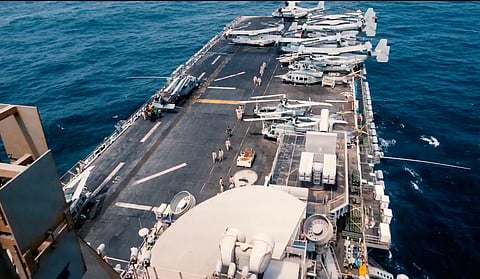
As the US-Iran war enters its seventh month, President Donald Trump has again sought to emphasise the strength of the US military arsenal, saying Washington has virtually "unlimited" supplies of ammunition for the campaign against Iran.
His comments come amid reporting that the pace of the conflict had put pressure on some US stocks of certain weapons. The Pentagon has been working to increase production.
Washington message: The US is prepared to sustain military operations to achieve its objectives in Iran — a curb on its nuclear ambitions and get Tehran to stop Hormuz shipping disruptions.
For residents of the UAE, the conflict is being felt less through direct fighting and more through air travel disruptions, shipping risks, heightened regional security concerns and oil prices.
Get it: Fast, verified news for FREE ... download the Gulf News app — simply click here
Here are the key developments.
Iran economy 'buckling' amid extended sanctions, naval blockade: report
Iran has survived years of US sanctions by finding ways around them. Now Washington is combining sanctions with a naval blockade — and Tehran’s economic defences are reportedly beginning to crack.
Iranian officials say exports and imports have fallen about 35%, while inflation is approaching 70%.
The Iranian rial has plunged to record lows. Tehran's oil exports have reportedly collapsed from around 1.7 million barrels a day to roughly 260,000 under Trump's three-pronged strategy
US three-in-one package — bombs, sanctions and the blockade — are beginning to produce a much "more visible economic impact" inside Iran, according to Reuters, citing three senior Iranian sources.
This last figure may be the most important. Iran can evade a sanction. It is much harder to physically evade a blockade.
For years, Tehran relied on shadow fleets, intermediaries, ship-to-ship transfers and China as a crucial buyer of its oil. But if tankers cannot move, Iran loses the foreign currency needed to pay for imports, support the rial and keep its economy functioning.
Iran blockade: 86 Iran-linked ships 'redirected'
The US Navy is enforcing a maritime blockade around Iran’s ports as part of the broader US campaign to restrict Tehran’s ability to export oil and import military supplies. The US Central Command has said the Navy is strictly enforcing the blockade and conducting compliance checks on commercial shipping in the Gulf and Arabian Sea. As of Sept. 2, CentCom reported:
86 commercial vessels redirected away from Iranian ports.
3 vessels disabled during enforcement operations.
2 vessels boarded to verify cargo and destination.thedailyjagran+1
The figures show a steady increase from late August, when CentCom said 71–83 vessels had been redirected, with the same three disabled and two boarded.
More than 40 ships supporting humanitarian cargo were permitted through the blockade zone as of late August.
Rubio raises another warning: sanctions
The conflict is also moving into the economic sphere. US Secretary of State Marco Rubio warned that countries helping Iran evade American sanctions could themselves face sanctions.
Rubio said Washington would not object to countries maintaining their own foreign policies or diplomatic contacts with Tehran, but warned against helping Iran create mechanisms to generate revenue that Washington believes could support terrorism or Iran's nuclear program.
Iran says it hit US bases, ships; Washington disputes some claims
Iran has continued to claim attacks against U.S. military positions in the region. But a US defence official denied at least one recent Iranian claim that an American base had been hit.
The command also said IRGC's claims of two naval mines hitting a crude oil tanker transiting Hormuz on Tuesday (September 1) is a lie.
On the other hand, The US Central Command reported having escorted 40 ships, carrying a record 18 million barrels of oil through Hormuz even as the US-Iran strikes flared again on September 1.
The conflicting accounts underline one of the most difficult aspects of the war: information from the battlefield is increasingly contested.
Rely on official UAE authorities
This makes it important for UAE residents to rely on official UAE authorities, airlines and established news organisations rather than unverified social-media accounts, memes or videos.
The UAE itself previously denied Iranian claims that Al Minhad Air Base had been targeted.
Oil prices
While prices saw some softening on Friday morning, as Brent slid 1.30% at $95.52/barrel at 7.44am Tokyo on Friday, amid reports that more oil tankers are transiting Hormuz under US military escort and degraded Iranian capability to harass shipping through the strait, Brent quickly recovered, hitting $95.69 as of 11.58 am Tokyo.
Murban Crude, too, was down 1.30% to $104.7 while WTI was up 0.89% to $92.11/barrel.
Higher crude prices can support revenues of oil producers and the wider energy sector, except Iran amid the naval blockade preventing Iran from exporting its oil.
However, prolonged instability can simultaneously increase transportation, insurance and commodity costs.
Hormuz remains the big risk
The Strait of Hormuz remains one of the world's most important energy chokepoints. Recent fighting has sharply reduced shipping traffic through the waterway.
For the UAE, the issue is especially sensitive because Fujairah provides a strategic alternative to routes through Hormuz, including oil infrastructure designed to allow oil exports to bypass the strait.
But the broader Gulf economy cannot completely escape the consequences of a prolonged disruption.
UAE flights adjust to regional airspace, security conditions
Airlines operating from the UAE continue to adjust schedules as regional airspace and security conditions change.
Emirates, Etihad Airways, flydubai and Air Arabia have all issued cancellations, suspensions or schedule changes during the latest escalation, while other international carriers have also modified their Middle East operations.
For passengers, the practical advice remains simple:
Check your airline before leaving for the airport.
A flight showing as scheduled several hours earlier can still be delayed, rerouted or cancelled as airlines respond to changes in airspace restrictions.


