How Dubai gave this 83-year-old Pakistani artist a second chance at his passion
Dubai gave him a second life - now he wants his Quranic masterpiece to find a public home
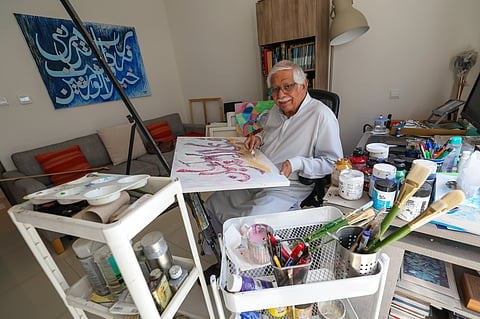
Dubai: In a makeshift studio carved out of a modest Dubai apartment, a man holds a canvas inches from his face. His eyes, once sharp enough to capture the subtlest shifts of light, now strained. Slowly, deliberately, he drags a palette knife across the surface, coaxing thick, heavy ridges of paint into life.
Nazar Haidri, who goes by Nazar in the art world, is 83 years old. A Pakistani artist who has called the UAE home for the past decade, his work has graced the walls of prestigious galleries in Dubai and Boston. But time, as it does for all of us, has begun to press. His eyesight has dimmed. The world he once painted with such clarity has softened at its edges.
"My eyesight has reduced considerably," he said, "Before I was diagnosed, I felt a black dim closing in on me. Darkness."
After consulting multiple doctors, he finally landed on an ophthalmologist who informed him that his optic nerves are drying out. Steroids have fortunately offered some relief, though his eyesight remains gauze-like and softened. For a man who has spent decades studying shadow and the precise weight of colour, such a diagnosis might have brought his art to a permanent end but Nazar has not stopped, and still meets life with an eager and excited eye.
"I can't stop painting. It's my passion," he said. "Before, I would sketch everything out, work with a brush, build up the detail carefully. That level of precision is harder for me now. So I found an alternative." For Nazar, it has become a liberation. The thick, expressive strokes of impasto demand presence over precision, they reward feeling over sight.
His goal, he says, is to keep painting for as long as his body allows. But there is one final ambition that sits closer to his heart than the rest, a body of work completed while his vision still held, pieces he considers among the finest of his long career.
"I made a Quranic calligraphy work of Surah Al-Fatihah, the first chapter of the Quran, seven verses. It is one of my proudest works. I really hope something so significant, so meaningful, can be placed in a public institution, somewhere it can not only be seen but truly appreciated."
His request feels less like an old man's wish and more like an artist's lifelong conviction: "The goal of any artist is for their work to reach and inspire as many people as possible."
Reinventing art in retirement
For more than four decades, Nazar built a career as a marketing executive in Saudi Arabia's advertising industry, a world of deadlines and commerce that ran alongside his creative instincts.
When he retired and moved to Dubai almost ten years ago to be closer to his children, something changed. The city gave him the time and freedom he needed, and he threw himself into art fully. The UAE took notice.
Nominated by Dubai Culture, he became a Golden Visa recipient, recognition of a contribution to the country's arts scene.
What makes Nazar's work immediately distinctive is his fusion of the geometric forms of Cubism with the ancient tradition of Quranic calligraphy and the luminous dot-work of Pointillism.
"I wanted to be different and was inspired by Picasso as an art student, and I found that Cubism gave me a unique way to stand out. Quranic calligraphy is traditionally black and white but I felt it could hold so much more by incorporating colour. And when it comes to inspiration - music, nature, poetry, the vibrant parts of life, Cubism allows you to play with colour in a way that depicts all of that."
From Lucknow to Karachi
To understand Nazar, you have to go back much further than Dubai. Back to Lucknow, India, where he was born, a city whose streets hum with centuries of Urdu poetry, music and art.
His family appreciated the arts, in the way that many cultured families do. Appreciating them, however, was quite different from encouraging a son to pursue them. "Back then, saying you wanted to study art was radical," he recalls. "I came from a modest, traditional family. They wanted stability, a government job. But since I was a child, I could never keep my hand from sketching."
In 1958, he migrated to Karachi, Pakistan, a young man starting entirely from scratch, far from family, in a city that owed him nothing. He worked at a petrol station to keep himself afloat. But then came the turn.
He found his way to the Arts Council of Pakistan, where his professors inspired him to push boundaries but fortune also intervened, in the form of two towering figures: Sadequain, the Pakistani artist and poet whose calligraphic murals would come to define a generation, and Zainul Abedin, the legendary Bangladeshi painter whose depictions of the Bengal famine had already secured his place in history.
Both men were commissioned to create murals for the State Bank of Pakistan. Nazar was selected as one of the art students to work alongside them. "Just being near them, watching the grit and the calm they brought to their work, still gives me inspiration today," he says.
His reputation grew quietly but steadily. He exhibited annually at the National Art Exhibition, and in 1963, Faiz Ahmed Faiz, the great Pakistani poet and a man for whom words were acts of resistance, purchased his work. It was the kind of validation few young artists ever receive.
Returning to art after retirement
Then, as it so often does, life called - family and responsibility. The brushes were set aside but the art never left him entirely.
He did finish his studies but building a life around art as a father and husband are two different things. Advertising and marketing offered a pragmatic middle ground. For decades, he threw himself into it. Major campaigns, regional clients and it was, by his own account, a good career. But something was always idling quietly beneath the surface.
"My passion for art took a back burner," he says. "But because of my job, I was able to travel to Europe, to America. I could walk into the great galleries."
It was in one of those galleries that the ember caught. Standing before Picasso's Girl with a Mandolin at MoMA in New York, something cracked open in him. He didn't just admire it. He began, instinctively, to translate it.
"I wanted to emulate it in a way I could relate to," he says. "Two girls playing the sitar and the santoor."
Dubai and a second beginning
Retirement brought him to Dubai to be near his children but the city gave him something he hadn't anticipated, a second beginning.
"Dubai was the place where, in my retirement, I could pursue my passion and be recognised for it," he says. "This city has given me a new lease on life. As an old man, its openness to all - that is what made me go on with passion."
Dubai Culture supported his work, and the exhibitions followed. His paintings have been shown across the UAE and Pakistan, at World Art Dubai and DIFC Art Nights, and in galleries and collections stretching from the United States and the United Kingdom to Hong Kong. Works that have sold for thousands of dollars, acquired by collectors who recognised in them something rare. But that was never the point.
"Art has been reserved for a few for too long," he says. "People need to have it in their lives. In their homes. Someone will buy a house for a million dollars but won't invest in a painting that has a soul." He smiles. "It's a zero sum game financially. But it's worth every penny for your soul."
The pandemic quieted things considerably. Haidri, who had been a fixture at gallery openings and exhibitions in the years before, stepped back, prioritising his health. His work, however, remains accessible through his website, a digital gallery for a man whose practice has always been deeply, bodily physical.
His practice lives on through adaptation - pencils replaced by markers, brushes replaced by the knife.
"I'm still inspired to create, even though my sight is weak," he says. "At the end of the day, Allah blessed me with a good life and a family that pushes me to keep going. I can't complain. Ever."


