Ramadan 2026: A deep dive into the history of the iftar cannon in UAE
From ancient forts to the Burj Khalifa: The journey of the Ramadan cannon in the UAE
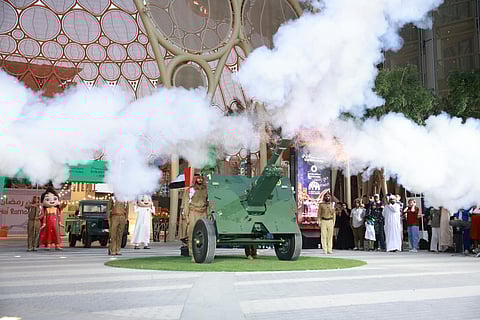
Dubai: Each Ramadan, as the sun dips and the sky turns to dusk, a cannon fires, a single thunderclap that rolls across neighbourhoods before dissolving into a plume of smoke. For those who have spent the day fasting, it is the moment they have been waiting for: the signal that iftar has arrived, and that the table can finally be set.
Today, no one strictly needs the cannon. Mosques broadcast the adhan to the minute, and any smartphone can display the precise moment of sunset. Yet the tradition endures, not out of necessity, but out of something deeper.
In the UAE, the iftar cannon has become far more than a timekeeping tool. It draws crowds of Muslims and non-Muslims alike, all gathered to witness the shot that ends the fast. But how did this beloved ritual take root here and where did it all begin?
The 19th century origins of the iftar cannon
The Ramadan or iftar cannon is not unique to the UAE, it is also seen across the Gulf and the wider Middle East. Its exact origins are unclear but historical records show the iftar cannon, known in Arabic as Midfa Al Iftar, was well established in 19th-century Egypt, with some historians tracing it back to the Mamluk era. From Egypt, the practice spread gradually across the Muslim world.
Apart from iftar, a Ramadan drummer would stroll through neighborhoods to alert fasting Muslims to partake in their pre-dawn meal (suhoor).
How the iftar cannon tradition began in the UAE
In the UAE, the story begins in Sharjah. Gulf News approached the Sharjah Museum Authority to find out how it started, and they explained that the tradition took root in the 1930s during the reign of Sheikh Sultan bin Saqr Al Qasimi. The first cannon was positioned at Al Hisn Square (Sharjah Fort), in front of the old city's historic fort.
"The cannon was placed in front of the fort so that its sound could be heard by residents in nearby neighbourhoods such as Al Mureijah and Al Shuyoukh. It was a simple but effective solution. In an era before loudspeakers graced the minarets of mosques, the cannon's boom was the only signal powerful enough to unify an entire community at the exact moment of iftar,” the Museum Authority explained.
Canons were introduced by the Portuguese in the late 15th century and later brought in greater numbers by British forces, they became a fixture of the Gulf's fortifications. The Qawasim, a confederation of tribes centred around Sharjah and Ras Al Khaimah, are recorded to have owned more than 70 cannons by 1819.
One of those used to guard Al Hisn Fort earned itself a nickname: Al Raggas, meaning ‘The Dancer’ so named because when fired, it was so powerful that it appeared to dance back and forth.
The tradition in Sharjah began in the 1930s (around 1930 AD), during the reign of Sheikh Sultan bin Saqr Al Qasimi. The first site was Al Hisn Square (Sharjah Fort) in the heart of the old city. The cannon was placed in front of the fort so that its sound could be heard by residents in nearby neighborhoods such as Al Mureijah and Al Shuyoukh.Sharjah Museum Authority told Gulf News
In Dubai, the cannon's Ramadan role dates back to the reign of Sheikh Saeed bin Maktoum Al Maktoum, though it was formalised at greater scale in the early 1960s under Sheikh Rashid bin Saeed Al Maktoum.
Muna Faisal Al Gurg, CEO of the Museums and Heritage Sector at Dubai Culture and Arts Authority, told Gulf News that Dubai Police oversaw the firings at key locations, including Al Ras and Zabeel, these sites chosen specifically for the reach of their sound.
"Before loudspeakers and broadcast media became widespread, it provided an audible public signal that Maghrib had arrived and the fast could be broken," she said. "Just as importantly, it made iftar something people experienced as a community, even from their own homes."
In Dubai, it dates back to Sheikh Saeed bin Maktoum Al Maktoum's rule, when it signalled the breaking of the fast for communities across neighbourhoods. The practice was formalised at scale in the early 1960s under Sheikh Rashid bin Saeed Al Maktoum, with Dubai Police overseeing the firing at key locations, including Al Ras and Zabeel, areas chosen for their wide sound reach.

The cultural significance of the Ramadan cannon in the UAE
The tradition spread across the Emirates over several decades. Sharjah began in 1930, Dubai followed in 1960, and Abu Dhabi joined in 1970.
Each cannon fires a total of 35 rounds throughout Ramadan and Eid, two rounds to confirm the Ramadan crescent sighting, one round daily at sunset to signal iftar, one round to announce the first day of Eid Al Fitr, and two celebratory rounds following the Eid prayer.
Why the iftar cannon still draws crowds
For many who grew up in the UAE, the cannon is a cherished part of their earliest memories of the holy month, with families tuning in to the live broadcast of the cannon fire on Sharjah TV or Dubai TV, while preparing food to lay out on the table.
Today, the adhan rings from every neighbourhood mosque and iftar times arrive as smartphone notifications. Yet when Ramadan comes, hundreds still make their way to the Burj Khalifa, the grand courtyards of Sheikh Zayed Grand Mosque, and Al Majaz Waterfront to watch a police officer fire the cannon at sunset. The boom and the rising smoke still draw crowds, still turn heads, still carry weight.
In a country that has changed rapidly, the iftar cannon endures, its echo rolling across the UAE each evening until the final night of the holy month.

