Dubai gold climbs above Dh621 after sharp fall amid volatile global markets
Dubai gold rebounds after steep fall as buyers return to market
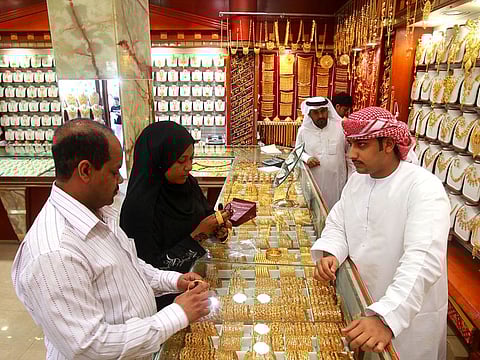
Dubai: Gold buyers in Dubai saw prices bounce back sharply on Wednesday morning after a sudden drop a day earlier, with the recovery highlighting the intense volatility currently gripping global bullion markets. (Check latest UAE gold prices here, alongside prices in Saudi Arabia, Oman, Qatar, Bahrain, Kuwait, and India.)
The price of 24-karat gold in Dubai stood at Dh621.25 per gram at around 9.30 am on Wednesday, compared with Dh614.25 on Tuesday. The 22-karat variety rose to Dh575.25 per gram from Dh568.75 a day earlier.
The rebound follows a sharp correction earlier this week that briefly rattled buyers across the UAE, many of whom closely track daily movements before deciding whether to purchase jewellery or investment bars.
Stay updated: Get the latest faster by downloading the Gulf News app now - it's completely free. Click here for Apple or here for Android. You can also find it on the Huawei AppGallery.
Gold traders say the latest move reflects the tug of war between geopolitical tensions, currency movements and short-term profit taking in global markets.
A volatile month for gold buyers
Recent price movements show how dramatically gold has swung through February and early March, offering buyers both rallies and sudden pullbacks.
At the beginning of February, Dubai gold prices were trading closer to the Dh590 level for 24-karat gold, while the 22-karat variety hovered near Dh550. The market then began climbing steadily as global investors increased their exposure to precious metals.
By the middle of the month, the rally had pushed 24-karat gold above Dh600 and lifted the 22-karat rate comfortably beyond Dh560. Momentum strengthened further in the final weeks of February, with prices frequently hovering between Dh620 and Dh630.
The final days of February and the opening days of March saw the market surge to much higher levels, with 24-karat gold briefly climbing above Dh640 and the 22-karat variety moving past Dh590. Tuesday’s drop to Dh614 triggered fresh interest from buyers who had been waiting on the sidelines for a dip.
Wednesday’s rebound back above Dh621 shows how quickly sentiment can shift in a market that remains heavily influenced by global political developments and investor positioning.
Global tensions driving demand
Recent movements in the bullion market have been closely linked to geopolitical tensions and global financial market volatility.
Gold recovered on Wednesday after dip buyers entered the market following a broad selloff across assets earlier this week. Investors had liquidated some leveraged positions after a sharp decline in equities forced margin calls in other parts of portfolios.
According to Ahmad Assiri, Research Strategist at Pepperstone, Asian buyers were among the first to step back into the market after the correction.
“The yellow metal received some support from Asian buyers early session following a broad sell off in assets, including commodities, which led to the liquidation of some leveraged positions and a brief price dip near the $5,000 per ounce threshold,” Assiri said.
He noted that prices quickly stabilised once buying returned.
Gold regained its balance to trade up to roughly $5,200, returning to the range recorded last Friday prior to the recent geopolitical development.

“Gold regained its balance to trade up to roughly $5,200, returning to the range recorded last Friday prior to the recent geopolitical development.”
Why prices dropped despite rising tensions
The recent pullback surprised many investors because it occurred during a period of heightened geopolitical risk linked to the escalating conflict between the United States and Iran.
Linh Tran, Market Analyst at XS.com, said the decline largely reflected a market correction after a strong rally rather than a shift in the broader outlook for bullion.
“Before recovering to the current price area around $5,150 per ounce, gold unexpectedly retreated sharply to nearly $5,000 per ounce after reaching a peak near $5,420 per ounce, despite escalating military tensions between the United States and Iran,” Tran said.
Part of the explanation lies in the fact that geopolitical risks had already been priced into the market following several weeks of strong gains.
“Prior to the correction, gold had risen for four consecutive weeks, pushing prices close to $5,420 per ounce and creating conditions for investment funds as well as retail traders to take profits, thereby triggering a sharp short term pullback,” Tran noted.
Another factor was the sudden strength of the US dollar, which tends to put pressure on gold.
In the coming sessions, gold’s outlook will likely depend heavily on geopolitical developments in the Middle East as well as the direction of the US dollar. Notably, divisions are emerging within the U.S. political establishment regarding the military campaign targeting Iran, as some lawmakers argue that the White House acted without full congressional authorization and are pushing for resolutions aimed at limiting any expansion of military operations.Linh Tran, Market Analyst at XS.com
“During periods of heightened volatility or rising market panic, capital often flows into the US dollar before gold due to its superior liquidity,” Tran said, noting that the US Dollar Index has been strengthening in recent sessions.
Safe haven demand remains intact
Despite the short-term volatility, analysts say the underlying outlook for gold remains supported by continued geopolitical risk and strong investor demand.
Gold has already surged nearly 20% this year and briefly reached a record high above $5,595 per ounce in late January.
The broader conflict in the Middle East continues to keep markets on edge, particularly after fresh military strikes were reported in Iran and fears grew that the crisis could expand further across the region.
Tran believes the recent decline should be viewed as a temporary reset in an otherwise supportive market environment.
“In an environment where geopolitical risks continue to escalate, gold still maintains its role as a key safe haven asset,” she said.
She also pointed to strong institutional demand. “Data from Bitget indicates that gold ETFs recorded strong inflows during January and February. By the end of February, SPDR held approximately 1,101 tons of gold, while in early March holdings remained around 1,094 tons.”
The relatively small decline in ETF holdings suggests the selloff was driven mainly by short-term trading activity rather than a large exit by long-term investors.
What buyers in Dubai are watching
Local gold buyers are closely tracking global developments that could influence the next move in prices.
Much will depend on how the geopolitical situation evolves and whether safe haven demand intensifies further.
Tran said the conflict trajectory will likely shape the next phase of the market.
“If the military campaign prolongs or expands across the region, safe haven demand could continue to support gold above the $5,000 per ounce level and potentially open the door for a retest of the recent highs,” she said.
- With inputs from Bloomberg.