IndiGo crisis may lead to higher UAE-India airfares, fewer flights
As IndiGo struggles, Indian travellers could face higher fares and fewer options: Experts
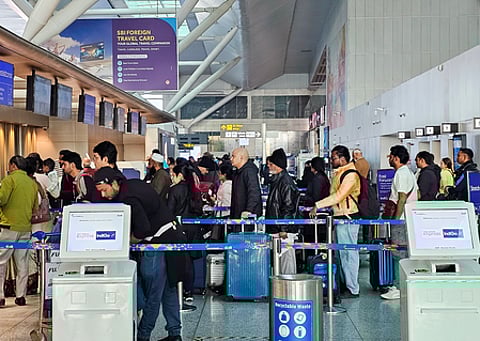
Dubai: Prolonged instability at India’s largest airline, IndiGo, could translate into higher fares, service volatility, and fewer travel alternatives — including for routes connecting India and the UAE.
Top aviation analysts in the UAE are calling the ongoing crisis, which follows the introduction of stricter pilot rest and fatigue management rules in India, an inflection point for Indian travellers.
“For Indian travellers, this is an inflection point. Air India is still in a multi-year turnaround, and the second tier of carriers lacks scale and capital. If IndiGo stumbles, even temporarily, the market loses its most dependable shock absorber,” said Linus Benjamin Bauer, Managing Director of BAA & Partners.
Summing up the ongoing crisis that’s left thousands of passengers stranded across India, Bauer said, “Stability at IndiGo isn’t just good for the airline - it’s a macro-level requirement for the Indian consumer.”
IndiGo holds approximately 64-65 per cent of India's domestic aviation market share by passengers carried, making it the dominant player. IndiGo operates more flights (220 weekly flights) between India and the UAE than Air India (including Air India Express). On the UAE- Abu Dhabi route alone IndiGo operates 111 weekly flights.
What it means for the India–UAE market
The UAE is one of IndiGo’s biggest international markets, with flights connecting Dubai, Abu Dhabi, Sharjah, and other Indian cities.
Any prolonged disruption could ripple into fare increases across high-demand routes, especially during the winter and year-end travel rush, where fares are already seeing highs of Dh1,700 to Dh2,000 (to capital cities in India).
Aviation industry insiders suggest that even a short-term reduction in capacity can drive fares up by 10–15 per cent on key India–Gulf sectors.
Leadership turbulence adds to worries
Beyond scheduling, Bauer believes IndiGo faces a governance and cohesion problem. “When leadership stops functioning as one, the airline’s strengths — reliability and predictability — are at risk,” he said. “If IndiGo fails to regain alignment quickly, you’ll see slower decisions, lower morale, and an impact on expansion plans.”
And the airline has been on a rapid expansion phase with new wide-body jets giving the airline space to grow in international markets, including The Netherlands and the UK.
IndiGo’s recovery plan
The airline says it’s restoring normalcy after India’s regulator temporarily paused parts of the new rule enforcement until February 2026. However, experts believe damage control must go beyond scheduling fixes.
“Stability at IndiGo isn’t just good for the airline — it’s essential for India’s middle class and for the wider travel economy,” Bauer said.
Meanwhile, Saj Ahmad, Chief Analyst at StrategicAero Research, called the crisis a “very costly exercise for IndiGo. “They'll really have to sit down and take a long hard look at how they messed this all up. The regulatory changes were known about, so why didn't they plan for it?”
However, he called the reputational damage “severe, but with rival Air India also in a state of distress itself, IndiGo really should have planned better to avoid the calamity it now faces.”
While he believes that the airline will, of course, get back to a stable footing, he guesses there may be no one that would he held accountable for the mishap. “My guess is that no-one will step up and take responsibility here and its ultimately passengers who suffer,” said Ahmad.
A space for foreign, UAE airlines?
Virendra Jain, Co-Founder and CEO of VIDEC, an advisory and analytics firm, said IndiGo’s challenges present a strategic opening for competitors to capitalise on.
He said, "Foreign carriers remain dominant in long-haul segments and are now positioned to capitalize on IndiGo’s constraints. Emirates, Singapore Airlines, Qatar Airways, and Air Arabia collectively transported over 13 million passengers in FY25, with Emirates leading at 5.6 million."
"While the foreign carriers’ share of India’s international traffic has declined from 62 per cent in FY20 to 55 per cent in FY25, these airlines continue to leverage their hub strength and deploy larger aircraft to absorb spillover demand. Improved yields and higher load factors are expected as travelers gravitate toward more reliable options, reinforcing the strategic advantage of global carriers in India’s fast-growing international market," he added.
According to VIDEC’s India Travel Market Opportunity FY22–FY27 study, India’s air market stood at $27.5 billion in FY24, with international travel contributing 61 per cent ($16.9 billion) and domestic accounting for $10.6 billion. While domestic sector led in volume with 154 million passengers, the international segment—though smaller at 67 million passengers—generated a higher revenue share, underscoring stronger yields and premium demand.


