Has Iran’s surviving missile arsenal changed Trump’s war calculations?
Iran’s surviving missile arsenal raises fears of wider war if US-Israeli strikes resume
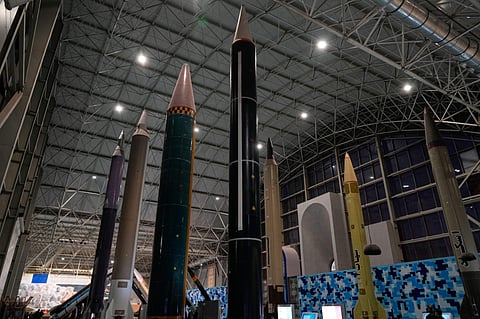
Dubai: Nearly nine months after the United States and Israel launched their military campaign against Iran, a troubling question is emerging in Washington and Tel Aviv: Has Tehran retained enough military firepower to make another offensive far more dangerous than its planners anticipate?
Despite months of US-Israeli strikes targeting Iran’s military infrastructure, American intelligence agencies reportedly believe Tehran still possesses between 1,500 and 2,500 ballistic missiles — a substantial arsenal that could complicate President Donald Trump’s calculations as he weighs renewed military action.
The assessment, reported by The Wall Street Journal, comes alongside warnings from within Israel’s own military intelligence establishment that another attack on Iran could ignite a wider regional conflict involving Lebanon, Syria and Gaza.
Together, the developments raise questions about whether another round of strikes could deliver a decisive result or instead unleash a prolonged confrontation across the Middle East.
Thousands of missiles remain
According to US officials cited by The Wall Street Journal, Iran’s remaining ballistic missile stockpile is estimated at between 1,500 and 2,500.
The officials described the figure as a low-confidence assessment because of difficulties tracking Iran’s weapons, but indicated that Tehran retains substantial missile capabilities despite the destruction inflicted during the conflict.
Israeli officials reportedly believe Iran possesses more than 1,500 ballistic missiles.
An unnamed Western official also told Bloomberg earlier this month that Iran could have at least 1,700 missiles remaining and might be producing as many as 50 additional missiles each month.
Iran has meanwhile unveiled another underground missile facility, reinforcing concerns that it is rebuilding military capabilities damaged by US-Israeli strikes.
The significance goes beyond the number of missiles. A surviving arsenal gives Tehran the potential to retaliate against military installations, energy infrastructure and other targets across the region if Washington and Israel launch another offensive.
Israeli intelligence warns Netanyahu
In a development that adds another dimension to the debate, Israeli military intelligence officials reportedly warned Prime Minister Benjamin Netanyahu last week that an attack on Iran could trigger a multifront regional war.
According to Israel’s Channel 12 television, the warning was delivered during a closed-door meeting involving Netanyahu and senior defence officials.
Military intelligence reportedly assessed that renewed strikes could ignite fighting involving Lebanon, Syria and Gaza, challenging expectations that an operation could remain limited to three to five days.
The warning comes as Netanyahu reportedly presses Washington for another offensive against Iran, while Trump has yet to authorise a new campaign.
The disagreement highlights a central military dilemma: Even if an initial attack succeeds in damaging Iranian targets, can its consequences be contained?
Why Trump is waiting
Trump has alternated between threatening renewed strikes and suggesting that Washington could avoid another major military confrontation.
Reuters reported on November 14 that the president had told senior advisers he might hold off on attacking Iran if Washington faced no fresh provocations from Tehran or the Iran-backed Houthis in Yemen.
The report also said US intelligence agencies had assessed that additional strikes would be unlikely to significantly change Iran’s negotiating demands.
Trump has since indicated that he is prepared to wait until the new year before deciding whether to resume major military operations.
However, his latest statements suggest growing frustration with Tehran.
On Sunday, Trump accused Iran of intensifying its missile and drone attacks following the November 3 US midterm elections, claiming Tehran had become more aggressive because it regarded the Democrats as weak.
He has also warned that further military action remains possible if negotiations fail.
Gulf countries face the consequences
For Gulf countries, the implications of another offensive are particularly serious.
Iranian missile and drone attacks have already affected Bahrain and Kuwait, while repeated attacks on commercial shipping have heightened concerns over maritime security in the Strait of Hormuz.
The risk is that another US-Israeli offensive could provoke retaliation extending beyond the countries carrying out the strikes.
Military installations hosting American forces, energy infrastructure and shipping routes could become targets, potentially widening the economic and security consequences of the conflict.
That concern helps explain why regional governments have continued pressing for diplomatic solutions even as attacks persist.
Iran claims longer missile range
Adding to the uncertainty, Iranian parliamentarian Ahmad Bakhshaesh Ardestani claimed on Monday that Tehran had extended the range of its missiles from 2,000km to 4,500km, potentially putting parts of Europe within reach.
The claim has not been independently verified, and there is no publicly established evidence in the available reports that Iran has deployed operational missiles with that range.
Nevertheless, the statement reflects Tehran’s efforts to project military strength as Washington considers its next move.
Can another offensive achieve more?
The question confronting Trump is not simply whether American and Israeli forces can strike Iran again. Their military capabilities to do so are not in doubt.
Rather, it is whether another campaign could substantially weaken Tehran’s remaining arsenal, prevent retaliation and produce concessions that months of military and economic pressure have failed to secure.
Israel’s reported intelligence warning and the US estimates of Iran’s surviving missiles suggest those outcomes cannot be taken for granted.
For now, Washington appears to be keeping its military options open while allowing more time for economic pressure and diplomacy.
But with Iran continuing attacks across the region and negotiations showing little sign of a breakthrough, the central question remains unanswered: Would another offensive bring the conflict closer to an end — or open a more dangerous chapter?


