Will US strike Iran again? Trump says decision can wait until 2027
Trump signals no rush for Iran action, but escalation still possible
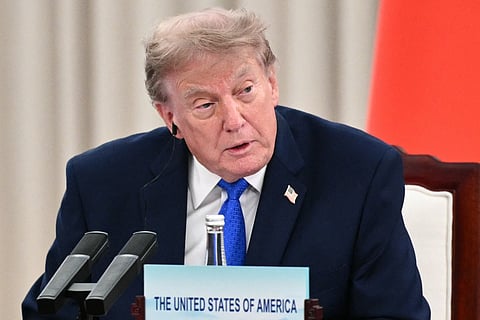
US President Donald Trump has pushed back a decision on possible fresh military strikes against Iran until after the beginning of 2027, signalling that Washington is in no immediate rush to launch another major bombing campaign.
Trump indicated in separate interviews on Thursday that he would wait until the beginning of next year before deciding on his next move against Tehran.
Asked by Reuters about the possibility of renewed strikes, Trump said: “Well, I’ll talk to you about it after the beginning of the year.”
“We’ve got time,” he added, speaking aboard Air Force One as he returned to Washington from his visit to China.
Get updated faster and for FREE: Download the Gulf News app now - simply click here.
In a separate phone interview with Axios, Trump said: “I am not rushing into any decision [on Iran]. We will see what happens after the beginning of the year.”
He also told Fox News: “We'll see what happens after January 1.”
The comments mark a shift in the timeline Trump had previously suggested for a possible escalation, with the US president having indicated before the November 3 midterm elections that Iran could face renewed military action after the polls.
However, his latest remarks do not rule out an earlier decision, as tensions between Washington and Tehran continue.
Why Trump is delaying a decision on Iran
Trump's comments come amid a continuing standoff with Iran, with Washington maintaining a naval blockade and economic pressure campaign while considering its military options.
According to Axios, the delay could give the US blockade and sanctions more time to influence Tehran and encourage concessions.
However, the report also pointed to another possibility: Trump may want to retain enough time to authorise military action before the new Democratic-controlled Congress takes office in January.
Axios cautioned that the president could change his mind at any moment. His stated timeline does not necessarily mean an attack has been ruled out before the new year.
US still considering fresh strikes with Israel
Despite describing another major round of strikes against Iran as “quite unlikely” last week, Trump is still considering a joint military operation with Israel, Axios reported.
The reported options include:
Strikes on suspected Iranian nuclear facilities, including the Pickaxe Mountain site.
Attacks on bridges and power plants.
Targeting Iranian military and civilian leaders.
The White House has asked the Pentagon and intelligence agencies to assess how Iran could respond to different military scenarios, according to sources cited by Axios.
One of Washington's key concerns is whether any proposed operation could trigger Iranian retaliation against oil and gas infrastructure in Gulf countries.
The assessments are intended to help officials understand the potential consequences of renewed military action, particularly for regional energy supplies and security.
Netanyahu presses Trump to resume military action
Israeli Prime Minister Benjamin Netanyahu is reportedly pushing Washington to launch another round of strikes against Iran.
Mossad chief Roman Gofman visited Washington and Miami last week for talks with CIA Director John Ratcliffe and White House envoy Steve Witkoff.
An Israeli source cited by Reuters said Gofman was sent by Netanyahu to advocate renewed military action.
The discussions also covered Israeli concerns about Iran's alleged chemical weapons research.
According to Axios, Israeli officials claimed to have intelligence indicating that Iran had stepped up research and development in this area and conducted tests. A US official said Trump had been briefed on the intelligence.
Tehran has rejected the allegations.
Trump addresses reported dirty bomb threat in Washington
Trump also responded to a CNN report alleging that Iran could be planning to detonate a dirty bomb in Washington.
A dirty bomb uses conventional explosives to disperse radioactive material.
Asked by Fox News whether people in the US capital should be alarmed, Trump appeared to downplay the reported threat, saying: “I don't think so.”
However, he claimed there were indications that Iran was looking at chemical and biological weapons.
“There is indication that Iran is looking at gases, looking at bio, because we've shut them out with the nuclear,” he said.
Iran's Foreign Ministry rejected US allegations that Tehran was developing chemical and biological weapons, describing them as an attempt to create fear and justify military action.
The ministry had earlier dismissed the CNN report as baseless.
Trump defends Iran war despite Republican election losses
Trump's latest comments come after Republicans suffered significant losses in the November 3 midterm elections, with Democrats set to take control of Congress in January.
Before the elections, Trump repeatedly suggested that Iran would be more willing to negotiate an agreement after the US polls.
His administration has since maintained that the naval blockade and economic sanctions are working.
Trump acknowledged that the conflict played a role in the Republicans' electoral losses but insisted that he would not have changed his decision to launch military action.
Asked by Reuters whether he would make the same decision again, Trump said: “And the big thing is if you had to do it again, would you do it? And the answer is yes. Because you can't let Iran have a nuclear weapon.”
Vice President JD Vance had publicly distanced himself from the conflict, citing it as one of the reasons behind the party's poor electoral performance.
Trump later directed Vance away from Iran-related diplomatic efforts and towards domestic matters.
When asked by Reuters about Vance's comments, Trump said: “What he said was right.”
US Senate rejects measure to curb Iran war powers
Meanwhile, the US Senate on Thursday rejected a Democratic-backed resolution seeking to curb Trump's military campaign against Iran.
The measure failed in a 48-51 vote, with most Republicans backing the administration's position. Three Republicans voted in favour of the resolution, while Democratic Senator John Fetterman joined Republicans in opposing it.
The vote was the first on the conflict since Republicans suffered losses in the midterm elections.
Public opposition to the war has also grown. An Associated Press survey found that about six in 10 voters believed US military action against Iran was the wrong decision.
Iran war costs $48.3 billion
The financial cost of the conflict is also coming under scrutiny.
A Pentagon official told the Senate Armed Services Committee on Thursday that the war had cost an estimated $48.3 billion as of November 13.
The figure includes military operations and the replacement of equipment and munitions but excludes damage to US military bases in West Asia.
For now, Trump has indicated that he will wait until after the beginning of 2027 before making a decision on further military action. However, with Israel pressing for renewed strikes and Washington continuing to assess possible military options, the prospect of another escalation remains open.
With inputs from AFP and AP


