USS Ford arrival raises stakes: Is the US hinting at a wider Iran operation amid unresolved talks?
Carrier move raises questions over scale of action as Trump’s deadline pressures Tehran
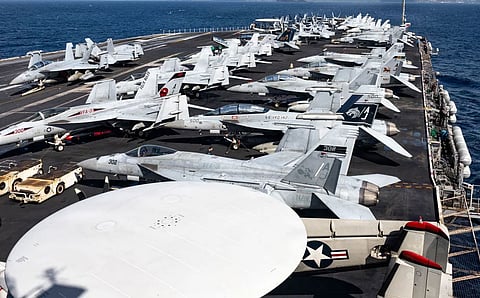
Dubai: The arrival of the USS Gerald R. Ford in the Mediterranean Sea has sharpened focus on Washington’s Iran strategy, as military preparations intensify even while diplomatic contacts continue.
Trump has said prospects for a deal with Iran would become clear within roughly 10 days, warning that “bad things” could follow if negotiations fail.
Ford has now reached the region at a moment of heightened uncertainty. While Iran’s foreign minister said Friday he expected to have a draft counterproposal ready within days following this week’s nuclear talks with the United States, President Donald Trump’s sweeping demands appear unlikely to be fully met by Tehran — keeping the possibility of military action firmly in play.
The deployment underscores what increasingly looks like a dual-track approach: negotiations on one hand, and visible military pressure on the other.
According to the Washington Post, current and former US officials say the Trump administration has been assembling a significant strike force capable not merely of conducting limited operations, but potentially sustaining a far more extended campaign should diplomacy fail.
US aircraft positioned across region
Crete, Greece
RC-135V reconnaissance aircraft – 4
P-8A Poseidon reconnaissance aircraft – 1
Awali, Bahrain
P-8A Poseidon reconnaissance aircraft
Azraq, Jordan
RC-135V reconnaissance aircraft – 2
P-8A Poseidon reconnaissance aircraft – 5
Al Kharj, Saudi Arabia
E-11A BACN battlefield communications aircraft – 3
F-16 Fighting Falcon multirole fighters
P-8A Poseidon reconnaissance aircraft
E-3 early warning and control aircraft
US naval assets in and around Middle East
Red Sea/Strait of Hormuz
USS Delbert D. Black – Destroyer
USS Mitscher – Destroyer
USS Santa Barbara – Littoral Combat Ship
USS Michael Murphy – Destroyer
Arabian Gulf
USS Tulsa – Littoral Combat Ship
USS Canberra – Littoral Combat Ship
Carrier Strike Groups
Ford Carrier Strike Group (Now in region)
USS Gerald R. Ford – Aircraft Carrier
USS Bainbridge – Destroyer
USS Mahan – Destroyer
USS Winston S. Churchill – Destroyer
Air wing assets include:
F/A-18E Super Hornet fighters
EA-18G Growler electronic warfare aircraft
E-2 Hawkeye early warning aircraft
MH-60R / MH-60S Sea Hawk helicopters
C-2A Greyhound cargo aircraft
Lincoln Carrier Strike Group (Northern Arabian Sea)
USS Abraham Lincoln – Aircraft Carrier
USS Frank E. Petersen Jr. – Destroyer
USS Spruance – Destroyer
USS McFaul – Destroyer
USS Pinckney – Destroyer
Air Wing Assets Include:
F/A-18E Super Hornet fighters
EA-18G Growler aircraft
E-2 Hawkeye aircraft
F-35C Lightning II fighters
MH-60R / MH-60S Sea Hawk helicopters
Locations are approximate and subject to change. Military sites based on unclassified material and may not represent all US facilities, CNN said.
The newspaper reported that the military posture suggests preparation for something “much more extended than a one-day cycle” of strikes, pointing to the scale of naval and air assets repositioned toward the Middle East. Officials familiar with the planning told the Post that the buildup carries inherent risks, including potential US combat fatalities and the danger of regional escalation involving Iran’s missile arsenal and proxy forces.
Such concerns reflect the broader strategic dilemma facing Washington: while US and Israeli forces would hold overwhelming conventional superiority, Iran retains the capacity to impose significant costs through ballistic missiles, asymmetric tactics and disruption of regional shipping routes.
No final decision yet
Yet despite the visible show of force, the CNN reported that no final decision on military action has been made.
Citing sources familiar with internal deliberations, CNN said US troops have not received a specific target list — a key indicator that Trump has not formally authorised strikes.
The network characterised the administration’s posture as deliberately ambiguous, noting that advisers remain divided between those advocating sustained diplomatic engagement and others arguing that Iran is unlikely to concede to core US conditions.
Trump himself has reinforced that uncertainty.
In recent remarks, the president warned that prospects for a deal would become clear within roughly “10 to 15 days,” while declining to specify what actions might follow if negotiations collapse. The timeline, coupled with the ongoing force deployments, has added to perceptions that military options are being preserved as leverage rather than as an inevitable course.
Diplomatic signals from Tehran, meanwhile, have further complicated the picture.
Iranian officials have indicated that discussions remain active, with the foreign minister suggesting a counterproposal could be ready soon. However, analysts note that the fundamental gap between Washington’s demands — particularly regarding uranium enrichment — and Tehran’s long-standing red lines remains wide.
Beyond uranium enrichment, differences also remain over Iran’s ballistic missile programme, an issue Washington and its allies have repeatedly flagged as a major security concern and one Tehran has historically resisted placing under negotiation constraints.
This disconnect is central to the administration’s pressure strategy.
If Iran refuses to scale back key elements of its nuclear programme in line with US expectations, the White House may argue that coercive measures have been exhausted — a logic that could justify anything from narrowly targeted strikes to broader operations.
At the same time, regional diplomats and security experts continue to warn that even limited military action risks spiralling into a wider confrontation.
Deterrence planning
The presence of multiple US carrier strike groups, air assets, and missile defence systems reflects both deterrence planning and contingency preparation, but also highlights the fragility of the current moment.
For now, the trajectory remains unsettled.
As CNN emphasised, diplomacy has not collapsed, and the absence of final strike orders signals continued White House caution. But as the Washington Post’s reporting suggests, the scale of the buildup points to serious contingency planning should negotiations fail to produce a breakthrough.
In effect, Washington’s Iran policy appears caught between deadline diplomacy and the shadow of force — with the next moves likely to hinge on whether the latest round of talks can narrow a divide that has repeatedly defied resolution.


