US avoids all-out war, but why is the Gulf paying the price for Iran’s aggression?
Tehran hardens stance as fresh attacks expose Gulf states to growing risks
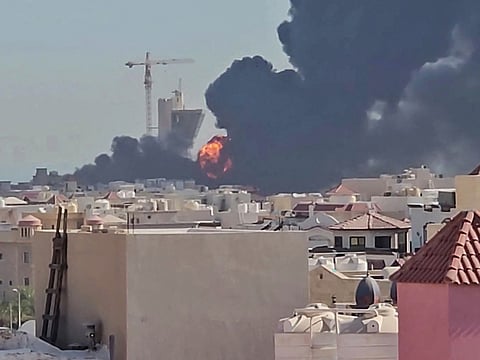
Dubai: President Donald Trump is holding back from another full-scale offensive against Iran, but Tehran’s increasingly defiant posture following his Republican Party’s midterm election defeat is raising the stakes for Gulf countries already bearing the consequences of the nine-month conflict.
Iranian attacks on Kuwait and Bahrain, alongside renewed threats to commercial shipping in the Strait of Hormuz, have continued even as Washington pursues economic pressure and limited military strikes rather than another major bombing campaign.
Iranian leaders have been emboldened by electoral setbacks suffered by Trump’s Republicans and Israeli Prime Minister Benjamin Netanyahu. Rather than soften their position, they are demanding that Washington make the first move towards ending the conflict.
For Gulf states seeking stability, the dilemma is stark: American restraint has not stopped Iranian attacks, while diplomatic efforts remain deadlocked.
Iran widens attacks
Iran’s military said its drones targeted US installations at Ali Al Salem Air Base in Kuwait on Wednesday, after American forces struck a Revolutionary Guards missile launch site on Qeshm Island in the Strait of Hormuz.
Kuwait said its air defences responded to hostile drones, while Bahrain reported another Iranian aerial attack — the fourth in six days.
The US strike on Qeshm followed an Iranian claim that its drones had targeted an American radar installation at Bahrain’s Sheikh Isa Air Base. US Central Command said the drones were intercepted without damage or injuries.
Meanwhile, an ADNOC Logistics and Services vessel was attacked in the Strait of Hormuz, leaving one crew member missing and 11 injured.
The incidents underline the danger facing Gulf countries as limited US-Iran military exchanges threaten regional security and shipping.
‘Iran strikes the Gulf instead’
Ebtesam Al Ketbi, president of the Emirates Policy Center, captured the Gulf’s predicament in comments to Reuters.
“The United States strikes Iran, but Iran does not strike America directly — it strikes the Gulf instead,” she said.
Trump has held back from another major offensive, calculating that renewed bombing could provoke further Iranian retaliation against Gulf energy infrastructure without changing the outcome. Yet Washington’s restraint has not shielded Gulf states from continuing attacks.
GCC Secretary-General Jasem Al Budaiwi said last week that member states had faced more than 7,000 Iranian missiles and drones during the war.
Trump’s setback strengthens Iranian hardliners
Reuters reported that Iranian hardliners believe Trump’s weakened domestic political position gives Tehran greater leverage to demand concessions.
Iran wants the US naval blockade lifted, frozen assets released and oil exports restored before substantive negotiations begin. It also seeks an end to hostilities and a recognised role in managing passage through the Strait of Hormuz.
In return, Tehran would reopen the waterway but initially offer only a commitment to discuss its nuclear programme.
Washington insists on reciprocal steps from the outset, including verifiable nuclear commitments.
Dennis Ross, a former US Middle East negotiator, described the impasse.
“There’s a dual reality. Trump doesn’t have good options, and the Iranians don’t have good options,” he told Reuters.
Both sides, he said, have defined conditions for ending the conflict that the other cannot accept.
Has the war strengthened Iran?
Some European officials believe the American military campaign has produced consequences opposite to those Washington intended.
One senior European official told Reuters that the campaign had strengthened Iran’s hardline leadership and worsened concerns surrounding its nuclear programme.
Iran insists its nuclear programme is peaceful and has refused to readmit international inspectors while the conflict continues.
Reuters also cited a European official who said Revolutionary Guards hardliners believed Iran had emerged victorious and had little interest in negotiations.
Alan Eyre, a former US diplomat involved in nuclear negotiations, described the political pressures facing Iranian negotiators.
“Everyone is scared of being the softest hardliner,” he said.
Washington’s decision to avoid another major offensive does not mean military operations have stopped.
NBC News reported that American forces have continued conducting strikes against Iranian targets, many without public acknowledgement.
Trump has concentrated on a naval blockade and economic pressure, hoping Tehran will eventually accept concessions over its nuclear programme.
Secretary of State Marco Rubio told G7 ministers in Paris that Washington had a third option between renewed war and an unacceptable agreement: sustained economic pressure until Iran made concessions, according to diplomats cited by Reuters.
Could the stalemate trigger another war?
The prolonged stalemate carries the risk of renewed fighting, with Washington relying on economic pressure while Tehran refuses to make the first concessions.
Eyre also warned that the American naval blockade could eventually force Tehran to escalate.
“Eventually, if the US doesn’t lift the blockade, Iran is going to escalate because they can’t last,” he told Reuters.
Can Gulf diplomacy break the deadlock?
Oman and Qatar continue mediating, but Washington and Tehran remain divided over who should make the first concessions.
European officials believe a possible compromise could involve concessions framed around Gulf security requirements rather than direct compromises between the US abd Iran.
Such an arrangement could allow Tehran to portray an agreement as protecting regional interests rather than yielding to Washington.
But Iranian hardliners appear increasingly determined to exploit what they see as Trump’s political weakness, while the US President faces growing constraints following the midterm elections.
For Gulf countries, the concern is that neither Washington’s restraint nor Tehran’s defiance has brought lasting security.
Instead, attacks on Gulf territory and shipping demonstrate how a confrontation short of all-out war can still impose a heavy price on neighbouring states.
The question now is whether mounting pressure will push Washington and Tehran towards compromise — or leave Gulf states facing another dangerous escalation.


