Modi flags off India’s fastest metro, completes Delhi–Meerut Namo Bharat Corridor
High-speed rail and metro services rolled out as Delhi–Meerut corridor goes fully live
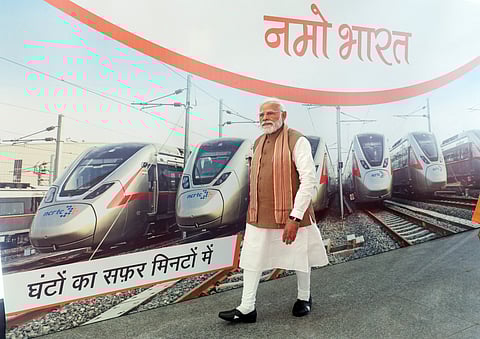
Dubai: Prime Minister Narendra Modi on Sunday inaugurated the Meerut Metro and flagged off the remaining sections of the Delhi–Meerut Namo Bharat Regional Rapid Transit System (RRTS), marking a significant milestone in India’s high-speed rail and urban transport expansion.
The launch completes the entire 82-km Delhi–Meerut Namo Bharat corridor, the country’s first operational Regional Rapid Transit System designed to dramatically reduce travel time between Delhi and western Uttar Pradesh. The project is expected to reshape daily commuting patterns, offering faster, more reliable alternatives to road travel.
During his visit, the Prime Minister inspected facilities at the Shatabdi Nagar Namo Bharat Station and later took a ride on the newly inaugurated metro service.
Officials said the projects form part of a broader development push, with Modi also dedicating infrastructure initiatives worth approximately Rs 12,930 crore (Rs129.3 billion), according to Indian media reports.
Key highlights
Delhi–Meerut Namo Bharat Corridor: 82 km fully operational
Meerut Metro Network: 23 km intra-city system
Top Speeds: Namo Bharat (180 kmph design), Metro (120 kmph operational)
Travel Time: Delhi–Meerut ~55 minutes
Integration: Shared stations and infrastructure in Meerut
Seamless travel model
A defining feature of the project is the shared-infrastructure design, allowing passengers to transition between Namo Bharat and metro services without leaving station premises. This model, officials say, creates a unified mobility system combining regional and urban transport.
The trains are fully air-conditioned and equipped with modern passenger amenities including CCTV surveillance, charging ports and energy-efficient systems such as regenerative braking.
Impact on congestion and emissions
Authorities expect the twin projects to ease road congestion and contribute to lower vehicular emissions by encouraging greater use of public transport. The systems are positioned as part of India’s broader push toward faster, cleaner and more sustainable mobility solutions.
Ahead of the launch, Uttar Pradesh Chief Minister Yogi Adityanath described the inauguration as a milestone in the state’s infrastructure development, calling it a step toward modernising public transport.
Full corridor now operational
The Delhi–Meerut Namo Bharat system connects Sarai Kale Khan in Delhi to Modipuram in Meerut, enabling high-speed regional travel across key urban centres including Ghaziabad, Sahibabad and Modinagar.
The final operational segments commissioned on Sunday include:
• A 5-km stretch between Sarai Kale Khan and New Ashok Nagar in Delhi
• A 21-km stretch between Meerut South and Modipuram in Uttar Pradesh
With these additions, the corridor becomes fully functional. Designed for speeds of up to 180 kmph, Namo Bharat trains are built to deliver rapid intercity connectivity, reducing the Delhi–Meerut journey to under an hour.
Transport planners say the corridor represents a major shift in regional mobility, particularly for thousands of commuters who travel daily between the National Capital Region and satellite cities.
India’s fastest metro network
Alongside the RRTS expansion, Modi inaugurated the Meerut Metro, a 23-km intra-city system that will operate on the same infrastructure as the Namo Bharat trains within the Meerut section — a first-of-its-kind arrangement in India.
With a maximum operational speed of 120 kmph, the Meerut Metro is set to become the fastest metro system in the country. Authorities said the network will significantly improve urban mobility while integrating seamlessly with the regional rapid rail system.
The corridor consists of:
• 16 km of elevated track
• 7 km of underground sections
Officials said the metro can cover a 21-km stretch in roughly 30 minutes, offering a high-speed alternative for city commuters.


