US-Israel-Iran war: What UAE residents need to know today (Oct. 27, 2026)
Strait of Hormuz at risk as global powers seek to prevent wider Middle East war
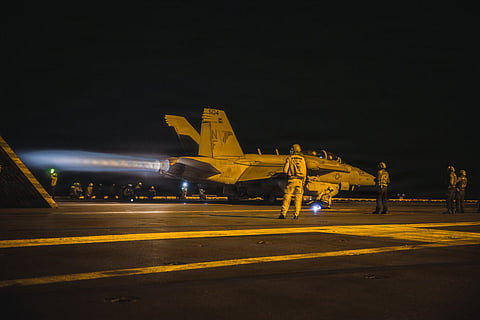
The Middle East is currently experiencing significant tension amid escalating military threats between the US and Israeli on one side and Iran on the other.
Meanwhile, diplomats from Saudi Arabia, Pakistan and Turkey, members of the Mecca pact, met with Iranian leaders in Tehran in a new push for de-escalation and seek a potential US-Iran deal to prevent a wider regional war.
As the US naval blockade holds, depriving Iran of billions of dollars in oil exports and cripplying its economy, European powers like the UK and France have also announced plans for a multinational mission to secure shipping lanes through mine-hunting drones, provided hostilities cease.
Simultaneously, regional disruptions include significant flight cancellations at Riyadh's King Khalid International Airport due to Houthi missile and drone strikes.
Get it: Fast, verified news for FREE ... download the Gulf News app — simply click here
The conflict involves high stakes for global energy: oil prices remain elevated as the Brent crude benchmark stayed at $114.66 (a 0.99% slide) as of 11.30am on Tuesday (Oct. 27, 2026), while Murban Crude stood at $117.67, slightly off by 0.28%.
The ongoing tensions highlight the global role of Strait of Hormuz as a vital oil and gas chokepoint.
Following are the latest UAE and Gulf security updates:
Saudi-led coalition intercepts Houthi missiles
The Saudi-led coalition said it intercepted and destroyed four drones launched by Yemen's Houthi militia towards Saudi Arabia's southern region. Coalition spokesman Major General Turki Al-Malki confirmed the interceptions. Its air defences also intercepted and destroyed three ballistic missiles launched by Yemen's Houthi militia towards Saudi Arabia's Eastern region, according to Al Malki.
Oman's call for non-aggression pact among 8 Gulf states
Badr Albusaidi, Oman's top diplomat, urged a Gulf security framework that includes Iran and a non-aggression pact among the region’s eight states. Speaking at Cambridge University’s Girton College, he called for “a new regional security structure” designed and implemented locally. Excluding Iran would make any framework inherently unstable, he said. “It’s not a matter of whether you’re friendly or hostile to Iran,” Albusaidi said. “A Non-Aggression Pact between all eight states should be the goal,” he added, referring to the six Gulf Cooperation Council (GCC) members, Iraq and Iran.
Iran insists on 7 conditions for talks with US
An Iranian official insisted that Washington must fulfill seven conditions before Tehran considers negotiations. Ali Bagheri Kani, deputy for foreign policy and international security at the Supreme National Security Council secretariat, spoke to state television after Mecca Pact talks involving Iran, Saudi Arabia, Turkey and Pakistan in Tehran. “If the United States fulfills them, then entering a new path could be considered,” he said.
UAE continues diplomatic coordination on regional security
The UAE Foreign Ministry reported that Foreign Minister Sheikh Abdullah bin Zayed Al Nahyan discussed regional developments and efforts to strengthen security and stability with Arab League Secretary-General Nabil Fahmy by telephone on Oct. 24. This documents continuing diplomatic engagement
There is no evacuation instruction or change in the UAE’s domestic security posture.
Saudi, Pakistani and Turkish officials pursue Iran talks
Senior officials from Saudi Arabia, Pakistan and Turkey met Iranian officials in Tehran on Oct. 26 in an effort to prevent renewed regional fighting and promote regional peace. The four-way discussions involved the Mecca pact countries, with participants agreeing to continue talks. The talks tackled the regional security environment affecting aviation and maritime trade.
Vessel fire reported in northern Gulf; cause and crew status unconfirmed
UK Maritime Trade Operations issued a warning late on Monday (No. 183-26, Oct. 26) after receiving multiple third-party reports of a vessel on fire approximately 63 nautical miles southeast of Al-Faw, Iraq. The vessel’s identity, crew status, damage and potential environmental effects were not established in the reports located. This was a northern Gulf report, not a confirmed incident in UAE waters or the Strait of Hormuz. UKMTO noted that the time of the incident is "TBC" (to be confirmed):
Disruption of UAE–Saudi flights
Etihad’s live advisory: The airline’s official flight-status page confirms that all flights between Abu Dhabi and Riyadh, and between Abu Dhabi and Dammam, are canceled through Thursday, Nov. 5, because of regional disruption. It warns that further changes remain possible.
For travelers: Check the entire itinerary, including connections. Etihad says affected passengers will receive information about available options; keep booking contact details updated.
Selected Etihad Jeddah flights are also cancelled through Nov. 5:
Abu Dhabi–Jeddah EY601, EY603
Jeddah–Abu Dhabi EY602, EY604
Emirates’ Saudi services
Services between Dubai (DXB) and select cities in Saudi Arabia are currently disrupted or suspended due to regional security concerns, with staggered resumption dates scheduled:
Dubai – Jeddah (JED): Flights are scheduled to resume on October 30, 2026 (including flights EK801, EK805, and EK803 to Jeddah, and EK802, EK806, and EK804 returning to Dubai).
Dubai – Riyadh (RUH): Flights are expected to resume on November 8, 2026.
Dubai – Dammam (DMM): Flights are expected to resume on November 8, 2026.
[For updates, verify the flight number and date directly with airlines].
Riyadh airport reopening
Gulf News reported that King Khalid International Airport resumed operations on Oct. 25 after a two-week closure. A Oct. 26 report cited Cirium data showing that 7,802 of 17,299 scheduled Saudi departures — about 45.1% — were canceled or did not operate between Oct. 8 and 25.
Why it matters for UAE passengers: An airport reopening does not establish that a particular airline has resumed its service or that a connecting itinerary is viable.
Iranian airlines’ UAE services remain suspended
As of Oct. 26, flights operated by Iranian airlines to and from the UAE remain suspended until further notice, including Iran Airtour services involving Dubai. This is a restriction described for Iranian-operated services. Obtain carrier-specific confirmation before traveling.
Emirates–flydubai Tel Aviv codeshare suspension remains posted
Emirates’ official travel-updates page continues to state that its codeshare operations with flydubai to and from Tel Aviv are suspended until further notice. The notice was last updated Oct. 5 at 8:31 pm Dubai time.
This confirms the Emirates codeshare restriction; it does not, by itself, establish the operating status of every flight sold directly by flydubai. Affected customers are directed to Emirates or their travel agent.
Practical takeaway for travelers
Check your exact flight number, departure date and return sector directly with the airline before leaving for the airport.
Do not assume that an airport reopening restores all services, or that every delay is conflict-related.
The latest aviation roundup explicitly distinguishes security disruption from operational and other causes.


