‘This railway was built for you’: Inside the journey of one of Etihad Rail's first Emirati train captains
He shares how years of training, commitment to safety prepared him for the role
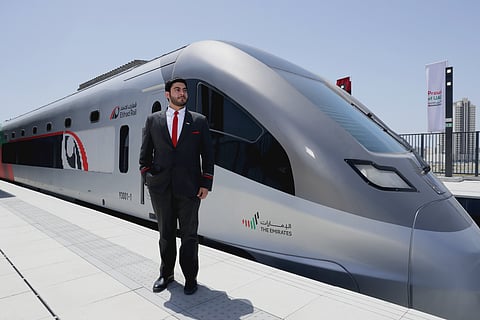
Dubai: The passengers settling into their seats may never think about what it takes to get a train moving safely and on time. They see the doors close, the journey begin, and the landscape glide by. What they do not see are the years of training, countless hours of practical experience, and unwavering focus on safety that make every trip possible.
For Ibrahim Al Hammadi, one of Etihad Rail's first Emirati train captains, every journey is the culmination of a path that began straight after high school. It took him from classrooms to freight trains carrying heavy industrial cargo across the UAE before he stepped into the driver's cabin of the country's new passenger railway.
Today, as thousands prepare to experience rail travel in the UAE, Al Hammadi is among the people helping turn a national vision into an everyday reality.
Get updated faster and for FREE: Download the Gulf News app now - simply click here.
Bold choice
Al Hammadi's journey has started when he enrolled at the Abu Dhabi Vocational Education and Training Institute (ADVETI), joining the UAE's first diploma programme specialising in railways, launched in partnership with Etihad Rail.
The programme has combined two years of theoretical study with a full year of practical, hands-on training on the railway network.
When he graduated in 2020 as part of the programme's first cohort, he has already made a decision that would shape his future.
“I was the only person in my class who chose the train captain pathway,” Al Hammadi told Gulf News.
It was the first of several competitive stages that has eventually led him to become one of the first Emirati captains on Etihad Rail's passenger network.
Learning the fundamentals on freight
Before taking responsibility for passengers, Al Hammadi has gained years of operational experience driving freight trains transporting granulated sulphur from the gas fields at Shah and Habshan to the export point at Ruwais.
The trains have been unlike anything most people imagine. With up to 110 wagons, they could stretch for more than a kilometre, demanding complete concentration from departure to arrival.
Every journey has started with a detailed inspection, including fuel checks, brake pressure tests, and a series of safety procedures before the train could leave.
“That grounding in freight, where safety and precision are everything, is what prepared me to take responsibility for passengers,” shared Al Hammadi.
The experience has taught him the discipline and judgement needed to operate one of the country's most sophisticated transport systems.
Years of learning never really end
Reaching the passenger driver's cabin has required more than completing a diploma. After graduating, Al Hammadi has underwent further specialist training before being selected as one of the first Emirati passenger train captains.
“It was a competitive process at every stage,” described Al Hammadi.
Selection has involved an extensive qualification programme covering railway operating systems, safety procedures, modern driving technologies, and field training on live operational rail networks, all designed to the highest international standards. Even after qualifying, learning continues.
“The foundation was the three-year railway diploma at ADVETI. Moving to passenger services then required a further multi-stage qualification programme combining theoretical and practical elements.”
Among the systems he has to master was the European Train Control System Level 2, an advanced in-cab signalling technology used across the passenger network, along with comprehensive emergency and safety procedures.
For Al Hammadi, continuous training has been simply part of the profession.
Watching the railway grow
One of the moments Al Hammadi has remembered most vividly was taking control of the new passenger fleet for the first time.
“The most memorable moment was the first time I took control of the new passenger fleet,” recalled Al Hammadi.
“That was a defining milestone, seeing everything come together and knowing you're at the forefront of a new chapter in rail, delivering a completely different kind of service to the country.”
The milestone has been more than a personal achievement. It has also mirrored the transformation of the railway itself.
“Growing with the company as the network itself has grown, from a single freight line to a national passenger railway, has been the privilege of my career.”
A journey he will never forget
Among the many journeys he has completed, one remains especially significant. Al Hammadi had the honour of driving the train carrying His Highness Sheikh Mohammed bin Rashid Al Maktoum, Vice President, Prime Minister of the UAE and Ruler of Dubai.
“It was a proud and unforgettable experience, not only as a train captain, but as an Emirati representing my country in such a significant moment for the UAE's transport sector,” exclaimed Al Hammadi.
“Being at the controls in that moment really brought home the scale and ambition of what we've built.”
For him, it has been a reminder that every successful journey represents years of preparation and teamwork.
“Experiences like that stay with you because they represent more than just the journey itself, they reflect years of dedication, precision, and collaboration behind the scenes.”
‘This railway was built for you’
Today, Al Hammadi has noted that the greatest reward is seeing passenger services become a reality and knowing the railway is making travel easier for people across the UAE.
“Seeing passenger services in operation and knowing people are travelling more easily and comfortably across the UAE is incredibly rewarding,” said Al Hammadi.
“Every journey is an opportunity to make a tangible difference to people’s day-to-day lives, and as an Emirati, that is a genuine source of pride.”
His message to residents is one he hopes every passenger remembers as they board.
“My message to UAE residents is simple: this railway was built for you. Every aspect of the journey has been designed with safety, comfort, and reliability in mind. We are proud to serve our community and look forward to welcoming you on board to experience a new way of travelling across the UAE.”
For passengers, a train journey may last only a few hours. For Al Hammadi, it has represented years of dedication continuing today as he helps shape the future of transport for generations to come.