The fastest way to end the US-Iran War isn’t more missiles: 2 options to consider
From oil chokepoint to common corridor: a diplomatic blueprint for Hormuz
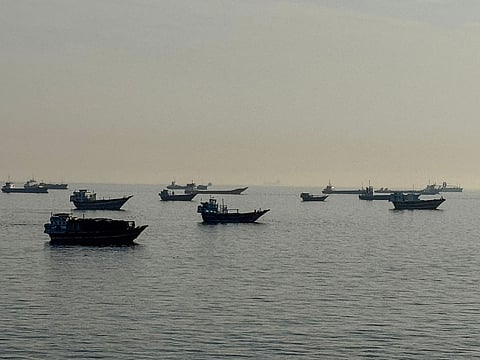
Wars often end not because one side wins decisively, but because both sides discover they have more to gain from stability than perpetual escalation.
If there is one place where that logic applies today, it is the Strait of Hormuz — the narrow waterway between Iran and Oman through which one-fifth of the world's oil supply passes.
For months, the US-Iran conflict has transformed the strait from a commercial shipping lane into the world's most dangerous economic chokepoint.
Commercial vessels have come under attack, insurance premiums have surged, and oil markets have swung wildly as traders react to every missile strike, media statement or X post.
Get it: Fast, verified news for FREE ... download the Gulf News app — simply click here
Fighting spreads beyond Hormuz
Recent fighting has even spread beyond Hormuz, with attacks on and from Iraq, Jordan, near Egypt's Suez Canal, underscoring how rapidly the conflict can expand.
Yet amid the renewed spiral of violence, two diplomatic ideas deserve far more attention than they have received.
Option 1:
The first is a proposal that would fundamentally change how the Strait of Hormuz is governed.
Instead of allowing the waterway to remain a geopolitical weapon, Gulf nations — including Iran — could jointly administer maritime services, navigation safety and ecological protection through a regional framework.
Possible? Yes. In fact, the foundation for such an arrangement may already exist.
A previously-negotiated memorandum envisioned Iran and Oman working together to define the future administration of the strait while consulting other Gulf littoral states.
The text of Paragraph 5 of the Islamabad MOU reads:
“The Islamic Republic of Iran will conduct dialog with the Sultanate of Oman to define the future administration and maritime services in the Strait of Hormuz in discussion with other Gulf littoral states in line with the applicable international law and the sovereign rights of coastal states of the Strait of Hormuz.”
“The Islamic Republic of Iran will conduct dialog with the Sultanate of Oman to define the future administration and maritime services in the Strait of Hormuz in discussion with other Gulf littoral states in line with the applicable international law and the sovereign rights of coastal states of the Strait of Hormuz.”Islamabad MoU (signed June 17/18, 2026)
Rather than treating Hormuz as territory to be controlled by a single power, the actual MoU wordings point toward a cooperative management model.
If cooler heads prevail, this formulation could reduce military tensions while ensuring that global energy supplies continue to flow.
It's certainly worthy of further exploration: It resembles successful maritime cooperation elsewhere — where coastal nations jointly oversee navigation, search-and-rescue ops and ecological protection without surrendering sovereignty.
Critics argue that such a framework rewards confrontation.
But the alternative is worse: a permanent cycle in which every regional crisis immediately pinches everyone's pocket.
Option 2:
The second source of optimism lies outside Washington and Tehran.
Although a British-backed international conference on protecting commercial shipping failed to materialise, the underlying idea remains compelling.
Europe, India, East Asia and many other economies depend heavily on uninterrupted Gulf energy supplies.
They have every incentive to broaden diplomatic efforts rather than leave negotiations solely to the countries directly involved in the conflict.
This wider international involvement is already taking shape.
Oman has emerged as the principal intermediary, holding discussions with Iran over future navigation arrangements – and possible mechanisms to safely reopen commercial shipping through Hormuz.
‘Shipping fees’
One particularly interesting compromise concerns "shipping fees".
Iran has reportedly favoured charging oil tankers for using Hormuz, while Oman has objected, stating that international law guarantees freedom of navigation through international straits.
Instead, Muscat is promoting a system in which ships would "voluntarily" pay for maritime services — such as navigation assistance, environmental protection and emergency response — rather than transit itself.
It may sound like a technical distinction.
But, politically, it could prove significant.
Calling the payments “maritime service fees” — instead of transit “tolls” — allows governments to fund safety operation.
More importantly, this can be done without directly violating long-standing international maritime principles.
Does this mean an agreement is imminent in any way, shape or form? One could only hope so.
Tehran continues to insist on a larger role in managing shipping through Hormuz.
Trump insists on keeping an "iron wall" via a naval blockade on Iranian ports.
This highlights the difficult negotiations still ahead.
Even so, diplomacy appears to be slowly replacing military escalation as the primary battleground.
Markets have noticed. Oil prices eased after reports of renewed maritime talks and proposals for multinational efforts to secure shipping routes.
This suggests a trend: investors increasingly believe diplomacy could eventually curb supply risks.
'Not worth it'
If Iran and the United States continue trading blows around the Strait of Hormuz, the danger is no longer confined to the battlefield. The global economy could begin to wobble under the weight of disrupted energy flows, higher shipping and insurance costs, inflationary pressure and growing uncertainty.
It is ultimately a lose-lose-lose proposition: Iran risks deeper economic isolation and destruction; the United States risks a costly, open-ended conflict and economic blowback; and the rest of the world pays through higher energy prices, disrupted trade and renewed inflation.
Hormuz is not just a geopolitical flashpoint. It is a pressure point for the global economy. The longer the bombing continues, the harder it becomes for anyone to claim there is a winner.
Today, two-thirds of Americans say the war isn't worth it. Washington is facing growing war fatigue: Poll after poll shows growing skepticism that the military campaign has been worth the price, amid concern over casualties, military losses, rising energy costs and inflation.
An Ipsos survey found just 24% considered US military action worthwhile and 51% said it was not.
More than half in the Ipsos poll said the conflict had negatively affected their personal finances.
The message from the American public: whatever Washington hoped to achieve in Iran, many Americans do not want another open-ended, costly foreign war.
They want their government focused on security and prosperity at home — and they are increasingly skeptical that another deadly intervention in the Middle East delivers either.
'Excursion'
Trump has repeatedly framed the Iran conflict as an “excursion” — a limited intervention rather than a war that demands the full mobilisation of American power.
That distinction matters.
For much of the American public, the rise of extremist regimes and conflicts in the Middle East remain regional security problems, not existential threats to the American homeland.
Iran may threaten US forces, allies and interests in the region. But the Islamic regime has not produced the kind of direct attack on the US that historically transforms public opinion overnight.
There has been no Pearl Harbour moment — no single, devastating strike on the American homeland capable of creating an overwhelming political mandate for escalation.
Trump, Hegseth, Rubio and Co can argue ad nauseam that another 9/11 moment is what they're trying to prevent with the current "excursion".
But without that kind of shock, there is little appetite for Washington to turn a limited military operation into an open-ended war requiring Congress to formally declare war on Iran.
The political reality is stark: Americans may support striking Iran's military capabilities, and degrade IRGC's nuclear ambitions.
But that does not mean they are prepared to sacrifice lives, accept sustained economic costs or commit the US to another major Mid-East war.
Trump can call it an "excursion". The American public appears increasingly determined that it not become another Iraq.
Get it: Fast, verified news for FREE ... download the Gulf News app — simply click here
More of the same vs shift in thinking
At the moment, it's unrealistic — given the deep mistrust and renewed exchanges of fire — to expect either option to be tackled.
No single agreement will erase decades of mistrust between Washington and Tehran.
Still, peace cannot be built with mutual threats or death-dealing arms, as Pope Leo XIV has urgently pointed out, even as he appealed for nations to recall their moral responsibility to seek peace.
Amid the shifting sands of diplomacy, however, it's not impossible for the warring parties to hit a “sweet spot”, at least on the Hormuz issue.
History suggests durable peace is built around shared economic interests.
If every country bordering Hormuz benefits from keeping the waterway open — and every major energy importer has a stake in preserving that stability — the incentives begin to shift away from a shooting war and an indefinite "dual blockade".
The Strait of Hormuz, barely 33 to 39 kilometres wide at its broadest navigable points, has long been a choke point where geopolitics, military power and global energy security collide.
Today, the threat is amplified by cheap, long-range and increasingly precise drones.
A single disruption — even a temporary one — could send shockwaves through shipping and energy prices worldwide.
Yet the flipside is also possible: The strait could become the region’s first genuinely shared strategic asset.
That may not end every dispute between the Washington and Tehran, given the deep ideological differences.
And that could be part of formula that could end the war over the world’s most important waterway.
And that could be a significant beginning.


