Inside Iran's ‘golden weapon’: The real story behind Tehran’s tanker attacks
Analysts say the real reason behind the attacks goes far beyond transit fees
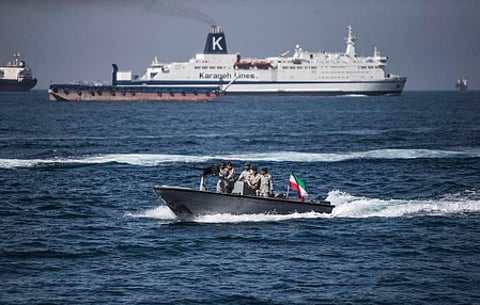
Dubai: When three commercial tankers came under attack in the Strait of Hormuz this week, many saw it as another act of escalation in the long-running confrontation between Iran and the United States.
But analysts say the attacks were driven by a deeper concern in Tehran: A growing belief that it was gradually losing strategic control over the world’s most important oil chokepoint.
Rather than simply trying to disrupt shipping or strengthen its hand in sanctions negotiations, Iran appeared determined to remind the world that no lasting security arrangement in the Gulf could bypass its influence over the Strait of Hormuz.
That calculation may also explain why Tehran chose to act despite risking the collapse of the fragile ceasefire and Memorandum of Understanding (MoU) signed with Washington just three weeks ago.
Hormuz, not fees, became the bigger issue
Under the June 17 MoU, Iran agreed to reopen the Strait of Hormuz to commercial shipping in exchange for economic relief, while negotiations continued over more difficult issues including sanctions, frozen assets and its nuclear programme.
But the agreement soon began to falter.
Commercial traffic remained well below pre-war levels and many ships increasingly used routes encouraged by the United States and Oman rather than those favoured by Tehran.
According to Reuters, Iranian leaders came to believe they were gradually losing authority over the Strait itself. The news agency reported that Tehran now regards Hormuz as its “golden weapon” — a strategic asset that provides greater long-term leverage than even its disputed nuclear programme because it allows Iran to influence one of the world’s busiest energy corridors.
From Tehran’s perspective, analysts say, allowing alternative security arrangements to take shape around Hormuz risked weakening one of the few sources of leverage it still possessed.
US believed Tehran was changing the rules
The New York Times reported that Iranian officials increasingly viewed American actions as an effort to shift control of the Strait away from Iran.
“The MoU increasingly looked like a mirage,” Vali Nasr, professor at Johns Hopkins University’s School of Advanced International Studies, told the newspaper.
“The view from Tehran is that the US is engaged in a concerted effort to take control of the Strait out of Iran’s hands, to weaken its position in Lebanon and to regain its own strength in order to put even more pressure on Iran or to go back to war,” he said.
Those concerns extended well beyond shipping.
Washington was simultaneously pursuing diplomatic efforts aimed at securing a lasting settlement between Lebanon and Israel, including attempts to disarm Hezbollah, Iran’s most powerful regional ally.
Meanwhile, expectations that Tehran would quickly receive meaningful economic relief under the Hormuz agreement continued to fade.
For Iranian leaders, analysts say, the combined effect was the gradual erosion of both military and diplomatic leverage.
Why strike now?
Rather than wait for that leverage to diminish further, Tehran appears to have concluded that demonstrating its ability to disrupt global shipping remained its strongest bargaining tool.
Reuters reported that Iranian officials increasingly believed preserving influence over Hormuz mattered more than immediate economic benefits.
In Tehran’s view, surrendering control of the Strait today could invite additional Western demands tomorrow — on its missile programme, regional alliances and nuclear activities.
The timing may also have carried symbolic significance.
The attacks coincided with funeral ceremonies for Iran’s wartime leadership, reinforcing the government’s message that despite months of conflict it remained capable of projecting power across the Gulf.
“Having withstood this pummeling from the US and Israel, they are probably feeling quite secure,” Suzanne Maloney, a senior fellow at the Brookings Institution, told the New York Times.
“I think the timing of the attacks... demonstrates a bit of triumphalism on the part of the regime.”
A gamble that could backfire
Whether that calculation proves successful remains uncertain.
President Donald Trump declared the ceasefire “over” and warned that the United States was prepared to intensify military operations if attacks on commercial shipping continued.
American aircraft subsequently launched fresh strikes across Iran, while Tehran vowed additional drone and missile attacks against US allies in the Gulf.
Some analysts believe neither side has abandoned diplomacy.
“I think it is mostly posturing,” Nate Swanson, a former US National Security Council official now with the Atlantic Council, told the New York Times.
“I think it is akin to what Trump is doing. He is negotiating through kinetic actions and loud threats, so in some ways they are speaking the same language.”
Others are less convinced.
“They risk misreading President Trump, which they have done over and over again,” Joel Rayburn, a former US special envoy for Syria who is now a senior fellow at the Hudson Institute, told the newspaper.
“They are overplaying their hand.”
More than a shipping dispute
The latest attacks underline how the Strait of Hormuz has become far more than a commercial waterway.
For decades, the narrow passage has been central to Iran’s deterrence strategy, allowing Tehran to influence a route through which roughly a fifth of the world’s seaborne oil trade passes.
Analysts say the latest confrontation suggests Iran now sees preserving that influence as essential to its broader regional strategy.
The dispute is therefore no longer simply about sanctions, transit fees or even commercial shipping.
Instead, it has become a contest over who ultimately shapes security in the Gulf — and whether Iran can retain its role as the dominant power along the Strait of Hormuz.
If that assessment is correct, the tanker attacks were less an isolated military action than a strategic message: Tehran believes that losing its grip over Hormuz would mean losing its strongest card in any future confrontation with the United States and its regional allies.


