'Egypt drone attack shows US interests are vulnerable anywhere'
Analysts say the attack extends regional tensions beyond Gulf and into the Mediterranean
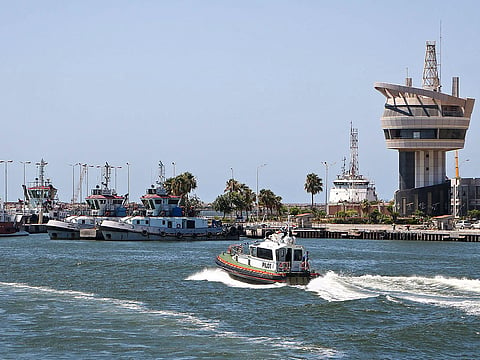
Cairo: A drone strike on the Egyptian port of Damietta, the first attack on the country since the US-Iran war broke out, could be a high-risk message for American interests everywhere in the Middle East, analysts say.
No party has claimed the strike on the Mediterranean port and Egypt has not assigned blame for the attack, which struck an American-owned and operated floating gas storage vessel.
Houthi militants in Yemen, who have imposed a Red Sea blockade on Saudi Arabia, have denied carrying out the attack, which raised fears for the only remaining safe maritime route for the world's largest crude producer.
Get updated faster and for FREE: Download the Gulf News app now - simply click here.
According to analysts, the goal of the attack -- regardless of who launched it -- could be to drag Egypt into the conflict, after months of Cairo acting as one of few diplomatic channels between Iran and the US.
The port strike, the furthest afield from the Gulf since the war broke out, also marks a new milestone by crossing the Red Sea into the Mediterranean.
Precision strike
Damietta, a Mediterranean port, is more than 1,300 kilometres away from Iran and 2,000 kilometres from Yemen.
The precision strike caused fires on the US-owned Energos Winter storage and regasification vessel and the Greek-owned GasLog Salem tanker, which was moored alongside.
"The attack may have been calibrated to damage a United States-linked asset without killing Egyptians," King's College London professor Andreas Krieg told AFP, though Cairo would not "find that distinction reassuring".
According to Royal United Services Institute analyst HA Hellyer, the distance means "it's unlikely that Iran would have struck Egypt directly from Iranian territory".
But, he said, it is possible Tehran's regional allies could have done so, via the Houthis in Yemen or Iran-aligned militias in Iraq.
Houthi-affiliated news agency Saba on Thursday said the "rumours" were "unfounded".
Iran's other powerful ally, Hezbollah in Lebanon, is closest to the port less than 400 kilometres away.
"A drone launched from the Lebanese coast could fly west over the eastern Mediterranean before turning south towards Egypt," Krieg said, enabling it to avoid both Israeli and Egyptian airspace.
But Cairo University political science professor Mustapha Kamel Al-Sayyid believes Hezbollah is "wiser" than to pick a fight with the largest Arab military.
What is the message?
While energy facilities elsewhere in the region have been hit by drones and missiles over the course of the United States and Israel's war on Iran, Egypt had so far been spared.
"I would not automatically interpret this as an attack on Egypt itself," Krieg said, adding the purpose was to "show that United States assets are vulnerable beyond the Gulf".
"For Egypt, this is a warning that neutrality does not guarantee immunity," Krieg added.
Wednesday's attack took place as the United States and Iran returned to hostilities following a brief lull -- an apparent message that Iran could disrupt global trade even farther than it has.
According to Hellyer, "that would mean that Iran's strategy is very high risk, with a lot of downsides for their security relationships".
"Cairo and others would see an attack by any Iranian-aligned group on Egyptian territory as a formidable escalation, and that won't go down well for the medium-to-long term at all for Tehran," he told AFP.
Egypt has for months walked a diplomatic tightrope, keeping phone lines open with both Tehran and Washington.
It helped secure a ceasefire earlier this year and serves as a diplomatic channel between the US, Iran and powers in the region.
"Egypt is the only major power in the region that still adopts a near-neutral stance," Al-Sayyid told AFP, adding that "only Israel" benefits from a firmer Egyptian stance.
Mediterranean fallout
Egyptian ports have this year absorbed substantial trade rerouted form the Gulf, as major shipping companies have tried to avoid the Strait of Hormuz and the Gulf, according to data from risk intelligence firm Vortexa and ship tracker MarineTraffic.
Following the Houthi blockade on Saudi Arabia and ensuing attacks ships crossing the Bab al-Mandeb strait, tankers transporting Saudi crude have used the Suez Canal and an overland Egyptian pipeline as the only safe, albeit expensive, route.
But that alternative route depends on the safety of Egyptian shipping lanes and, crucially, the Mediterranean.
"I expect at least some vessel owners and operators to adopt a wait-and-see approach as the risks around Suez's northern gateway are assessed," George Morris, a market analyst at Vortexa, told AFP.
Market behaviour, he said, will depend "on whether the attack is viewed as an isolated incident or the beginning of a broader escalation".
The Egyptian government -- for which the Suez Canal is a crucial foreign currency earner -- has put out multiple statements affirming that marine traffic is flowing normally and the Damietta port remains operational.


