Why Gulf states remain exposed to the US-Iran conflict
Renewed attacks show why Gulf security cannot depend on a fragile ceasefire
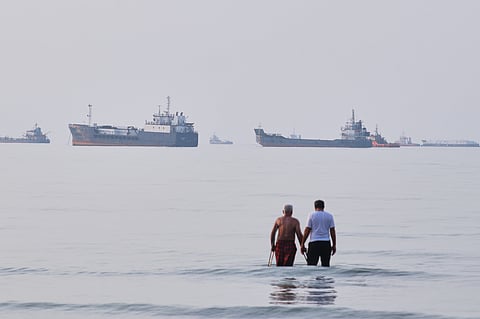
After weeks of fragile calm, the United States and Iran are once again engaged in direct military confrontation. Tehran has responded to US attacks along Iran’s southern coast by launching fresh strikes across the Gulf. Bahrain, Kuwait, Qatar and Oman were among the countries affected, with Iran describing the attacks as retaliation for a new wave of American airstrikes.
For Gulf countries, the war they had hoped diplomacy would contain has erupted once again. Yet the collapse did not happen overnight. It followed the gradual breakdown of an agreement that had been fragile from the start.
The 60-day ceasefire signed in mid-June never rested on firm foundations. It followed the first phase of the war, which erupted on February 28 and led to the death of Iran’s supreme leader, Ayatollah Ali Khamenei. After several days of funeral proceedings, he was buried. He has been succeeded by his son, Mojtaba Khamenei.
Hormuz reignites the conflict
The immediate trigger for renewed hostilities was the Strait of Hormuz.
The US military attacked Iran after accusing Tehran of striking three ships in the strategic waterway. The Islamic Revolutionary Guard Corps Navy then announced on July 11 that it had closed the strait and struck a Cyprus-flagged vessel, followed by a second ship the next day.
That prompted the United States to attack dozens of Iranian military targets in an effort to weaken Tehran’s ability to threaten commercial shipping. In one operation, the US military said it struck 90 targets along Iran’s coastline.
Each round of escalation plays out along the Gulf’s most important shipping route, and GCC economies feel the effects of every confrontation.
Gulf territory becomes part of the battlefield
The war has once again reached GCC territory.
Iran’s military said it carried out drone strikes against US military sites in Bahrain, Kuwait and Qatar. It said the targets included a Patriot air defence system in Kuwait, a satellite and early-warning station in Qatar, and fuel depots used by American forces in Bahrain.
Tehran presents these strikes as attacks on American assets rather than on the countries hosting them. In practice, that distinction offers little reassurance to Gulf states because the explosions still take place in their airspace and near their cities.
Kuwait’s military reported intercepting hostile drones, while Bahrain sounded air raid sirens and urged residents to remain indoors. Oman said it was taking all necessary measures to respond to developments and ensure the safety of the country and its residents.
For Gulf governments, the pattern is familiar. Previous escalations have followed a similar sequence: Iran attacks commercial shipping, the United States responds with limited strikes, and Tehran then targets American assets in Gulf countries.
Whatever calculations drive each side, the outcome is often the same. GCC countries end up bearing the risks of decisions made in Washington and Tehran.
Caught between two powers
The GCC’s predicament is rooted in geography and security.
Several Gulf states host American forces under long-standing defence agreements. At the same time, they share coastlines, trade links and, in some cases, years of carefully rebuilt relations with Iran.
This leaves them caught between two competing powers. They depend on the United States for security, but they also know that any confrontation with Iran can quickly spill into their airspace, territorial waters and economic systems.
The economic stakes could hardly be higher.
The Strait of Hormuz carries a large share of the world’s oil and gas exports, much of it from GCC producers. Oil prices had fallen from a mid-May peak of $104 a barrel to as low as $68 in early July while the ceasefire held. They are now under renewed pressure following the closure of the waterway.
The US military also said it disabled an empty tanker heading towards Kharg Island, a key hub for Iranian oil exports.
But the risks to Gulf economies extend far beyond energy. GCC diversification plans depend heavily on aviation, logistics, tourism and investor confidence. All of these sectors suffer when the strait is disrupted and regional security deteriorates.
Diplomacy continues, but space is narrowing
Despite the renewed fighting, Gulf diplomacy has not stopped.
Qatar, alongside Pakistan, is working to bring Washington and Tehran back to the negotiating table. This reflects a consistent regional position: the Gulf’s interest lies in de-escalation, not in the outright victory of either side.
Yet the space for mediation is narrowing.
President Donald Trump has questioned the value of further talks, calling negotiations a “waste of time dealing with them”. An Iranian Foreign Ministry spokesperson, meanwhile, said Tehran had no plans to resume negotiations.
Within the US administration, Vice-President JD Vance has continued to argue that the war cannot be won through military force alone. He has noted that it remains relatively easy for Iran to attack ships in the strait, regardless of how many Iranian military bases are destroyed.
The central dispute remains unresolved
At the heart of the conflict is a fundamental disagreement over control of the Strait of Hormuz.
Iranian Foreign Minister Abbas Araghchi has insisted that Tehran must retain control of the strait, warning that any alternative arrangement would merely delay its reopening.
Washington, by contrast, treats freedom of navigation and control of the waterway as non-negotiable.
Between these positions sit the GCC countries, whose security, trade routes and airspace have become the arena in which the dispute is being tested.
The past five months have taught Gulf countries a difficult lesson. The ceasefire was never truly secure, and neither the United States nor Iran appeared to regard it as a durable end to the war. When the conflict resumed, both sides were ready to continue fighting.
For Gulf countries, the central takeaway is clear: an agreement negotiated by Washington and Tehran alone will not be enough to protect the region.
Real security will require a lasting settlement that addresses the future of the Strait of Hormuz and the wider regional order. Gulf states must also have a role in shaping that agreement, rather than simply living with the consequences of decisions made elsewhere.
Noor Almutawwa is Research Assistant at TRENDS Research & Advisory in the UAE


