How Gulf allies shaped Trump’s dramatic Hormuz fee U-turn
Gulf allies championed freedom of navigation as Trump dropped Hormuz tolls
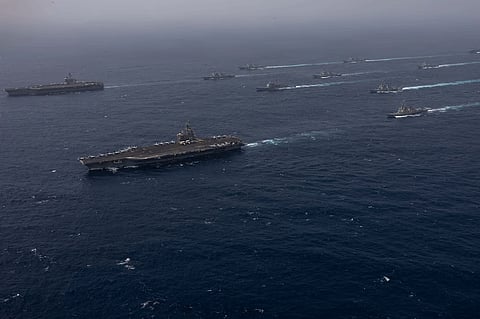
Dubai: President Donald Trump’s abrupt decision to abandon his plan to impose tolls on ships passing through the Strait of Hormuz has highlighted the growing influence of Gulf allies over Washington’s approach to the Iran conflict.
The reversal came just a day after Trump proposed charging commercial vessels for US protection while transiting the strategic waterway. But following strong objections from Gulf partners, the proposal was quietly dropped, underscoring how regional allies remain central to US decision-making on one of the world’s most sensitive maritime corridors.
For Gulf countries, the issue was never simply about money.
Freedom of navigation
The Strait of Hormuz carries a large share of the world’s seaborne oil exports, and any additional costs or uncertainty risk disrupting trade, increasing insurance premiums and unsettling energy markets. Gulf states have consistently argued that freedom of navigation should remain protected without new financial burdens on shipping.
The episode also reflects the delicate balancing act Gulf capitals have pursued since the war began. While maintaining close security partnerships with Washington, countries including the UAE, Saudi Arabia, Qatar and Oman have also sought to prevent the conflict from widening and have supported diplomatic efforts to reduce tensions with Tehran.
The toll proposal threatened to complicate that strategy.
The rapid reversal suggests Gulf leaders were able to make clear that preserving confidence in international shipping was a higher priority than introducing a controversial new system of transit charges.
Beyond the immediate policy shift, the incident raises broader questions about Trump’s Iran strategy.
What began as an operation expected to last only weeks has stretched into months, with the collapse of the ceasefire agreement forcing Washington back into military pressure while diplomacy remains uncertain.
Resilience of Iran’s political system
Several analysts told The New York Times that the conflict has exposed the limits of relying on pressure alone.
Vali Nasr, a Middle East scholar at Johns Hopkins University, said Iran has proved unwilling to operate on Washington’s terms, resisting efforts to force quick concessions. Suzanne Maloney of the Brookings Institution argued that Tehran was never likely to follow the path Trump expected, while Aaron David Miller, a veteran US negotiator, said the president now faces “a brutal and tenacious adversary.”
Others believe the administration underestimated the resilience of Iran’s political system.
John Hannah, a former adviser to US Vice-President Dick Cheney, argued that Washington had based its campaign on flawed assumptions about how easily the Iranian leadership could be weakened. Abbas Milani of Stanford University also questioned whether the White House fully understood the nature of Iran’s ruling establishment despite repeatedly expressing interest in reaching a negotiated settlement.
For Gulf governments, however, the most immediate concern is less about Washington’s long-term strategy than about regional stability.
The Hormuz episode demonstrated that decisions affecting the Gulf cannot be made in isolation. Whether through diplomacy, security cooperation or economic influence, Gulf allies have shown they can shape policy when their own interests are directly at stake—even as the broader conflict with Iran remains far from resolution.


