Why the US-Iran conflict flared again: The real trigger
How the dispute over the Strait of Hormuz is pushing the US and Iran back to the brink
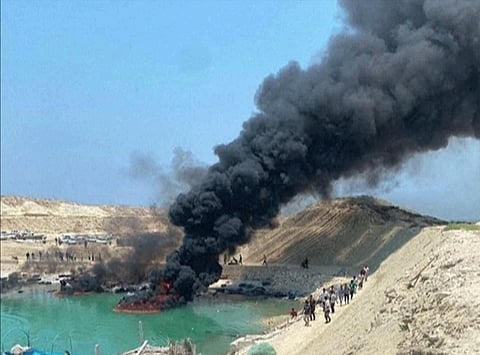
Dubai: The Middle East edged closer to a wider regional conflict on Sunday after Iran struck a commercial vessel in the Strait of Hormuz, prompting the biggest US military response since the collapse of the ceasefire.
American forces launched strikes on about 140 Iranian military targets, while Tehran retaliated within hours with missiles and drones aimed at Oman, Bahrain, Kuwait, Qatar and Jordan. Qatar reported injuries from falling debris after intercepting incoming missiles, Kuwait activated its air defences and explosions echoed across parts of the Gulf. Iran also declared the Strait of Hormuz closed once again, threatening one of the world’s busiest energy and shipping corridors.
The renewed violence came less than 24 hours after Iranian and Omani officials met in Muscat to discuss reopening the Strait of Hormuz to normal commercial shipping. Oman proposed allowing vessels to use both the southern shipping lane in Omani waters and the northern lane in Iranian waters without additional approval requirements. Iranian officials said they would take the proposal back to Tehran for further consultations. Instead, within hours, diplomacy gave way to the biggest military escalation since the ceasefire.
The UAE’s National Emergency Crisis and Disasters Management Authority (NCEMA) said the situation remained stable, adding that missile threats detected on Sunday morning were outside the UAE’s borders.
Meanwhile, India’s Ministry of External Affairs said one Indian national was missing after the attack on the commercial vessel near the Strait of Hormuz.
Yet Sunday’s violence did not erupt in isolation. It was the culmination of weeks of mounting tensions after the US-Iran interim agreement began to unravel.
The latest exchange was not simply about one ship or one round of air strikes. At its heart lies a much bigger dispute over control of the Strait of Hormuz, freedom of navigation and the future security architecture of the Gulf.
1. The attack on a merchant ship became the spark: The immediate trigger was Iran’s strike on a Cyprus-flagged container ship sailing through the Strait of Hormuz. Tehran said the vessel ignored repeated warnings to follow an approved shipping corridor and described the strike as a warning.
The ship caught fire, suffered significant engine-room damage and its crew abandoned it. Washington rejected Iran’s explanation, calling it an attack on civilian maritime traffic and a direct threat to one of the world’s most important trade routes. Within hours, the Pentagon ordered another wave of military action.
2. Hormuz remains the biggest unresolved dispute: Although the interim agreement halted the fighting that began in February, it never resolved the central dispute over the Strait of Hormuz. Iran argues that, as a coastal state, it has the authority to regulate shipping through the narrow waterway and has repeatedly insisted vessels must follow routes approved by Tehran.
The United States and its allies reject that position, maintaining that the Strait is an international waterway where commercial vessels must enjoy unrestricted passage under international law. Every confrontation at sea therefore risks becoming a direct military confrontation.
3. Washington sought to restore deterrence: The United States described Sunday’s operation as its largest military response since the ceasefire. About 140 Iranian military targets were hit, including missile launchers, drone sites, ammunition depots, command-and-control facilities and naval infrastructure.
American officials said the objective was not simply retaliation but restoring deterrence by reducing Iran’s ability to threaten commercial shipping and international navigation. The strikes also sent a clear message that attacks on merchant vessels would draw an immediate and overwhelming response.
4. Iran widened the conflict beyond US forces: Rather than confining its retaliation to American military assets, Iran expanded the battlefield by targeting Gulf countries that host US forces.
Missiles and drones were launched towards Oman, Bahrain, Kuwait, Qatar and Jordan, while Iran also claimed attacks linked to facilities supporting US naval operations in Oman.
By widening the scope of its response, Tehran increased pressure on Washington’s regional partners while demonstrating that any future confrontation over Hormuz is likely to involve multiple countries across the Gulf.
5. Diplomacy is hanging by a thread: The latest exchanges have dealt another serious blow to already fragile diplomatic efforts.
Iran has again declared the Strait of Hormuz closed until what it calls American intervention ends, while Supreme Leader Mojtaba Khamenei has vowed revenge for the killing of his father, former supreme leader Ali Khamenei.
The United States says it remains willing to negotiate but has warned that any further attacks on shipping or regional partners will invite stronger military action. With both sides refusing to compromise over Hormuz, the strategic waterway has once again become the centre of the confrontation — and the issue most likely to determine whether diplomacy survives or the conflict spirals into a wider regional war.


