UAE rain and storms: Is remote work mandatory for the private sector during unstable weather?
WFH vs. the office: Experts explain your rights on remote work, pay, and commuting
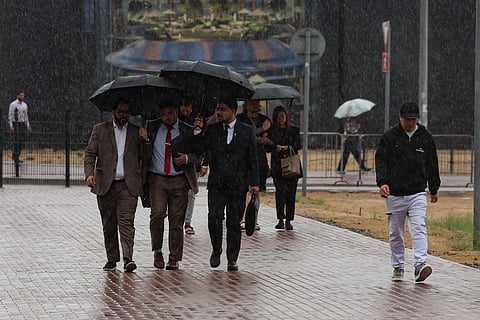
Dubai: Unstable weather continues across the UAE, with rain, strong winds and dense cloud cover expected to last until Friday, according to the National Centre of Meteorology. Authorities have issued safety advisories, reduced speed limits and introduced precautionary measures to minimise risks.
Amid these conditions, the Ministry of Human Resources and Emiratisation (MoHRE) has urged private sector companies to strengthen workplace safety, adopt flexible or remote working arrangements where necessary, and ensure workers have adequate protection, safe transport and suitable working conditions.
The advisory has also raised questions among employees about remote work, salary deductions, commuting delays and employers’ legal responsibilities during severe weather.
Is remote work mandatory for private sector employees?
There isn't a mandatory remote work policy for private sector companies during periods of unstable weather. However, authorities have consistently encouraged employers to remain flexible and place employee safety first.
“Remote work isn’t mandatory for the private sector but employers are encouraged to be flexible and prioritise safety,” Emily Aryeetey, partner at Stephenson Harwood Middle East LLP, told Gulf News.
Aryeetey explained that since the extreme rainfall and flooding in April 2024, weather warnings are taken far more seriously by UAE employers.
“Every heavy rain forecast now prompts companies to think carefully about travel disruption and employee safety,” she said.
This, she added, is why having a clear adverse weather policy is increasingly important. Such policies can outline options such as remote work, flexible or adjusted hours, and how pay or absences will be managed when commuting becomes unsafe.
Since the extreme rainfall in April 2024, every forecast of heavy rain now prompts UAE employers to think much more seriously about how to manage travel disruptions and keep staff safe. That’s why having a clear adverse weather policy can be a good idea. An adverse weather policy can spell out options like remote work, flexible or adjusted hours, and how pay or absences will be handled when travel is unsafe.

Can employers deduct salary if employees arrive late or miss work due to rain?
According to UAE Labour Law, salary deductions are only permitted in very limited legal circumstances, typically related to disciplinary penalties.
“When it comes to absences caused by adverse weather and travel disruption, salary deductions are generally not allowed,” Aryeetey said. “The law permits deductions only in specific cases, such as disciplinary action or repayment of advances — not for absence due to events outside the employee’s control.”
If absences extend over several days, employers and employees may discuss whether time off should be treated as annual leave. However, Aryeetey stressed that any such arrangement must be mutually agreed and handled transparently.
Can commuting time be counted as working hours during bad weather?
During periods of severe weather, traffic congestion and public transport delays often worsen, significantly increasing commute times. MOHRE has clarified that, under certain conditions, commuting time may be counted as part of official working hours.
Cabinet Resolution No. (1) of 2022 confirms that commuting is not usually considered working time. However, exceptions apply during adverse weather, transport disruptions, or when employment contracts specifically allow for it.
These provisions are designed to provide flexibility during exceptional circumstances, such as severe weather that directly affects employees’ ability to travel safely.
Why employers are being urged to rethink work-from-home policies
“I believe working from home and flexible hours should be implemented wherever possible in the private sector, especially during adverse weather,” said Sarah Brooks, Managing Director of FikrahHR.
“Employers have a duty of care at all times, but this responsibility becomes even more critical during unstable weather,” she told Gulf News.
Brooks added that employers are expected to follow official guidance and weather alerts, noting that reliable forecasts are readily available.
“Legally, employers are responsible for ensuring their employees’ commute to and from work is safe during extreme weather,” she said.
I believe that working from home and flexible timings should be implemented wherever possible in the private sector, particularly during adverse weather conditions. Employers have a duty of care at all times, but this responsibility becomes even more critical during periods of unstable weather.

What the law says about employer responsibility during severe weather
Brooks highlighted Administrative Decision No. (19) of 2023, which governs occupational safety, health and labour accommodation. Article 7 specifically outlines employers’ obligations regarding transportation.
“The law clearly states that employers who provide transportation must prioritise employee safety,” she explained. “More importantly, it requires employers to ensure the safety of all workers travelling to and from the workplace, taking into account warnings issued by the National Center of Meteorology.”
Crucially, this responsibility extends beyond company-provided transport.
“These rules do not apply only to staff buses or arranged transport for construction or hospitality workers,” Brooks said. “They also apply to employees using their own vehicles.”
Employers are required to educate staff on safety precautions and are expected to show a high degree of flexibility around working hours during severe weather.
This regulation does not only apply to company-arranged transport, such as buses for construction or hospitality staff, but also extends to employees using their personal vehicles for commuting.Sarah Brooks, Managing Director of Fikrah HR
What about sectors where remote work isn’t possible?
While remote work and flexible hours may not be feasible for sectors such as healthcare, hospitality and retail, Brooks stressed that employers in these industries are still required to follow specific safety protocols during adverse weather.
“It’s not just about rain making commutes difficult,” she said. “Post-rain conditions can result in flooded roads, waterlogged areas and public transport delays. Employers need to recognise these risks and act accordingly.”
Stay updated: Get the latest faster by downloading the Gulf News app now - it's completely free. Click here for Apple or here for Android. You can also find it on the Huawei AppGallery.
Why many UAE companies are already prepared
Brooks noted that many private sector companies already have work-from-home and flexible working policies in place, largely carried over from the COVID-19 pandemic.
“The pandemic showed that remote work can be successfully implemented for many roles without disrupting business operations,” she said.
With most work now digital, employees can often continue working remotely for short periods using laptops, secure systems and online collaboration tools.
“Since last year’s floods, many companies have refined their policies further, activating remote work in response to official weather alerts and putting employee safety first,” Brooks added.
This article was published on December 19, 2025 and has been updated since.


