Why are Trump and Iran telling different stories about what they agreed to?
Public contradictions suggest key parts of the US-Iran framework remain unresolved
Dubai: Just days after the United States and Iran signed a framework agreement in Switzerland aimed at ending months of tensions, both sides are offering sharply different accounts of what was actually agreed.
Iranian officials, however, have publicly pushed back on several of those assertions, creating confusion over the contents of the 14-point memorandum of understanding and raising questions about how close the two sides really are to a final deal.
The disagreement reflects a familiar reality of US-Iran diplomacy: While negotiators may agree on broad principles behind closed doors, they often present different versions of those understandings to domestic audiences.
Inspections at the centre of the dispute
One of the biggest points of contention is nuclear inspections.
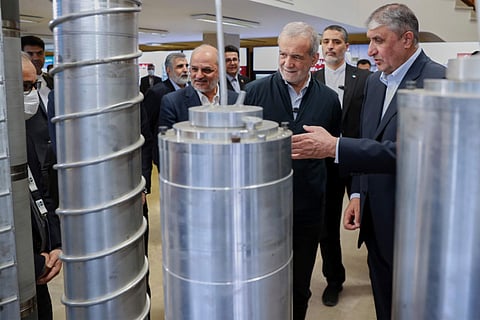
Trump said Iran had agreed to allow the “highest level” of inspections indefinitely. But Tehran quickly rejected suggestions that international inspectors would soon be granted access to key nuclear facilities at Isfahan, Natanz and Fordo, all of which were hit by US strikes last year.
What do the US and Iran differ on?
Nuclear inspections: Trump says Iran agreed to extensive inspections; Tehran says no access plans have been finalised for key nuclear sites.
IAEA access: Washington suggests inspectors will return soon; Iran says details remain under negotiation.
Frozen assets: Vance says released funds will be overseen by US and Qatari officials; Iran rejects that claim.
US farm products: Washington says Iran will use funds to buy American agricultural goods; Tehran says it has no such obligation.
Control of released funds: Iran insists it alone will decide how the money is spent.
Status of the agreement: The US portrays major breakthroughs; Iran describes many issues as still unresolved.
Negotiating process: The two sides have also offered conflicting accounts of how talks continued following Trump’s threats over the Strait of Hormuz.
According to diplomats familiar with the negotiations, inspection arrangements were discussed during talks in Switzerland, and officials from the International Atomic Energy Agency (IAEA) were involved in consultations. However, details such as timing, scope and implementation appear to remain unresolved.
That means both sides may be describing different stages of the same discussion: Washington highlighting a principle agreement, while Tehran insists no operational commitments have yet been finalised.
Frozen assets and farm products
A similar dispute has emerged over Iran’s frozen overseas assets.
Vance said funds released under the agreement would be overseen by US and Qatari officials and used to purchase American agricultural products.
Iranian officials rejected that characterisation, saying the agreement imposes no such obligation and that Tehran will decide independently how any released funds are spent.
Still, Iranian statements have stopped short of ruling out purchases of American goods, suggesting that some understandings may exist but have not been formally written into the agreement.
Battle for public opinion
Analysts say the conflicting statements are also part of a political messaging battle.
Trump has often used public announcements to build momentum behind negotiations and lock counterparts into positions before final details are settled.
Iran, meanwhile, faces pressure from hardliners who oppose engagement with Washington and therefore has an incentive to publicly downplay any concessions.
Suzanne Maloney of the Brookings Institution said Washington and Tehran are engaged in a struggle to shape public perceptions and advance their preferred interpretation of the talks.
The public contradictions, she argued, reveal how much work remains before a durable agreement can be reached.
A deal, but not a final one
For now, the accord appears to be more of a framework than a fully detailed settlement.
Both sides agree they want sanctions relief, nuclear safeguards and the reopening of normal economic activity. But disputes over inspections, frozen assets and implementation suggest many of the hardest issues have yet to be resolved.
The repeated contradictions may be frustrating for observers, but they also reflect the reality that the toughest bargaining often begins after a headline agreement is signed.


