Is the US–Iran deal really happening? Conflicting signals cloud talks
Diplomats report differing signals as discussions continue among key stakeholders
Dubai: Conflicting statements from Tehran, Washington and regional mediators have cast doubt over the status and timing of a proposed US–Iran peace framework, with Iranian officials signalling that no final decision has been taken on the agreement.
The diverging messages highlight uncertainty over whether weeks of negotiations are close to a breakthrough or still facing last-minute political and technical hurdles.
Iran’s Fars news agency, citing a source close to the negotiating team, said Tehran had “not yet taken or announced its final decision” on the memorandum of understanding being discussed to end the Middle East war. The report underscored mounting opposition from hardline factions, who argue the deal could weaken Iran’s leverage over the strategic Strait of Hormuz.
Later, Iran’s chief negotiator Mohammad Bagher Ghalibaf said there was “no point” in continuing peace talks with the United States following Israeli strikes on Beirut’s southern suburbs, sharply escalating uncertainty around ongoing diplomatic efforts.
“The Zionists’ aggression against Dahieh once again showed that the United States either lacks the will to implement its commitments or lacks the ability to do so,” he said on X.
“If you do not have the will or the ability to fulfil your commitments, then there is no point in talking about continuing down this path,” he added.
What Trump says
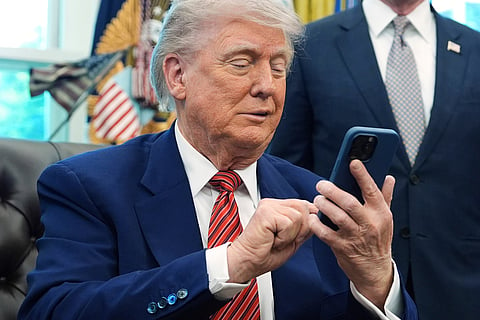
US President Donald Trump said a deal with Iran is “scheduled to get signed” on Sunday.
He said the Strait of Hormuz would be “open to all” immediately after the agreement.
Trump has repeatedly said a breakthrough was imminent since the April truce, despite earlier delays in talks.
What Iran says
Iran’s chief negotiator Mohammad Bagher Ghalibaf said there was “no point” in continuing peace talks with the United States following Israeli strikes on Beirut’s southern suburbs, sharply escalating uncertainty around ongoing diplomatic efforts.
Iran’s Fars news agency said Tehran has “not yet taken or announced its final decision” on the deal.
Foreign ministry spokesman Esmaeil Baghaei said the signing date is not fixed and “will not be tomorrow”.
Iranian officials say a deal is close but insist discussions are still ongoing and no final agreement has been confirmed.
The uncertainty comes even as multiple mediators suggested the agreement could be signed within days, reflecting a widening gap between diplomatic optimism and official caution.
A Qatari delegation arrived in Tehran on Sunday as part of ongoing mediation efforts, Iranian media reported, with diplomats describing the visit as aimed at “facilitating the finalisation” of the deal. Pakistan, which has also been involved in shuttle diplomacy, has indicated that an agreement could be concluded within hours.
'Deal not ready for conclusion'
But Iranian officials pushed back on the timeline.
Foreign Ministry spokesman Esmaeil Baghaei said there were no plans for an Iranian negotiating team to travel to Geneva or elsewhere for a signing ceremony, adding that while a deal “has never been closer,” it was not ready for conclusion.
“The possibility of this happening in the coming days cannot be ruled out,” he said, reinforcing the lack of a firm timeline.
The United States, meanwhile, has taken a more assertive public line. President Donald Trump said on social media that a deal was “scheduled to get signed” and would reopen the Strait of Hormuz immediately, restoring oil flows through one of the world’s most sensitive shipping lanes.
The proposed framework, according to officials familiar with the talks, would include reopening the strait, extending a temporary ceasefire, and launching further negotiations on Iran’s nuclear programme and US sanctions relief. Neither side has released the full text.
Diplomats say the emerging agreement remains fragile, with unresolved disputes over sanctions, uranium stockpiles and regional security arrangements — including parallel tensions in Lebanon — all posing potential spoilers.
The conflicting messaging has also exposed internal divisions in Iran, where conservative lawmakers and IRGC-linked media outlets have criticised the proposed deal, warning it could amount to excessive concessions to Washington.
With no joint text released and no confirmed signing venue, officials on all sides now appear to be managing expectations as much as negotiating substance — leaving the status of the deal unclear even as diplomatic momentum continues.
-- With AFP inputs