White House mulls renewed military action against Iran amid fears of regional escalation: report
Renewed Iran action could reshape Middle East stability and global oil markets
The White House is weighing possible renewed military action against Iran amid escalating tensions in the Middle East, Axios reported, citing US officials familiar with the discussions.
President Donald Trump has reportedly skipped his son Donald Jr's wedding and cancelled another key engagement to meet senior national security officials at the White House — even as signs of escalation toward war once again emerged across the Arabian Gulf, including widespread GPS and navigation jamming across the region.
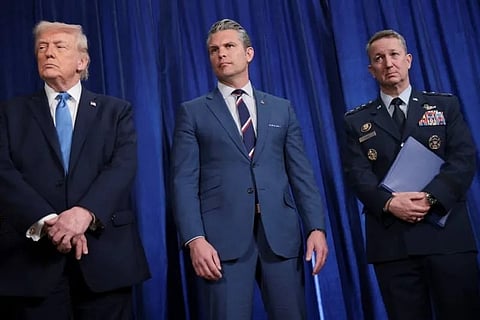
The meeting included top defence and intelligence officials, among them CIA Director John Ratcliffe, Defence Secretary Pete Hegseth, and General Dan Caine, as the administration assessed military and diplomatic options tied to Iran’s nuclear activities and regional security threats.
TRUMP ABRUPTLY CANCELS TRIP: President Trump has abruptly cancelled his trip to Trump National in Bedminster, New Jersey, and headed straight back to the White House following a speech in New York. It's unclear why, but in a post about not attending Don Jr.'s wedding, 47 said "I feel it is important for me to remain in Washington, DC, at the White House during this important period of time".
GPS jamming is often a result of a deliberate saturation of an area with radio signals that are stronger than standard satellite transmissions. This "noise" overpowers receivers, making it impossible for civilian devices — from smartphones to aircraft and ships — to accurately determine location or time.
Behind the scenes
According to sources cited by Axios, Trump’s advisers remain "divided" over how aggressively the US should respond.
Some officials have reportedly pushed for stronger military deterrence to prevent Iran from advancing its nuclear capabilities, while others caution that direct strikes could trigger a broader regional conflict involving Israel, Gulf states, and US forces stationed across the Middle East.
The Pentagon has already increased military readiness in the region in recent months, including deployments aimed at protecting maritime trade routes and deterring attacks by Iran-aligned groups.
The Institute for the Study of War-CTP cited leaked US intelligence assessments suggesting that Iran has regained access to 90% of its underground missile storage and launch facilities, "many of which remain at least partially operational, that were buried due to US-Israeli airstrikes".
Why it matters
The high-level meeting signals growing concern inside the White House over Iran’s expanding nuclear program and Tehran’s role in regional instability, including support for armed proxy groups across the Middle East.
Officials familiar with the matter said Trump is seriously considering authorising additional strikes against Iranian targets unless last-minute diplomatic efforts produce a breakthrough.
The discussions come as US intelligence and military officials monitor heightened risks to American forces and allies in the region.
Recent US intelligence assessments estimate that Iran still has about 70% of its mobile launchers and 70% of its prewar missile stockpile, including both ballistic and cruise missiles, as per the Institute for the Study of War (ISW) and the Critical Threats Project (CTP).
Tensions
Tensions between Washington and Tehran have remained volatile following years of disputes over sanctions, nuclear enrichment, and regional influence.
Trump previously withdrew the US from the 2015 Iran nuclear agreement during his first term.
Since then, Iran has steadily expanded uranium enrichment activities beyond limits set under the accord, while clashes involving Iranian-backed groups have intensified across Iraq, Syria, Lebanon, and the Red Sea.
Regional flashpoints have also sharpened since the Israel-Hamas war began, as Iran-backed militias launched attacks on US positions and commercial shipping routes, including the recent drone attacks on the UAE's Barakah nuclear power plant launched by Iran-based militias in Iraq.
What’s next
Diplomatic channels between Washington and Tehran remain active through intermediaries, though prospects for a comprehensive agreement remain uncertain.
Analysts say the coming hours or days could prove critical in determining whether tensions move toward renewed negotiations or military escalation.
Any decision to launch new strikes would mark one of the most consequential foreign policy moves of Trump’s presidency and could have far-reaching implications for global oil markets, regional stability, and US alliances in the Middle East.
The Institute for the Study of War (ISW) and the Critical Threats Project (CTP) assessed that Iran continues to exploit the ceasefire period to reorganise and regenerate its military capabilities at the tactical and operational levels, where it can recover relatively quickly.
Iranian forces have likely also reestablished communications between units and commanders — disrupted during the war due to US-Israeli airstrikes and had significantly degraded Iran’s ability to conduct operations to achieve its objectives.
US forces buried some of these assets during combat operations, which rendered the buried assets combat ineffective.
The restoration of underground missile storage and launch facilities means that Iran was degraded operationally and then prepared itself for a new round of fighting.
US forces have also prepared for a new round of fighting.
Russia has reportedly supported Iranian reconstitution efforts by sending drone components to Iran.
Iran’s efforts to reconstitute its military capabilities during the ceasefire period.
The ISW-CTP stated that Iran’s military strategy revolves around utilising its “Axis of Resistance” and regional proxy networks as its primary offensive and deterrent forces, while maintaining conventional capabilities aimed at regime survival, internal control, and disruption of global trade.


